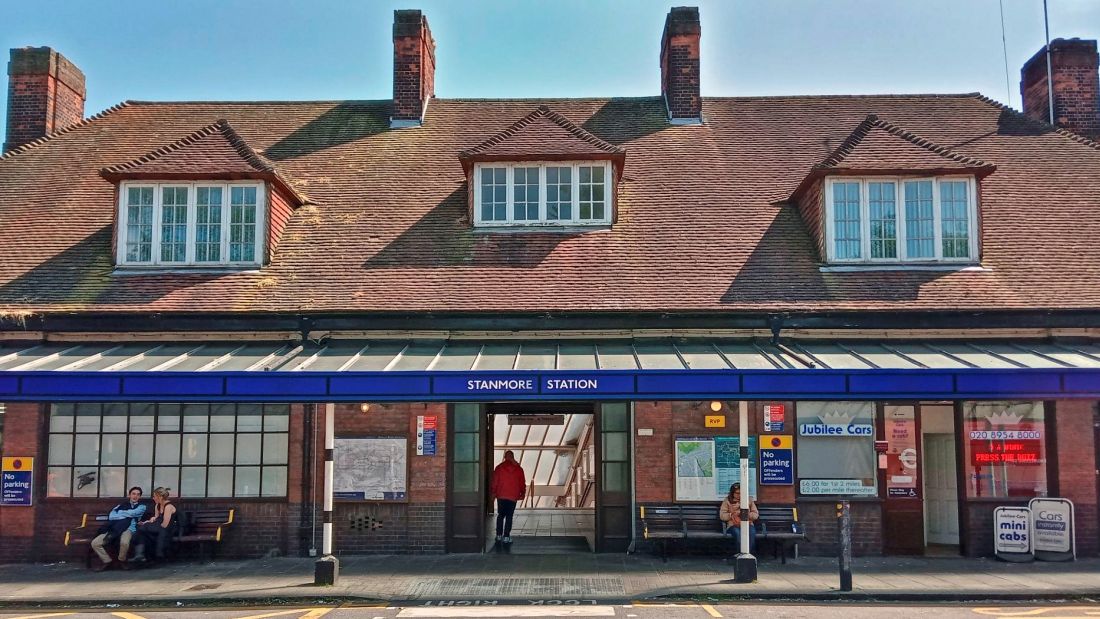
The tube was the first in the UK or Europe to adopt automated train control or Centralised Train Control (CTC) on a passenger line. This was used on the Metropolitan Railway’s new Stanmore branch which opened in 1932. The CTC was fully completed in 1933 when the branch became part of LPTB. In 1939 the Bakerloo took over with classic signalling. Forty years later the new Jubilee line took over.
It was far from a true automated railway operation however. Despite the Metropolitan’s innovation, it was another that set the standard. 1927’s Post Office Railway was the first fully automated line – and it would take until 1968 before any passenger Metro system was able to take on this challenge. That was London’s Victoria line.
The Metropolitan Railway’s new extension was of considerable note, despite it not being strictly full automation, the Stanmore line was described grandiosely in terms of the automated mode it offered. It was indeed described as a ‘Robot Railway.’ (Felixstowe Times 10th December 1932). As the paper pointed out, ‘robot’ wasn’t accurate, however it was eye opening how ‘all trains, even those used in shunting operations at the Stanmore yard, will be controlled from Wembley, four miles away. Another paper, The Advertiser and Gazette (16th December 1932) described the new railway as a ‘Robot Line’ and said ‘The most important feature, however… was the highly intelligent robot, for there are no signal boxes! It is protected throughout by the most modern conception of centralised train control, a system never used in this country before.’
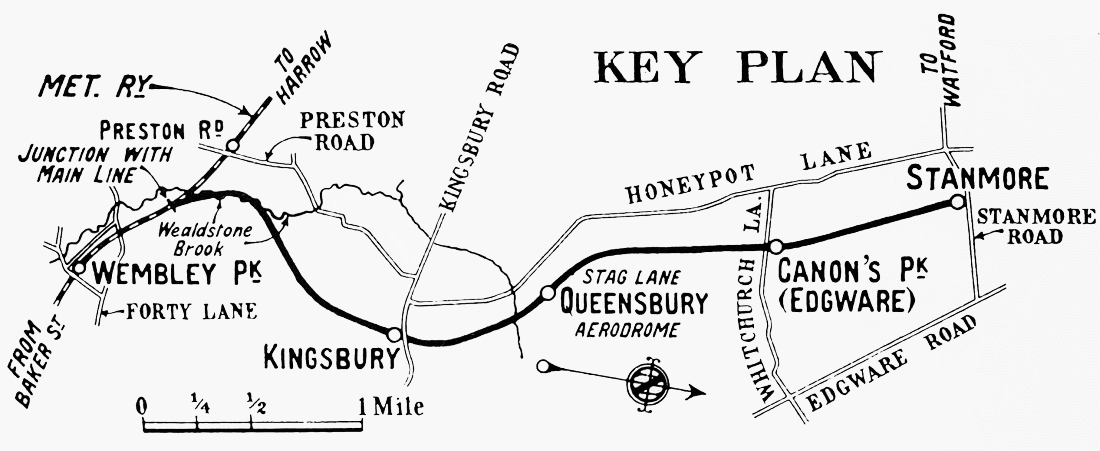
The Metropolitan Railway’s Stanmore branch from O.S. Nock’s Underground Railways of the World. Map cleaned up by the author. Note that Canon’s Park was to be supplanted with the subtext ‘Edgware’ as indicated on the above map. Originally it was to be Edgware (Whitchurch Lane), however the local council decreed it should be called Whitchurch Lane (Edgware). The station indeed opened as Canon’s Park (Edgware) however the suffix was dropped during 1933.
Automation was indeed novel and such intricacies were described as robotic. This extended to the new intelligent road control systems being introduced in London at the time. In the same year as the Stanmore line had opened there had been a short experiment to evaluate intelligent automatic lights in London’s Trafalgar Square. This was followed by the £40,000 ‘traffic-actuated signal’ scheme built along the Marylebone Road in 1935, this being the first automated traffic light system in the world using a‘mechanical mind’ or a ‘robot brain’
Whilst London’s roads were bravely embracing automation, the Stanmore branch’s unique CTC lasted barely five years before it was replaced by a more conventional means of controlling trains.
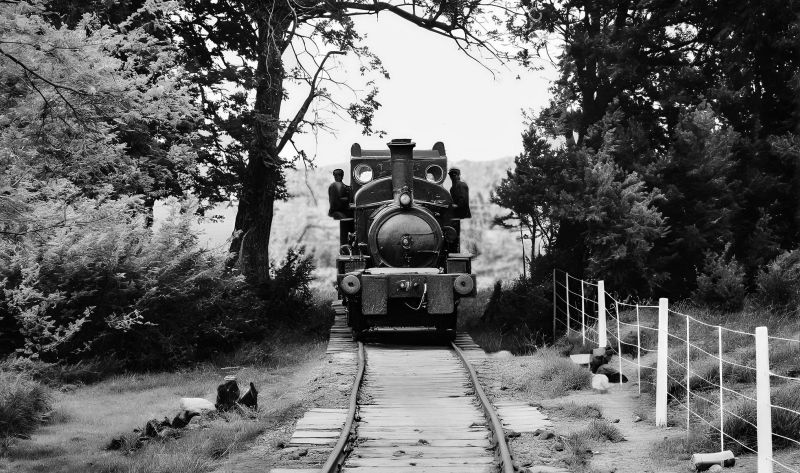
Its off to Stanmore we go! Re-graded, upscaled, image by the author of one of the contractors’ locomotives heading through the woods at Canons Park 19th May 1931. The original image of very poor quality was from the Railway Magazine.
It’s incredible the Metropolitan Railway ever thought about opening a new branch when it knew it would soon be replaced by the LPTB. R. H. Selbie, the company’s general manager, previously rejected suggestions for extensions. However, when an express line from Willesden Green to Edgware Road were mooted, Selbie also entertained the idea of a new branch. In addition to providing a more direct route towards Paddington and West London than by transferring at Baker Street, this express line would have relieved the routes south of Wembley to Baker Street.
New legislation made it nearly impossible to run even full-sized trains in tube-style tunnels. Concerns re using slam-door stock instead of sliding-door stock in narrow tunnels is why the Willesden Green to Edgware Road express tube line was abandoned. The Metropolitan Railway focused on obtaining legislation for its line from Wembley Park to Stanmore. This was approved on 4th June 1930.
The Stanmore route was the first ‘tube’ with level crossings within the London metropolis! These were located at Princes Avenue, Whitchurch Lane, and Kingsbury Road, but were actually traditional crossings used by the extensive contractors’ railway rather than the actual branch itself. This contractors railway was connected to the Metropolitan railway at Wembley Park and marked as a siding.
At Kingsbury, a depot with locomotive sheds and sidings was built. The line featured many wagons and seven Manning Wardle locomotives. In order to accommodate the new Metropolitan railway route, bridges were constructed as embankments and road crossings were managed by flag men. Once the job of building the branch was finished, all evidence of the contractors’ railway vanished.
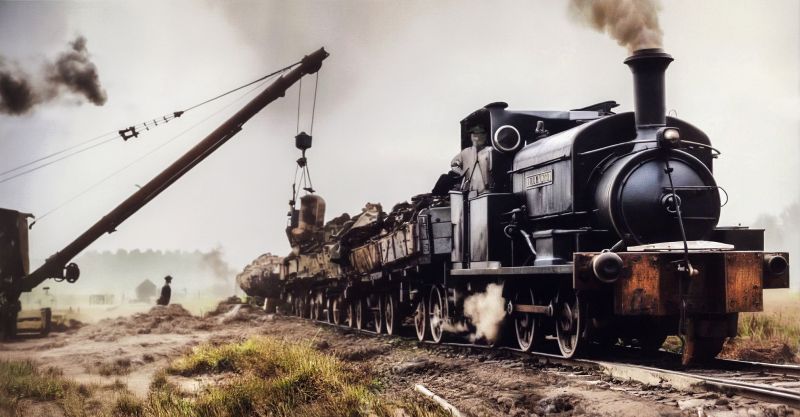
The contractors’ locomotive at work early 1931 just south of Kingsbury near where the present Fryent Way is. Re-graded, upscaled and colourised image by the author from a low quality one shown in Meccano May 1934. The same photograph was used for a full page feature on the new Stanmore branch in The Bucks Examiner, 16th December 1932.
Construction work suffered a number of setbacks. On 22nd June 1932 about 100 tons of the new embankment at Canon’s Park suddenly collapsed and the reminder continued to slip late into the evening. During the night of 24th October 1932 most of the CTC equipment manufactured by Westinghouse Brake Company and stored at Canon’s Park was destroyed in a fire. This included the entire stock of insulated cable ready for laying alongside the new tracks. The fire brigade were unable to fight this huge conflagration and it was left to burn out.
A building boom was highly anticiapted as soon as the new line opened. Even the Metropolitan Railway quickly submitted plans for new housing. Four to be built by the Metropolitan at Stanmore were approved although some other applications were turned down.
Considerable areas of land along the route of the new line have already been acquired by builders to be ready when the opening takes place. There seems little doubt that in the near future the existing quiet, pleasant meadows and sports grounds will be converted into attractive townships and busy centres. (The Times and Guardian 27th May 1932).
In reality the new branch struggled for patronage. By late 1933 passenger numbers numbered just a handful in the rush hour. The fact barely anyone used the new services meant proposed train frequencies consisting of 134 trains a day to Baker Street were drastically reduced and relegated to a mere shuttle between Stanmore and Wembley Park. Apparently the shuttle services were so bad it was better to take a bus! The line’s future patronage no doubt was dependent on the rate of new housing. Those at Kingsbury would not be ready until 1937 – thus in many respects the Stanmore line was not a success until the Bakerloo took over in 1939.
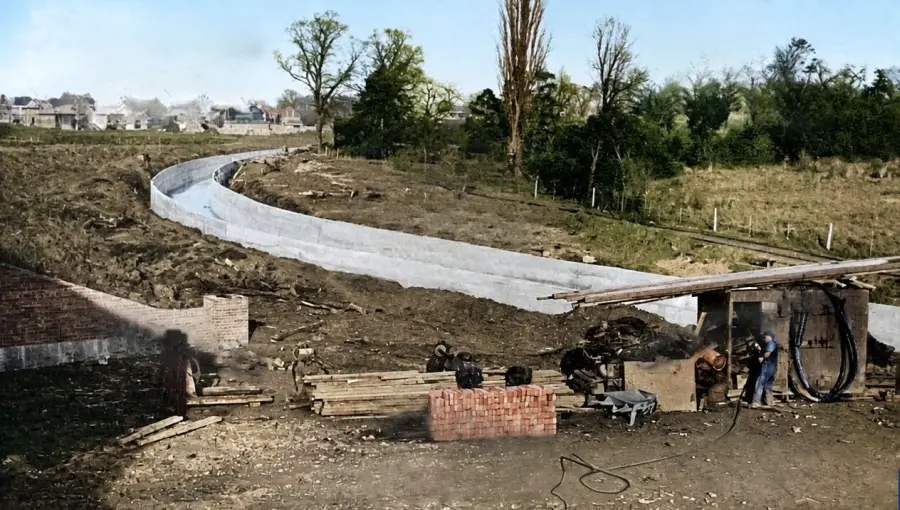
To allow the line, the Wealdstone Brook had to be diverted. Pic from The Sphere 26 Dec 1931. Colourised by author. Similar view today.
The introduction of the Bakerloo Line also saw conventional signalling provided. Remote operation of the branch’s trains did not return until the Jubilee line conversion to ATO in the early 21st century. What the Metropolitan railway had done in the 1930s was unheard of. It showed the technology at the time was quite capable of doing a job without human intervention and it was done in a way the branch’s trains operated fully independent of Wembley Park box.
In terms of remote (or unassisted train control) it wasn’t just the Metropolitan Railway who were at it. The LPTB too had tried a rudimentary form of automated train control on its new extension to Cockfosters. This came in the form of basic automated routing for trains using Wood Green siding. This meant trains could terminate at Wood Green when no signallers were present. The system was based on the train describers at the station so if a train was either to terminate there or start from there, the system would select the points and signals for the train to make those moves. However it was problematic because the train describers were quite occasionally wrong. Thus the points and signals were set for the incorrect route meaning trains for Arnos Grove, Enfield West or Cockfosters were directed to the station’s siding. Staff had to be called in regularly to reset the system and this led to the LPTB employing a signaller at Wood Green permanently.
The Stanmore CTC turned out to be a headache too. Not because it was a failure but it was an accusation that the design had been lifted from patents taken out in the US a decade or more earlier. More on that in another post perhaps.
One of the first questions to ask is why did the Metropolitan Railway decide on such a drastic and largely untested means of automated control for its trains? When its said ‘automated’ its not exactly that per se, but there was an element of automation about it however and its why several newspapers described it as a robot railway. Its likely that in view of the length of the branch and that practically all the trains would be simple out and back services, there wasn’t really any need for signallers along the line. In fact Stanmore station in those early days consisted of just two platforms and a single siding plus headshut – thus things could be kept very simple. The siding required control from Wembley Park of course (and once trains had passed onto that track they were able to attain the station’s other sidings without any recourse from Wembley Park. The signallers at Wembley Park could see what was happening by way of their track diagram and they could intervene if it was necessary.
With all the other existing tube termini all a signal box did was to receive and dispatch trains. A simple cross over in to an adjacent platform or a simple run straight in or out. No complexities of any sort. Thus the railway’s directors must have decided, on the advice most likely of its Superintendent of Signals and Telegraphs engineer, R Falshaw-Morkill, that this work could be done automatically. Of course the savings in construction of a number of signal boxes and extra staff would too be a advantage.

Wembley Park signal cabin with the single track junction for the temporary contractor’s railway to Stanmore clearly visible at the bottom right hand corner of the signalling map. Westinghouse Brake & Saxby Miniature Power Lever Frames.
The Stanmore line was the first of its example in Europe but not the world however. Automated signals are nothing new on the tube these have been in use since the very early days though largely in a capacity of automatic train protection (eg setting a route to red once a train had passed.) The more complex routes, junctions, stations, continued to remain under the control of station staff or signalmen.
Stanmore however entailed a basic element of automated points setting, which is why it was so radical at the time, and this more than 35 years before the Victoria line! The system set the route the trains would take into Stanmore station – even though it was a very simple operation involving the movement of an incoming train into either platform that was available, and the same again for the reverse operation onto the up line towards London. What this meant is Wembley Park did all the work – meaning the physical route for a train in or out of Stanmore station was operated remotely. It worked similarly in the reverse direction where trains from either platform were directed to the up line towards Wembley Park. These moves were also supplemented by route indicator lights – and the branch was the first instance of these being used on the Underground system.
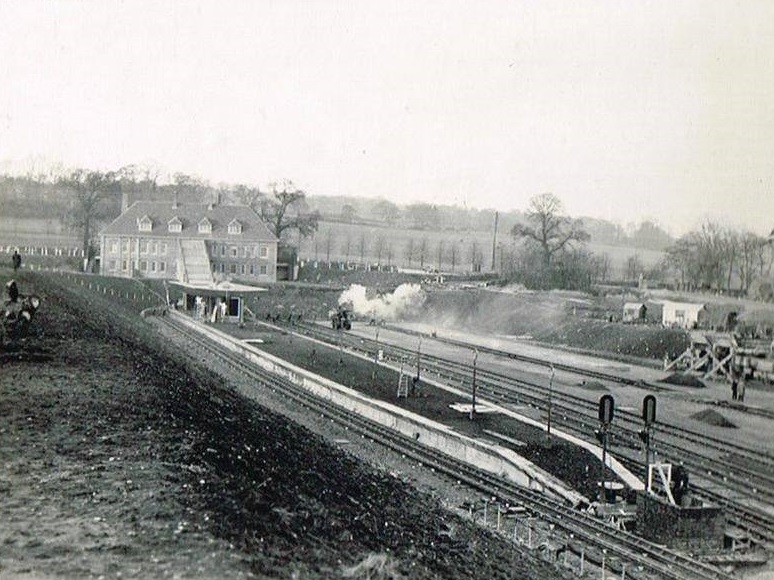
Stanmore station under construction. c1932. Stanmore Tourist Board.
The procedure involved was for the signaller at Wembley Park to select the route (but not actually actuate it) and then having done that, a button would then be pressed. This sent a code to Stanmore and that actuated a number of relays which unlocked the relevant points, and then switched these where necessary, and then locked them again. There were just ten push buttons in order to control the system and from those basically four options for route selection in and out of Stanmore station so it wasn’t really a complex set of choices even.
The means by which the new line operated was by means of a simple code developed for the purpose. It was a codeword in fact as one paper put it. The Citizen and the Daily News Chronicle (both March 19th 1932) say:
Thirty-five signals and points can be controlled with a single pair of wires. Eighty-one can be looked after by three wires. Everything depends on the “code”. A set of letters – perhaps X Y Z – acts on the circuit of each signal or group of points. The “code” works like that in automatic telephony – for instance MAY for Mayfair. Selective switches will ensure that only the right circuit will heed the code letters.
One must consider the rather simplistic ‘complexity’ of the Stanmore branch with the the early automated traffic lights systems – mentioned earlier – that were beginning to be seen on the streets of London at the time. The very first was perhaps the ATM (or Automated Traffic Management) system at the junction of Cornhill land Gracechurch Street which was inaugurated on 14th March 1932. Soon after an even more advanced form of ATM came to be outside Baker Street station itself. This must have been in the works for some time because it linked a number of road junctions in the Borough of Marylebone to a centralised control system – far more complex because the ATM had to analyse a large number of data from the various road junctions – hence the traffic lights could be managed and ensure traffic was not subject to jams.
In terms of the computer controlled traffic lights in Baker Street, one wonders if the Borough of Marylebone’s scheme had anything to do with the Metropolitan Railway’s decision to employ CTC? Had Morkill been advisory in that other project too? Doubtless if the roads could do it why not the railways too?
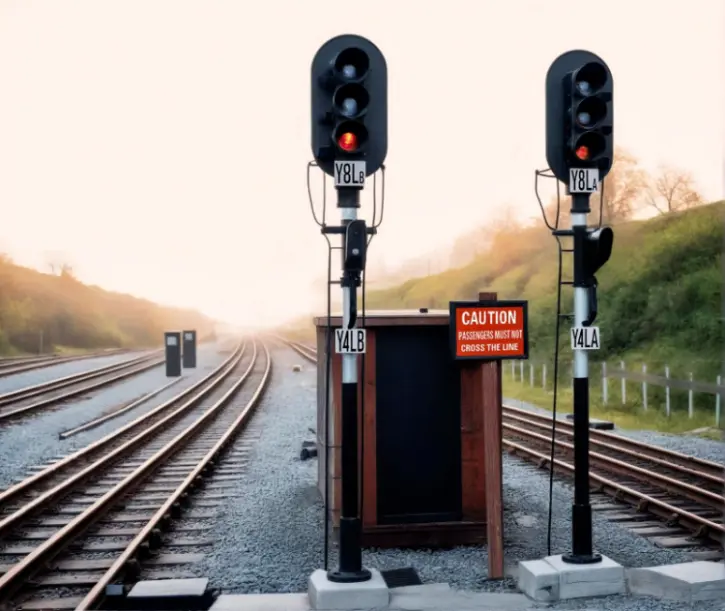
The CTC at Stanmore. The small signals are route indicators. Colour image by the author based on one in 1935’s Railway Wonders of the World.
One important thing is various American railroads had long employed advanced types of automated control. Ironically the American aspect is important in terms of Stanmore. A lawsuit was issued against the Metropolitan Railway’s contractors by an American company who claimed the Stanmore CTC system had been stolen from their US patents. Again its a subject perhaps for another article.
Morkill was no doubt expert in the use of CTC because he went to the States where he, as General Manager of Tyer & Co, were involved in establishing a number of installations there. But that’s where it ends because the company responsible for the Stanmore system were the Westinghouse Brake & Signal Company and the development had been entirely British with Morkill in an advisory position.
O.S. Nock and others believe the CTC was down to Morkill’s experience. It was no doubt his (Morkill’s) broad outlook – far beyond that of London commuter problems – that influenced his decision to try the American form of C.T.C, on the Stanmore branch…’ (Nock). Morkill viewed electric systems as the future – but these were still unreliable especially where wet weather was concerned. The L.P.T.B saw the C.T.C. as unsuited to their needs – they preferred the electro-pneumatic control systems developed by the LPTB’s signal engineer, Robert Dell.
Opening of the new branch
According to some the branch opened on December 10. Others say it was the 9th. Which is correct? Its the 9th for a report in The Times on 10th December cites the line had ‘been formally opened yesterday.’ Public services began the next day. Many details of the official opening were found, including sppeches and the visits to Canons Park substation and Wembley Park box. At the behest of all that, the collection of pictures which follows gives a pretty good idea of how the day had ensued.

The inaugural train at Stanmore. Source: London Reconnections

The official opening train on the Stanmore Branch 9th December 1932. The train conveyed at least one Metropolitan pullman coach for its directors. Source: Twitter/X.

Minister of Transport Mr P J Pybus CBE, MP is seen leaving the Wembley Park signal cabin with the Metropolitan Railway’s Chairman the Rt Hon Lord Aberconway (in top hat) and its Deputy Chairman Sir Clarendon G Hyde (with bowler hat). London Transport Museum.
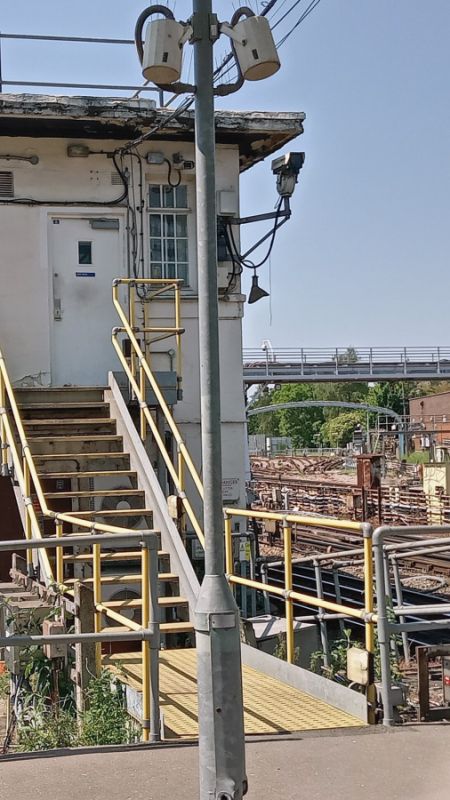
The same view today! The windows, handrails and stairs have changed however.
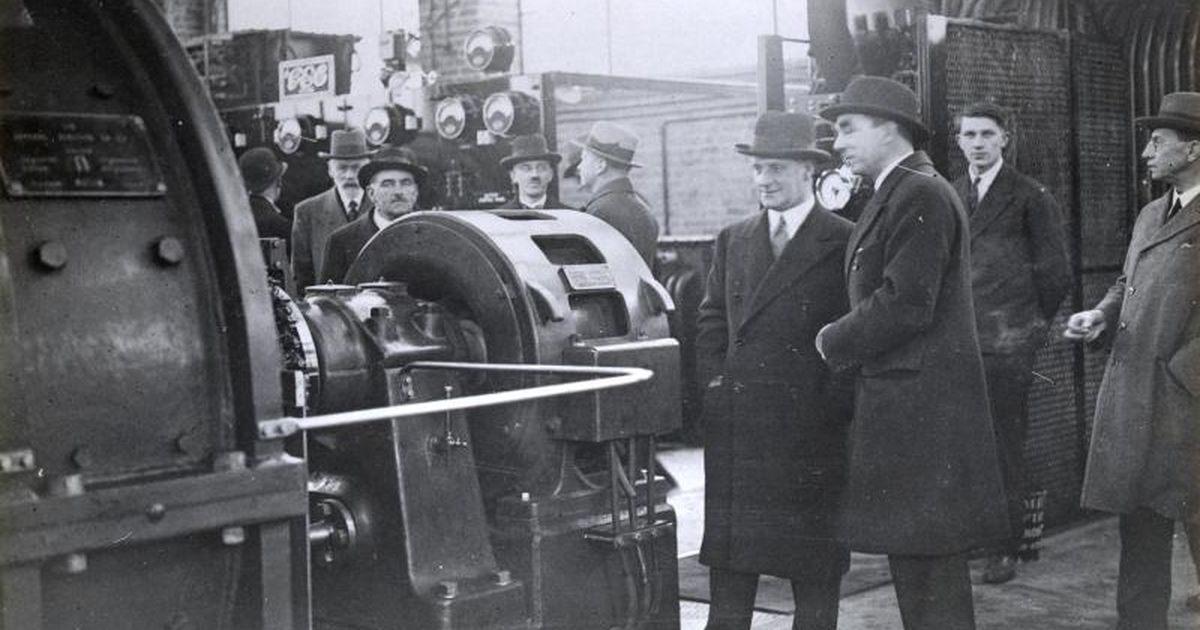
The Stanmore branch was opened by the Metropolitan Railway on 9 December 1933. The dignitaries are seen here examining the inspecting the Canons Park sub-station. London Transport Museum.

Poster advertising the new services. Source: Reddit.
Post originally written 2019 for both 80th anniversary of the Bakerloo extension to Stanmore and the Jubilee line’s 40th Anniversary. Expanded and updated for 2026.