The Llang0.0llen Canal hasn’t been forgotten! There has been minimal progress. Many had thought the boat winching that had been discussed would occur last week but one issue then was Storm Goretti which no doubt deferred things. As several videos reported last week workers were on site to inspect both Sefton and Ganymede in order to work out the best way of retrieving these stricken boats. In the meantime the Bakerl0.0 advertising came about thus it was an opportune moment to focus on some London based transport news! But there will always be a Llangollen or a Bridgewater report when the need arises.
No doubt the Llangollen news will continue for perhaps a few more days until such a time when Crouch has winched out the boats in question. It seems it’ll be this week. After that there will undoubtedly be a lull of sorts whilst the powers that be get their heads together in terms of demolition of the destroyed embankment and the planning that will be needed to detail and finalise the new New Mills embankment.
In terms of history, this part of the Llangollen canal was one of the last to be opened which is a surprise. It was this and then the Whitchurch Arm which were among the final bits of the Ellesmere canal to be opened. Yet information on that is scarce.
The issue here was the section of canal being built at Chirk and Pontcysyllte. Pages of news written during 1804 and 1805 was dedicated to the stupendous works along this part of the canal including its two substantial aqueducts. The rest of the canal received little mention, thus any detail of construction as well as a date for the opening of the canal from Grindley Brook past Whitchurch to Tilstock Park seems to have been left largely unrecorded although according to one report the designs for the new cut were undertaken by Thomas Telford.
One of the surprises of the New Mills embankment (which possibly began construction in late 1804 or early 1805) is the sand for this appears to possibly have come from the nearby Ravensmoor Common, extolled as a good source of sand and gravel. (Chester Courant, 28th August 1804). Ravensmoor Common was near the canal at Baddiley thus its possible some of the aggregate for the New Mills embankment may have been transported via an earlier completed section of canal.
it seems the New Mills embankment wasn’t perhaps finished until late 1805 or later when heads turned towards the provision of a branch from there into Whitchurch. The advertising for those contracts in August 1805 clearly denote the New Mills embankment so that’s its official name (or was its original name rather). Its said the awarded contracts for this work would be announced at the White Lion Inn, Whitchurch, on 30th September 1805 (Shrewsbury Chronicle 13th September 1805) hence its quite clear the state of work on the canal in this part of the world was much later than is generally thought. Thus it seems the section from Tilstock Park to Grindley Brook may have been completed in stages during 1807 and 1808.
Works either side of the Tilstock Park to Grindley Brook section were advertised for tender in 1803. The Shroppie society doesn’t give a date for the main line past Whitchurch – however it cites that the Whitchurch arm was opened on 6th July 1808. (Shropshire Union Canal Society).
It must be remembered the main line of the Ellesmere Canal was originally intended to be from Shrewsbury to Frankton and from there to Chirk, Poncysyllte and Chester, so that part was worked on first and completely finished by November 1805 with the grand opening of the Poncysyllte aqueduct. By then it was well realised the full scheme of things (the canal north to Chester and the section south to Shrewsbury ) were not to be realised hence (in part because of considerable engineering work that was necessary) thus a more basic waterway from Hurleston to Frankton was envisaged.
Current work to retrieve the stricken boats
In terms of the work to winch the stricken boats out it seems the plan possibly, is to use a field to the north. That is shown below:
This is from Google Streets! The field looks overgrown but its pretty clear at this time of year.
RileyRobey has this video which shows what appears to be the beginnings of work and includes a digger readily placed in the above field. In a later shot one of the boat owners (that of Ganymede) is seen being lead to view his boat. One of the things they might have been doing is ensuring that the weight of the boat was reduced – eg coal, other heavy stuff, be discarded. Narrowboats after all (especially those with liveaboards – as I know only too well having been one myself) have everything including lots of bags of coal, lots of cans of paints, tools, generators, even brick or concrete weights in side the boat (if these can be reached) no doubt the really heavy stuff. Maybe both the diesel tank and water tank will need to be emptied too because those will no doubt constitute a huge weight. And all that likely because if the plan is thought to be as it is, there’s no doubt a fair amount of driving trailers with substantially sized narrowboats on then through the adjacent fields.
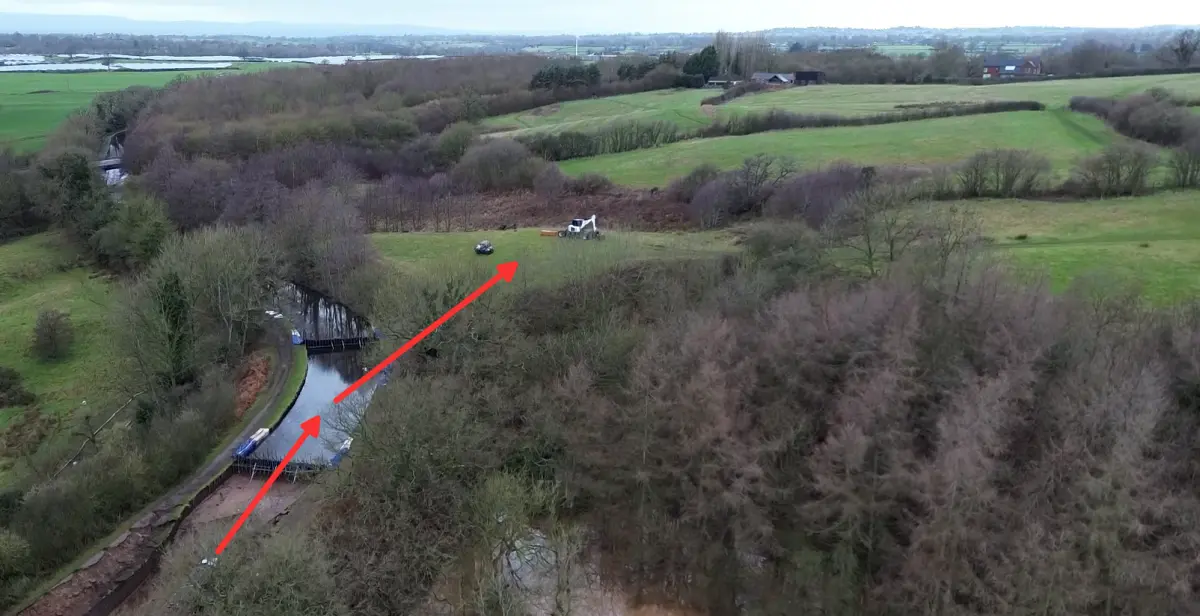
The likely route the two stricken canal boats could be retrieved by. The field at the top of the canal is no doubt being prepared. The question is getting the boats through the adjacent fields beyond to the nearest main road. Screencap from Kieran & Lottie Photography’s video.
So that it sees is at the moment the plan might be to drain the short pound between the two coffer dams, remove the one nearest to the ‘sinkhole’ then dig a ramp down to the boats (and also use wood as the base of the ramp – eg a temporary wooden roadway) and with that winch the boats out of the ‘sinkhole’ (the breach site in fact).
Once that has been done things will be left for a while. The cofferdam that has been removed will likely be placed further along the canal towards Grindley Brook (possibly by the Whitchurch By-Pass bridge) and that is because, as I have said before, its likely this entire section will need rebuilding in order to provide a uniform channel throughout.
This video from Court on the Cut and Riley Robey a couple of hours ago shows workmen at the site of the breach. One guy is welding something on the bows of the boat (evidently its something being welded around the bow rubbing strake – extra steel plates, strengthening, to form an anchor point). The bows are extremely strong however the steel hull might get damaged thus strengthening would be necessary around it as the rubbing strake – even though it can withstand impact – does not have a large enough area for strength and integrity as the task ahead appears to be requiring.
They were wondering what it was for. In my opinion it could be to facilitate a pulley or pulleys. I don’t think a mere winch operation will recover the boats – because the ramp will be steep and the remainder of the potential route into the adjacent field is also steep.
Thus possibly its a series of pulleys that will be used to winch the boats rather than a single steel rope. A single rope is too risky. It worked for Pacemaker but that was merely to move the boat a few metres along a level route. This operation is about winching narrowboats in the region of 15 to 20 tons up a slope and also overcome a height differential of perhaps thirty feet or so. Luckily these narrowboats are around fifty to fifty-five feet long which does make the job slightly easier – as a full length narrow boat (a seventy footer) could easily weigh around 25 tons. (See below re Sefton).
On another level, the operators wont have to worry about the boats being made lighter. Removing coal bags and stuff probably wouldn’t achieve much when one considers the total weight of the boat including its engine (and bow thrusters etc if either has those). It would help but given the severity of the site and the possibility a pulley system will be used, its not so vital given it’ll likely be a pulley system as opposed to single steel ropes.
A series of pulleys would also make it somewhat easier to pull Sefton away from the mud. No doubt Crouch, the winding and retrieval contractors, are fully aware of the tasks involved.
From the Narrow Boat Listings:
Sefton Built by M.Heywood Boatbuilders – Length : 17.06 metres (56 feet) – Beam : 2.07 metres (6 feet 9 inches) – Draft : 0.76 metres (2 feet 6 inches). Metal hull N/A power of 22 HP. Registered with Canal & River Trust number 46859 as a Powered Motor Boat. (Last updated on Wednesday 22nd May 2013).
Don’t have the details for Ganymede – there are quite a few with that name and the number of the one in the canal breach isn’t visible.
Update: 22.15pm on 12th January 2026.
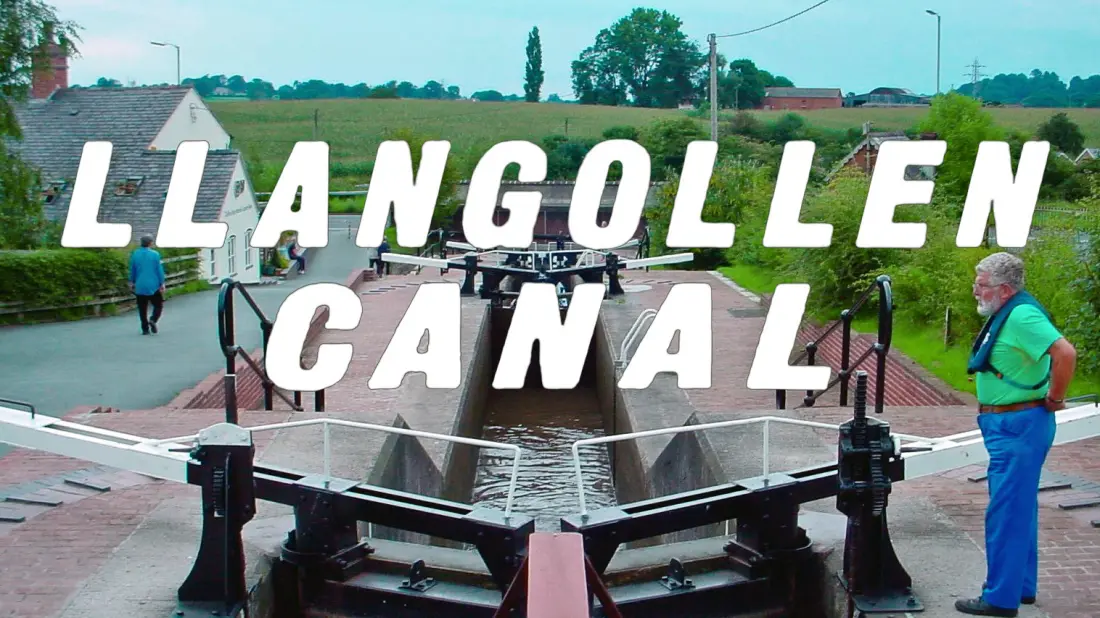
The feature image is taken from a trip heading down through Grindley Brook locks more than twenty years ago. The flight’s resident lock-keeper is seen at right. Naturally his employers of the time were British Waterways. Canal & River Trust did not take over until 2012. The green/blue staff attire was a fad at the time but it wasn’t well received and BW soon returned to the use of full blue attire.
Leave a Reply