Which of the two major canal breach sites of 2025 will it be that gets to see its repairs finished first. The answer is doubtless Whitchurch. That on the Bridgewater, well in my view its going to be finished sometime in 2027. For most of 2026 however, the two will be running concurrently thus it was deemed a combined update of both waterways would be better than creating numerous individualised reports.
The latest on the Bridgewater is they have recommenced the work to build a substantial bund across the canal. New Youtube channel Gingermanc whose video contains a fly through of the breach site and showed two relatively important aspects of the Bridgewater breach.
One of those happens to be what has ensued so far with the work that’s currently underway. Originally this work was to be finished before Xmas 2025, and here we are almost in February 2026 with no sign of the works being finished!
The other is about the design of embankment. Although it can be seen in many other videos Gingermanc’s video prompted the notion that what has been asserted in terms of canal embankment construction isn’t exactly as it has been set out. More on that later.
There has been various discussions as to what the current work on the Bridgewater was about. Originally it was known to be intended to form a new solid earth dam across the canal thus enabling the cofferdams and pumps to be removed.
However the way they went about it before Xmas (and indeed when they recommenced work in the third week of January 2026) was this weird three piece configuration, this being two layers of stone with clay in the middle and none of it high enough in any way or form to constitute an effective barrier for the watered canal section westward.
And they they left before Xmas with the work most clearly unfinished. Recommencement began 23rd January 2026 – which was more than a month.
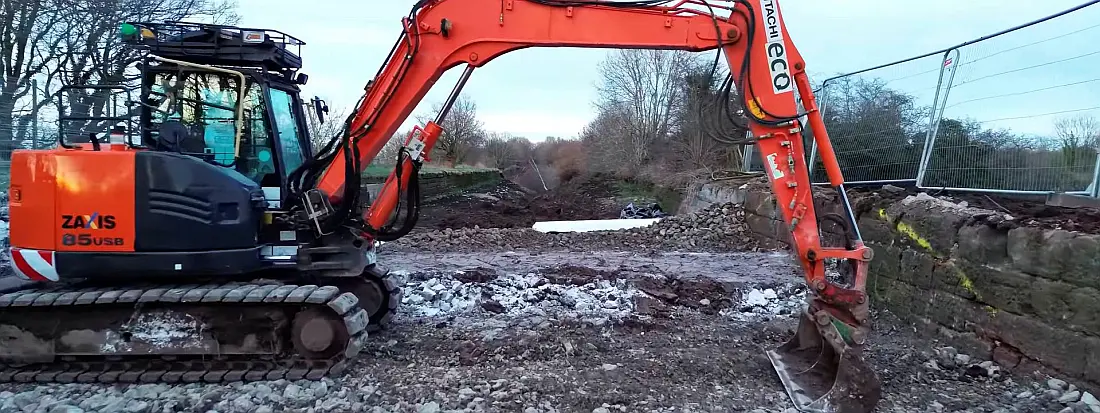
Gingermanc’s video shows the yellow markings on the stone walling which denotes a curved bund structure is planned for the site. Screencap from Youtube.
On Gingermanc’s video however it can clearly be seen its intended as a large bund. It seems the clay will be piled on top of the stones as well and this will form a substantial curved structure which will be absolutely solid.
As evidenced on Explore with Ant’s video published this afternoon, they’re finally getting to build that substantial clay bund.
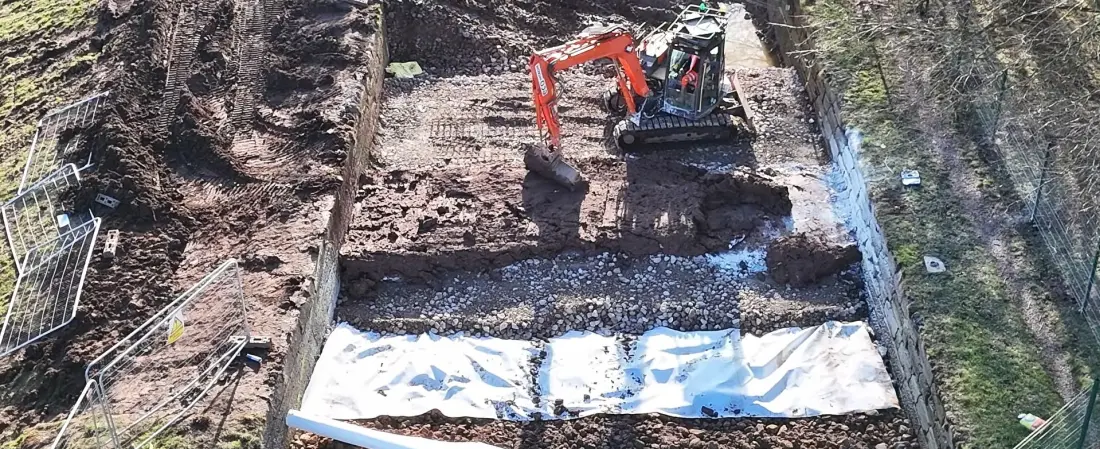
Screencap from Explore with Ant’s latest video showing how the eventual clay bunding is now rising above the stone aggregate.
In effect its merely a massive dam and nothing to do with the actual work of rebuilding the embankment itself. How that will progress is another mystery!
Does anyone have the feeling that work leading to full navigation of the Bridgewater canal once again will not be completed until the first quarter of 2027! As I have said several times the Llangollen breach will shoot ahead and be completed long before the Bolin embankment ever gets done!
One important aspect is CRT’s current view the repairs to the Whitchurch site will be completed in nine months. This was cited in a recent interview with CRT’s Julie Sharman.
Canal embankments – 2:1 or 3:1 construction?
As mentioned earlier this section came about because of Gingermanc’s video. In retrospect, the earlier London Rail post Whitchurch boat rescue #1 had also carried a substantial discussion about canal embankments and in that Court Above the Cut was cited as saying:
And before the 1800s, they didn’t really know what they were doing. It was all quite experimental. So, they were building these embankments and they were putting them onto anything. The Bridgewater is known where the bridge was before is known to have quicksand underneath. This could have anything under. So they need to know what they’re dealing with when they come back to repair it. The other thing that they used to do was they used to build them at a 2 to1 ratio. So they were very steep sided.
After 1800 and in the railway era, they built them at 3:1. So a much bigger, larger base to take that weight. So there’s a lot of work that’s going to have to be done here just to figure out what they’re dealing with so they know how much engineering needs to go into it to rebuild. You can’t just plunk a load of earth there and put some water in it cuz it’ll leak and it’ll breach again.
Quoted from Court Above the Cut.
It is quite evident it was the other way round. Brindley began his early embankments with a 3:1 ratio or thereabouts. Some of his later canals saw that reduced to 2:1. Thus at the Bolin embankment as the above picture shows, we can see what appears to be a 3:1 construction, whereas Whitchurch’s was more like 2:1. As the canal age progressed no doubt it was realised the latter was somewhat more risky thus it was reverted to 3:1.
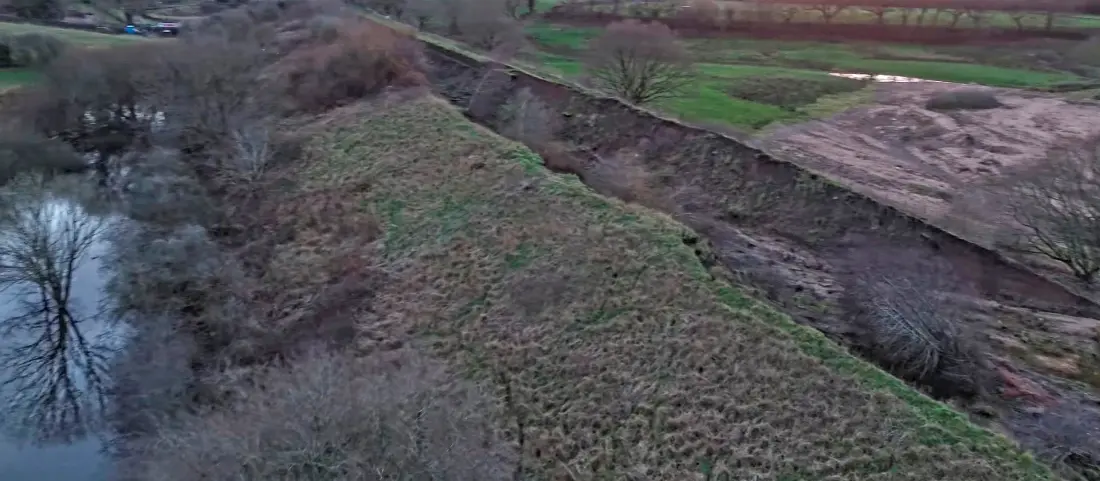
The much shallower slope of the Bolin embankment. This was built in the 1760s. Screencap from Gingermanc’s video.
It may have been the special technique (unauthorised undoubtedly) which was used to pack sand (something I discussed a year or so ago when first discussing the Bridgewater canal breach), that sort of gave a leeward effort towards building tighter canal embankments because that particular construction was deemed more superior.
As it stands these days, its quite different. A sandy embankment is seen as good in terms of a railway because it allows water to drain away effectively without compromising the structure. In terms of a canal its basically a no-no as numerous hydrology studies have shown – because the function of an embankment cannot be both to hold and drain water – unless a special form of structural integrity is designed to separate the two functions. An embankment can only have one or the other – invariably a canal channel consisting of traditional clay puddling soon gets to perform both functions because of leaks – and this potentially leads to failure. Its why a concrete channel or a special plastic lined channel (especially that used on canals that are being restored) are better solutions because this separates the function of water containment from the function of drainage.
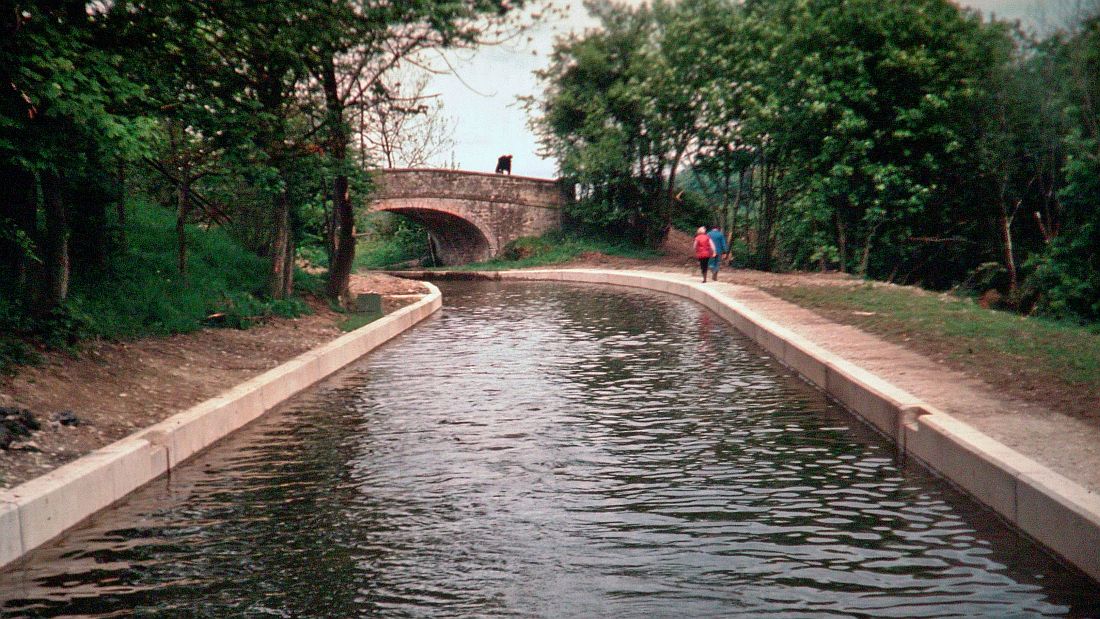
The Llangollen canal on the very day it reopened in 1983. Compare this section’s construction with the later version seen here. Photograph by the author.
The big mistake on the Llangollen in the 1980s was to build a vast new water concrete lined water channel from bridge 31W (Millars bridge) onward towards Sun Trevor but not provide sufficient drainage beneath. The lack of proper drainage beneath the channel was seen as being the cause as to why the expensively 1981-1983 built concrete channel collapsed spectacularly. The second attempt to build a new channel along this notorious section very clearly involved numerous drainage points constructed beneath the channel and its why a repeat of the first channel failure has not been seen.
Its invariably why new waterways are built with concrete channels – because that totally separates the two functions – especially on embankments.
I would think at Whitchurch CRT will be looking at least at a substantial form of rubberised/plastic sheeting of the type that has been used in canal restoration, if not concrete. Court Above the Cut suggested an aqueduct might be an idea. I had also suggested that for the Bridgewater. An aqueduct no doubt helps because one can see what the water is doing and take action.
In terms of that the Spey viaduct (Garmouth viaduct) on the former Great North of Scotland Railway which collapsed did so because the water channels had changed – and that eroded the ground on which one of the supporting pillars had stood. When the railway was in operation some effort was taken by railway maintenance workers to keep the Spey flowing along the designated channels underneath the main span because they obviously knew if they didn’t any alteration in the direction of flow could cause structural issues on the viaduct.
Over the last few decades the river has been left to its own devices and that sadly resulted in a scouring action that led to the partial collapse of the viaduct. Its the same with an embankment if its not prepared properly. Water will erode things totally unseen and then structural failure of the embankment occurs. Its why a bridge or aqueduct are superior and that is because action can be taken before any problems begin to occur. Not only that the water channels can be monitored and repaired where necessary. With a culvert its not possible.
Interestingly at the time of writing this post the very latest on the Spey is surveys that were supposed to have been carried out where never done due to lack of funds. STV News.
If CRT were to rebuild with a traditional embankment I would think larger culverts of a size that can be passed through and inspected/cleared of debris would be a total necessity. Yes they have those little robots that survey small culverts for defects but what use is that if they can’t effectively repair the culverts?
Llangollen/Whitchurch
In terms of the Whitchurch breach on the Llangollen canal, I had said Ganymede and Sefton would have to wait for the locks below to be reopened before they could be moved and craned out of the canal.
What actually happened was the boats were craned out at Grindley Brook – only just! That operation involved craning the boats past the boaters facility building and a large tree that stood on the site. It was very tight. Usually when a boat is craned out the arc of travel is quite wide which is why its often at boatyards where cranes are able to operate over a wide arc.
The site at the top of Grindley Brook locks in June 2025. Google Streets.
At Grindley Brook however the boats had to be craned out and then turned on the spot in order to pass through the narrow air space available. No doubt the operation required additional support and care because it was tight. Both Ganymede and Sefton had to be lifted out and then turned in order to pass underneath the large tree (whilst not hitting the railing belonging to the top lock gate of the Grindley Brook flight)
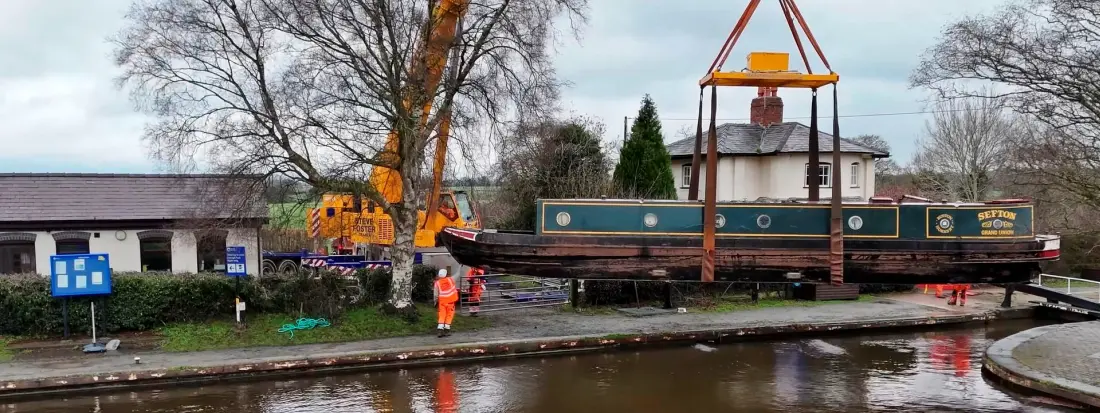
Court above the Cut’s video shows the tight lift up towards the small CRT yard avoiding that large tree and the top gates of the Grindley Brook flight!
RileyRobey today published this interesting video showing the rescue of the boats from the Whitchurch breach. There’s some unseen footage showing how the various steel cables and machinery were used to extract the boats from what were quite awkward locations.
Another video released today by RileyRobey suggests surveyors have been conduiting 3D surveys of the Whitchurch breach site. As one commentator says its simply 2D surveying. However its good to know that the roadmap leading towards site planning and construction has begun.
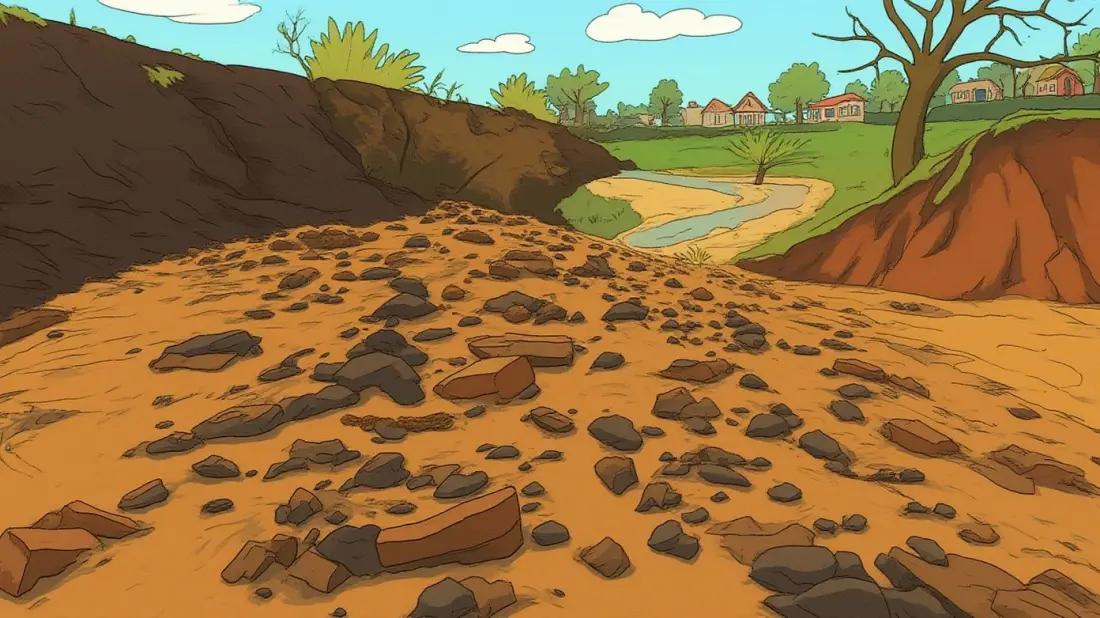
The feature image is a cartoonised view containing elements of both the Llangollen and Bridgewater breaches. The larger part of the image constitutes the Bridgewater breach whilst the smaller part of the image (at right) constitutes the Whitchurch breach – the houses overlooking the Whitchurch canal arm are clearly evident.
Leave a Reply