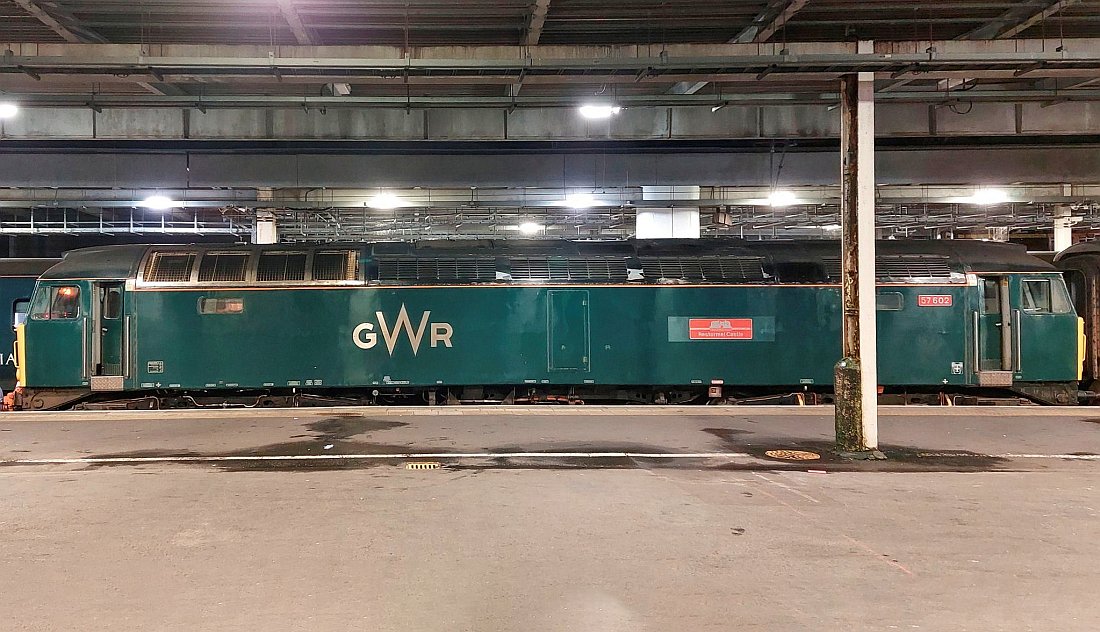
Well after 186 years it finally happened! GWR trains go to Euston! That had been the original intention back in the 1830s when Brunel and the London and Birmingham Railway had agreed to share the new terminus at Euston. What happened next was a series of disagreements which led to Brunel setting his mind upon building a temporary terminus at Paddington – before finally embarking upon construction of the now famous terminus.
Indeed the London and Birmingham Railway had bought extra land in order to accommodate the GWR’s terminus – and that before the plans fell through. The great irony of it all is Stephenson, the London and Birmingham Railway’s engineer, originally proposed a terminus at… yes you’ve guessed it – Paddington! Actually the proposed terminus was to be where Warwick Avenue is now – a mere 500m north of where Paddington station is. Conversely Warwick Avenue has had a station since 1915 and its that which belongs to the Bakerloo line.
In a bizarre twist, Warwick Avenue’s station also offers the opportunity for connections to the north of England – via the Bakerloo line! In the early days the connection between the Bakerloo and the LMS’ Watford line was a highly venerated one because of the numerous onward opportunities it offered. Back then Harrow was too for the Stanmore branch and Watford for local trains to Croxley and Rickmansworth.
Even now passengers can get a tube train from here to Queens Park, Willesden Junction, Harrow or Watford (via London Overground), depending on where they intend to go and what services they intend to catch – such as Manchester, Liverpool, Glasgow and not forgetting the St. Albans Abbey branch. Indeed the Bakerloo’s passengers could if they wanted, go the other way via Queens Park and the Lioness line to Euston itself in order to catch their main line trains directly from there.
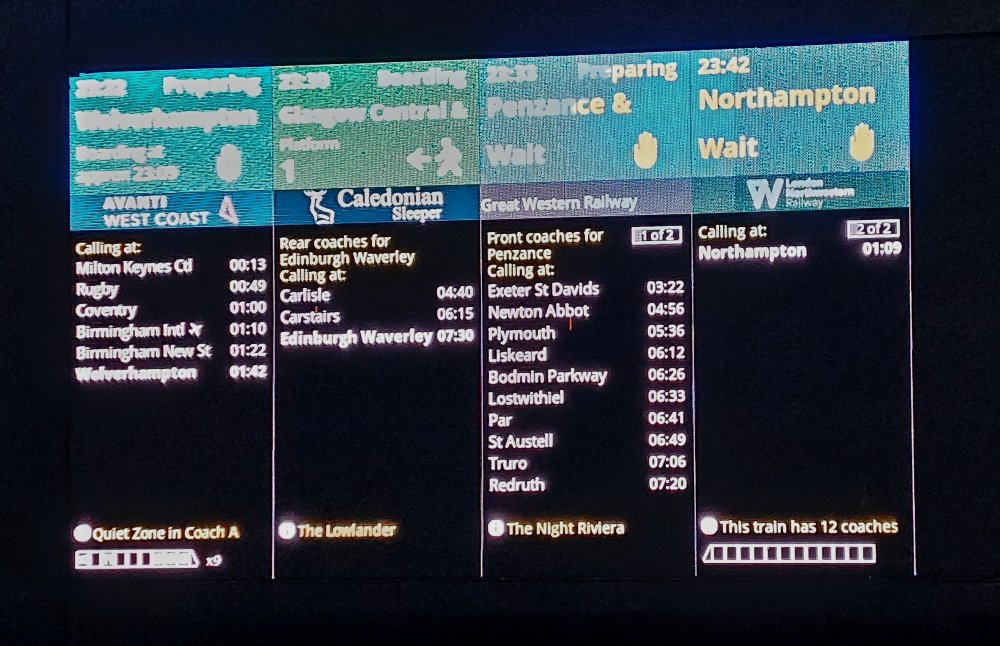
The train boards at Euston showing the Caledonian Sleeper and the GWR. What I liked about this was as the display rotated it also showed the London end Class 90001 (Royal Scot) as a ‘rear coach’ calling at the Depot only!
In a nutshell the geography of all this shows how and why the various railways (GWR and LBR) almost meet each in the Old Oak common area. Those early plans basically set the path for these new railway lines towards the western part of London in order to form a commodious connection with each other and with other proposed lines (such as the West London Railway) which would link round to those being built towards the south. In fact the GWR, instead of utilising Euston as a terminus, got to the point where for some time it also had Victoria as an alternative London terminus – complete with broad gauge tracks!
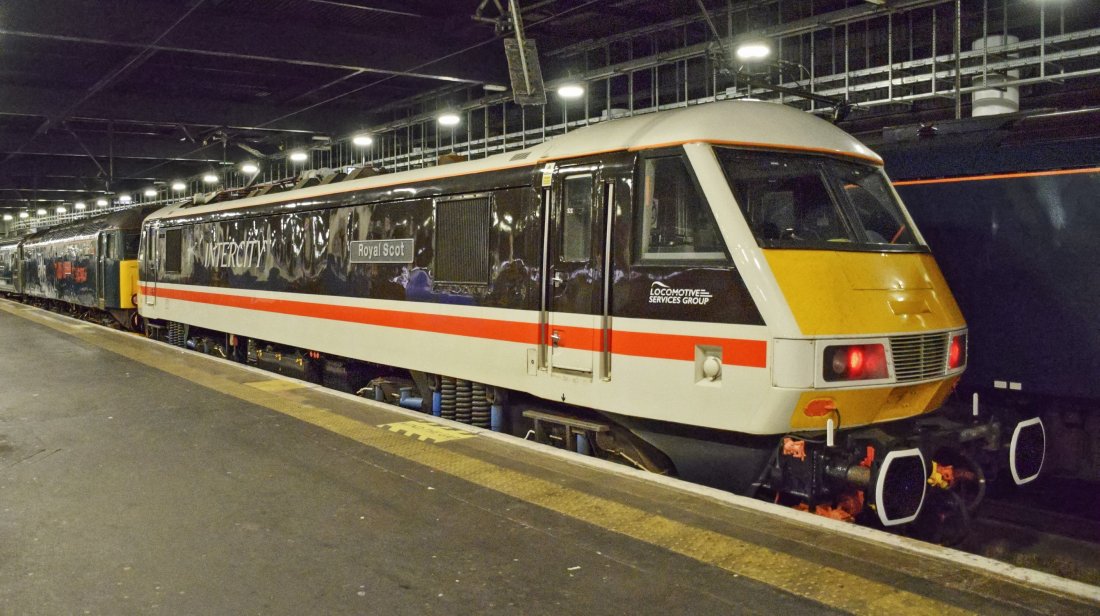
Class 90001 Royal Scot at the buffer stops on Euston’s platform 2. Behind is Class 57605 Totnes Castle. The Class 90 was provided as a power source because the Class 57s had to have their engines switched off.
Having written all that, there’s a technicality however. The present GWR service into Euston goes nowhere near where it would have gone. The site utilised – platforms 1 and 2 which are Euston’s less intensively used platforms – is more or less the LBR’s location. Its only because of ‘Line X’ that the GWR’s services can, in most cases, dive under the West Coast main line’s tracks in order to reach those platforms and avoid conflict with Avanti’s, London North Western’s or London Overground’s (Lioness line) services into Euston.
Back in the 1830s the GWR would have utilised an unbuilt station on the west side – a sort of echo of the currently unbuilt HS2 station – which one day (if its completed) will form a link between the GWR/Elizabeth line services at Old Oak Common and Euston station. That unused land on the west side of the original Euston station was later used to expand the station area considerably.
Thus history has come about full circle because the west side of Euston station is once again (depending on when its HS2 station gets built) seeing the possibility of a connection to the GWR although its not physical. However in 2024 there is a difference and it is a true interconnected service between the GWR’s and the West Coast Main Line’s tracks.
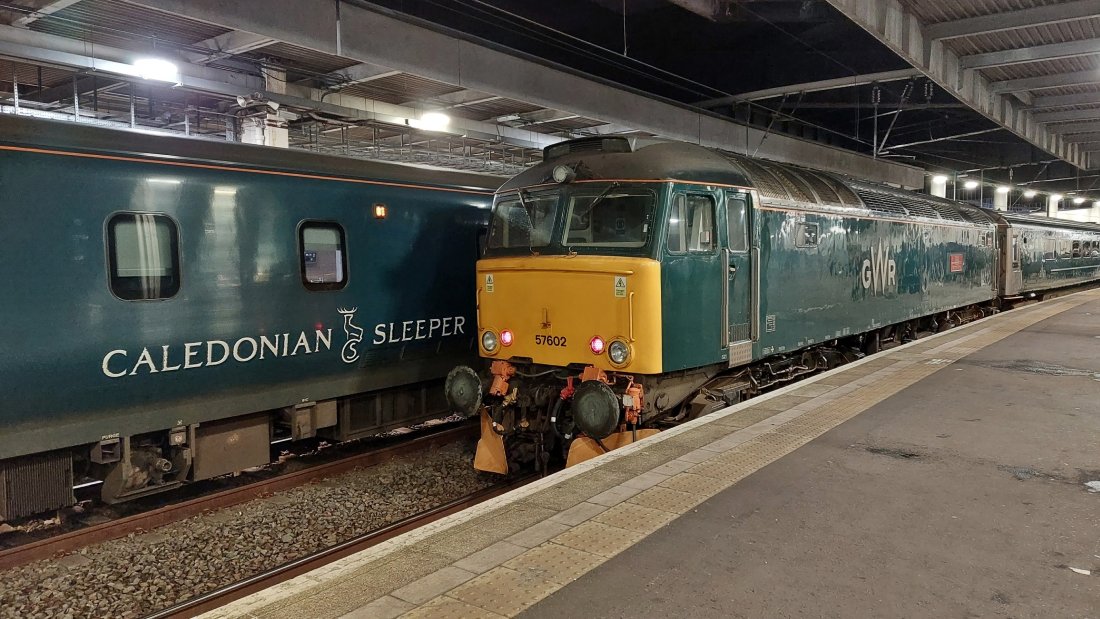
Class 57602 Restormel Castle at the head of the Night Riviera on Euston’s platform 2, with the Caledonian Sleeper adjacent in platform 1.
Enough of the intricacies of the situation – and its on with the present! Its not the first time GWR’s trains have been to Euston. Throughout 2024 a number of trial operations were undertaken to assess the route’s usage and the practice of using a totally new terminus, as well as providing route familarisation for train drivers. None of these were public services.
Iit must be said the route from the GWR to Euston isn’t anything new. Its been possible for decades, but its a sinuous route that’s really only for the use of freight heading towards the North London line and onward to the East London yards or other destinations such as the Gateway and Thameside freight depots or Felixstowe port. Only now is it being used for passenger trains and that will be the case for the next few years.
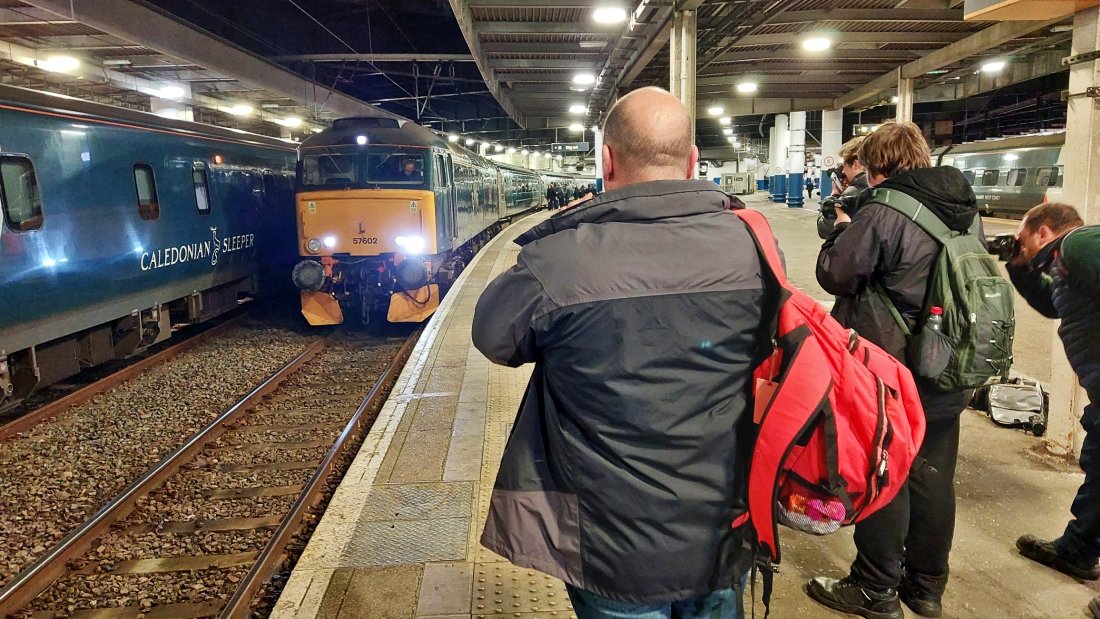
Enthusiasts photograph Class 57 Restormel Castle at the head of the 23.33pm Night Riviera for Penzance.
Its only with the complete total closure of the GWR main line from Acton West junction to Paddington for the purpose of the Old Oak Common GWR/HS2 interchange the alternative routing came into use for its first pubic services. Contrary to what would be the assumption, trains didn’t use Acton East (Poplar) Junction (as may be the case during later diversions) – and this is because the tracks there were under possession. Trains instead used the up and down Goods through Acton Yard – and these in turn become the up and down Poplar lines from Acton East Junction as far as Acton Wells junction. This route enabled the GWR’s trains to avoid the tracks through Acton Main Line station which (by way of being the continuation into the Old Oak possession) were no doubt under full possession too.
but now the Euston ones are stopped as well? pic.twitter.com/Hx6WVISP7k
— Toby Roberts (@workwithtoby) November 17, 2024
At one point however, a cracked rail (or more accurately, a broken fishplate) at Acton West junction looked like ensuring the Euston diversions didn’t go ahead. Its understood trains could still pass through but only at an extremely slow pace. That forced cancellation of at least two of the early services – including the first public GWR service (the 08.33am) out of Euston. For a while it was touch and go whether the services would run. The issue was quickly resolved due to the presence of the numerous track gangs in the area working in connection with the Old Oak possession. Those workers and their equipment were no doubt sent over to Acton West junction to deal with the problem. Quite a few track workers and their machinery can be seen on this Youtube video where the journey is filmed from Euston to Acton – in this instance the train is descending the Poplar lines from Acton Wells junction before passing through Acton Goods and then joining the GWR proper at Acton West junction.
There’s loads of reports on social media with coverage of the GWR services into Euston. with many exclaiming amazement that GWR should even run into the venerated (more likely vilified amongst the locals due to HS2) London terminus and enthusiasts were out in force there and en route too – for example at Kensal Green tube/overground station – always a good location to sight trains running on the West Coast Main line.
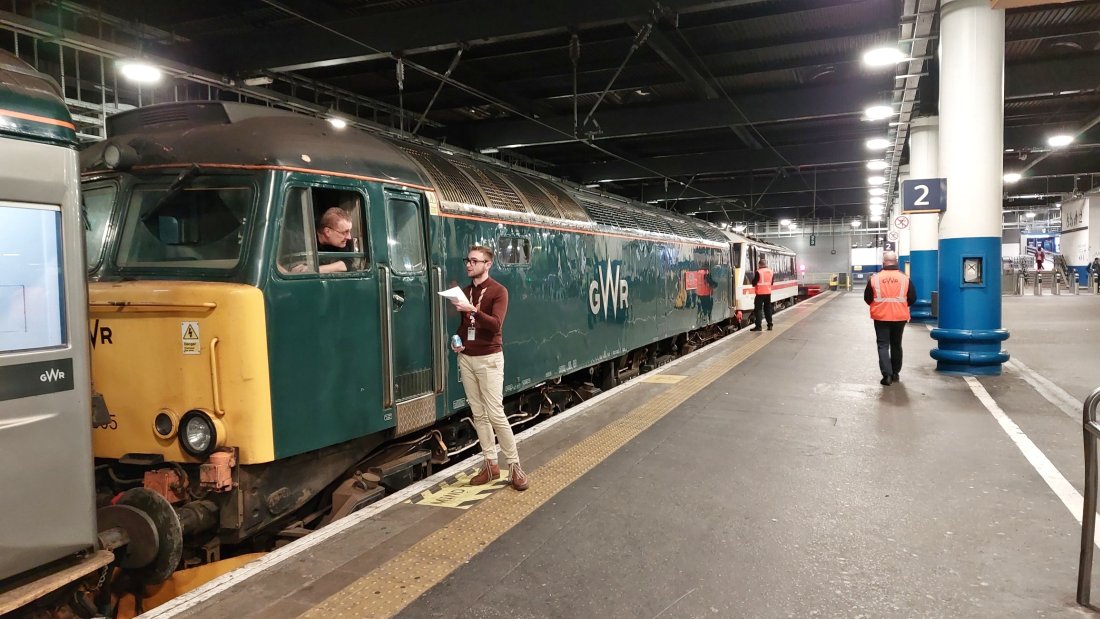
At the London end Class 57 awaits the departure at 00.33. Behind can be seen Class 90001 – denoted as a ‘rear coach’ heading for the depot!
In terms of the trains to Euston themselves, I personally don’t care much for the Everos/Azumas/IETs. I’m not a huge fan of these, and even less so after my one and only ride on these – a GWR Class 800 – whose ride was so appalling I never want to ride any of these again. It was the enormous thumps, the bangs, the way the unit lurched, that put me right off. Initially I had thought the bangs were some irate passenger in the seat behind banging very angrily the back of the seat I was in. if you don’t know my disabilities, well, you will NEVER understand where I am coming from. But those caused me such alarm that I kept looking around to see if the person behind was really slamming their fist into (or maybe violently kicking) the back of my seat. It took some distance on the ride before I became absolutely certain it was not that and the issue was in fact the IET itself. And what a bloody awful thump it was. It had put my nerves right on edge.
In my opinion if people want make a special trip to see the IETs at Euston well that was up to them. Enthusiasts fanning for the new ‘Thumpers’ no doubt! If I had somehow been passing by the station in the day, I’d probably have taken a look too, but in terms of making a special trip to see an IET, well that was always going to be an absolute no.
So you see, there was no special trip, no desire even to see these IETs at Euston. Plenty of others doing that – and I could go onto social media to view the pics. Its interesting to a point especially given the uniqueness of the occasion but evidently I had missed nothing – and there will be many occasions of GWR using Euston station over the next few years. Other people will no doubt think differently. Anyway, if there was to be a special trip, I much preferred to do that in order to see the Cally and GWR sleepers. A few of the photographs I took are shown above. The tweet depicted re the earlier delays to the GWR Euston service is not mine but its included to show the GWR’s Euston workings had been cancelled in the early part of the day.
Leave a Reply