On March 2nd 2026 Chancellor Reeves inadvertently eulogised what the railways are most excellent at. This being the art of aural communications. Its so much easier to pick up a microphone and make announcements isn’t it? “This government is making sure passengers aren’t asked to spend a penny more on regulated fares, including season tickets and peak and off-peak returns. Thank you very much.” 1 There’s absolutely no doubt Reeves’ announcements were NOT ever intended for those commuters who could well be Deaf/deaf or hard of hearing.
In 2025 Rail 200 celebrated the 200th year of railways. Rail systems the world over joined in unison to celebrate what was a significantly important occasion. The Rail 200 exhibition train said “There’s a role in rail for everyone.” Yet few realise the railways have an auditory medium as the heart of its legacy – horns for warning impending arrival or danger, plus announcements and vital information.
Sadly what this means is the railways have almost repeatedly throughout these 200 years ignored the D/deaf (**see notes at bottom), the deafblind and the hard of hearing. The railways are for those who can hear – there is no doubt about that – even so having a legacy aural medium is proving to be a huge problem these days as we shall see.
But first, in a report published this week the IMechE had this to say:
Most of today’s transport system was never designed to be inclusive — and that is where the biggest failure lies. 2
Exactly! Besides stairs, gaps in platforms, steps up onto trains, etc the system has never been designed to include D/deaf people either. And this is exactly what this London Rail article is about – this being that the railways are not for everyone. And there’s no doubt the IMechE recongise this only too well. Not only that they have also stated there needs to be substantial work to bring the system up to scratch if it going to include the D/deaf and deafblind too.
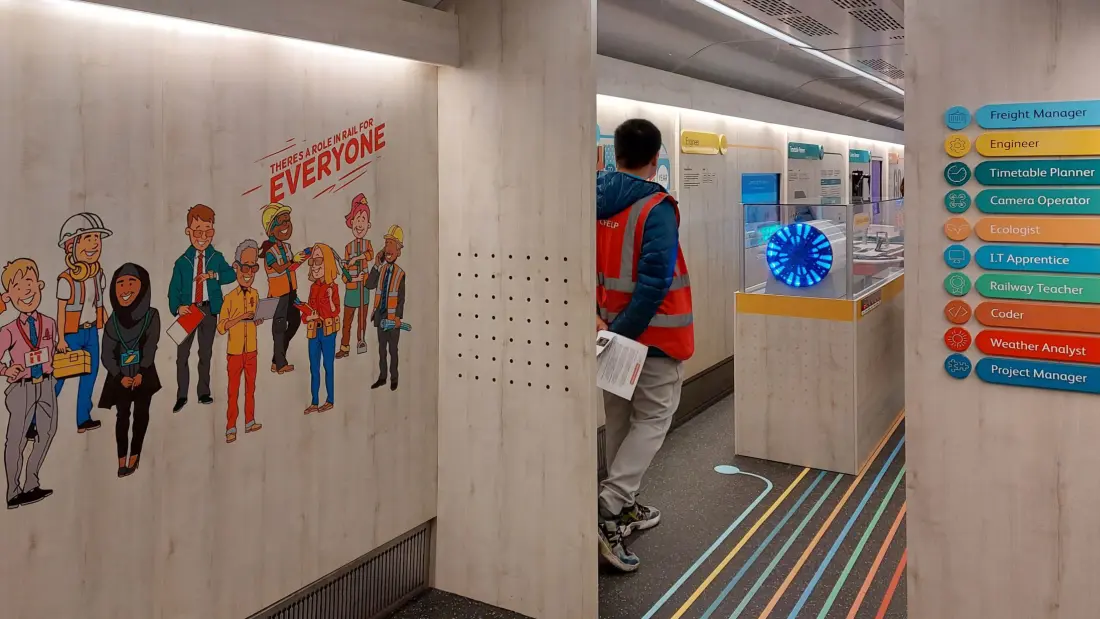
The Rail 200 train stressed that the railways were for everyone.
In February 2026 the London Assembly said:
“An accessible and inclusive public transport network should be easy for everyone to use. It is a network that does not create access barriers for people living with an impairment…”
Previously the Office of Rail and Road (ORR) gave the operators of Britain’s railways varying degrees of rating for work to ensure accessibility for the disabled. From that it was clear the UK’s railways have a long road ahead because some such as Northern were at rock bottom.
Government-owned train company has been failing on disability awareness training for more than four years@Doug_Paulley @LordOrk @Christiane @FlickHWilliams https://t.co/w5LEkq4bl7
— Disability News Service (@johnpringdns) March 5, 2026
Its a surprise when it comes to finding out which rail sectors have been failing in their duties!
The number of D/deaf and hard of hearing is larger than anyone would think:
One in three adults in the UK are deaf, have hearing loss or tinnitus. Over 18 million adults in the UK are deaf, have hearing loss or tinnitus. Over half the population aged 55 or more have hearing loss. Almost 80% of people over the age of 70 will have hearing loss. An estimated 2.4 million adults in the UK have a level of hearing loss that means they would struggle to hear most conversational speech. 3
Great Britain Railways (GBR) promises greater effort towards full accessibility. A considerable gap often little discussed in terms of accessibility on the railways the industry, except perhaps in passing, is one GBR recognises:
“A recent ‘Transport for All’ report found that 38% of respondents reported that inadequate accessibility information had been a barrier to train travel, with some abandoning journeys after encountering unexpected barriers. Common issues include unclear signage, inaccessible print or digital formats, and poor audio announcements—particularly affecting visually impaired and neurodivergent passengers. A lack of British Sign Language (BSL) resources and over-reliance on audio also create significant barriers for deaf and hard-of-hearing travellers.” [bold emphasis mine] – ‘Our Roadmap to an Accessible Railway’, Great British Railways, November 2025.
In the aforementioned ‘Transport for All’ document we find:
“The basic nature of audio based railways means that a lack of audio-visual announcements was a barrier for 16% of respondents, causing them to miss crucial live updates. Unexpected changes to the service were particularly problematic for deaf and hard of hearing passengers, as these tend to be relayed exclusively over audio announcement.” – Transport for All 2023 – Are we there yet? 4
Accessibility is not just about lifts or ramps yet the railways do rather ignore one sector of those who need accessibility, assistance, and information. This is the D/deaf, the deafblind and the hard of hearing. The Royal National Institute for the Deaf (RNID) found people were more likely to help with other forms of disability but who still (implicitly) had hearing. The survey implies subtly that if both parties are convivial at communication (eg speech and hearing), there is a greater willingness towards assistance and guidance.
One example of that was if someone was spotted wearing a hearing aid, the level of potential aid/assistance rose somewhat. Evidently the more one was seen to be able to hear, the more help they got!
In terms of actual service, the RNID’s ‘It Does Matter’ 5 report states in the last 12 months “22% of people with hearing loss, 36% of deaf people and 62% of BSL users experienced negative attitudes and behaviour from public transport staff.” It is distressing to find such numbers of D/deaf, deafblind and hard of hearing people are discriminated against on public transport!
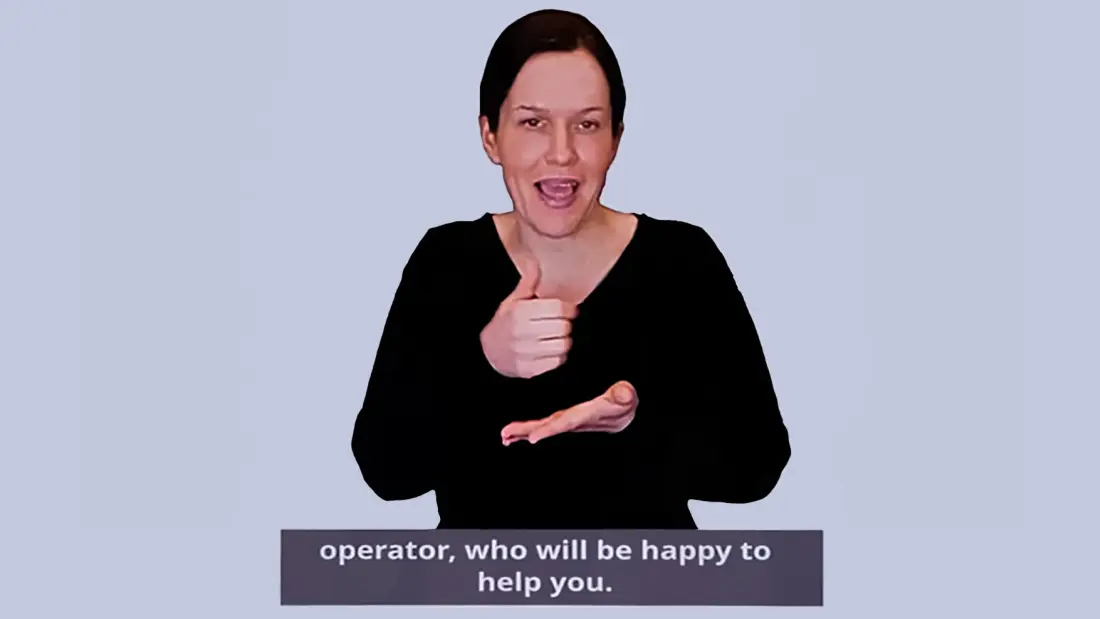
As for 62% percentage of staff ignoring the profoundly deaf BSL user, one may well ask what good have these BSL screens done? Many must think, ‘aha the Deaf are fully catered for – thus there is nothing for the transport staff to do.’ Yet when the D/deaf need assistance, there is annoyance in being asked to assist. Often its something well beyond the staff’s range of abilities. Even with increased visual information, staff still resist if there’s any need for communication other than mere verbal interaction. It is an indication little has changed.
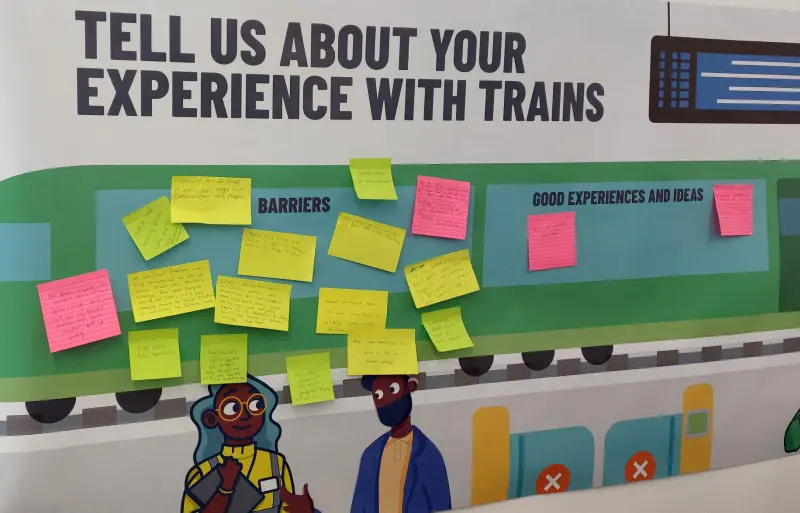
Survey undertaken for RNID entailing D/deaf people’s experiences. The good experiences are enormously outweighed by the bad!
Language isn’t just auditory
In the UK, BSL is the UK’s fourth official language. The other three, English, Welsh, and Scottish are tied to speech and hearing, however BSL clearly is tied to a visual medium.
BSL is covered by legislation too which means various authorities and services have to comply by providing a level of visual or signed information. Legislation includes the Equality Act 2010 and the BSL Act 2022. No doubt Great British Railways, as a Government signatory, is aware there is a duty upon it to comply with the relevant legislation.
Regardless of that legislation, it apparently does not matter whether one is profoundly deaf, hard of hearing or a Deaf BSL user because there is a measurable level of failure to accommodate the D/deaf on public transport, and in many areas it is persistent. Its down to the traditional uses of both speech and hearing above other modes of communication whether visual or sign language. Note that this is a societal issue as much as a railway one.
Burden of proof difficult to acquire
It is very difficult for the D/deaf and hard of hearing to ‘navigate’ this deep seated auditory legacy and even find ways of resolving it. Compared to those who hear and speak or communicate well, the problem is videos showing proof of discrimination are hard to come by for a very simple reason. For the Deaf to acquire proof they would need their smartphones or tablets for proof, yet these are also needed for communication. If there’s writing or even signing involved, its impossible to hold a smartphone. Besides, there are lots of other ways any actual infractions against any D/deaf, deafblind or hard of hearing can be avoided to another’s advantage. Thus the general notion is no deaf are being disadvantaged or discriminated at all.
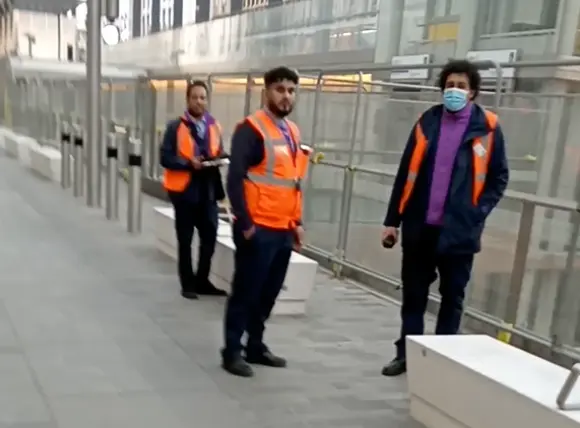
Elizabeth line staff’s horrific discrimination and total lack of cognizance proved to be one of the most distressing episodes ever the author has had. The guy with mask continued to keep it on while talking. It took months of counselling to even get over this episode somewhat. Even so it still affects the author considerably to this day.
Rail operators must provide ‘effective communication’ for passengers with disabilities. If announcements or essential instructions are not accessible visually or digitally, this counts as discrimination by omission. Legislation substantially requires visual information as a means of communication. The Rail Delivery Group 6 are obliged to seeks ways and means to develop provision of visual information.
“Visit any train station in the UK, and you will find that most of the essential travel information remains overwhelmingly audio-based, with inconsistent visual alternatives and minimal provision for deaf people, and in particular, British Sign Language users, despite BSL gaining legal status as a recognised language in the UK since 2022.” 7
The London Assembly recently said accessible public transport should ensure “people who are deaf or blind have access to the same level of information as everyone else.” 8
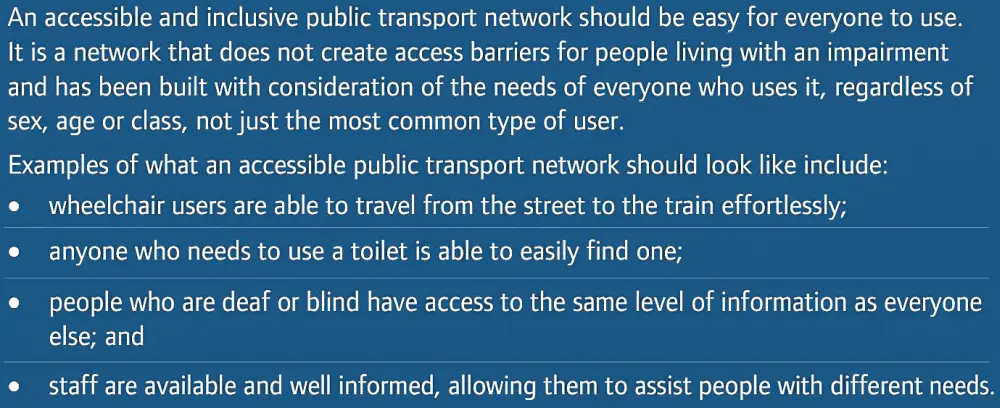
A section of the London Assembly’s Transport Committee February 2026 report concerning accessibility on TfL’s services. Link.
Plus ça change!
The ways and means Network Rail and other organisations attempt to address this constitutes a strategy that does not explicitly answer the issues the D/deaf, deafblind and hard of hearing face. In terms of history its no recent matter, yet persists with little recourse or solution. In 2017, the Guardian stated the UK’s railway was 200 years behind on rail accessibility. 9 Ironically under Rail200, 2025 ought to have been been a celebration of 200 years of rail inaccessibility too!
Remember anyone can become Deaf or hard-of-hearing and many do so through accident, illness, workplace environment, proximity to really loud noise, old age, or other disability etc.
Historically the railways have kept an entire subset of the populace unable to use the network effectively. As early as 1972, Robert Bowen, MP for Wells asked the Social Services Minister Sir Keith Joseph if he would issue a direction to British Rail that all stations be facilitated with visual indicators giving last minute train announcements, platform changes, and emergency messages for the D/deaf. (Somerset Standard 3rd March 1972). In 2025 its still a major omission for many rail operators opt to use verbal announcements over and above providing visual information at stations.
What if transport systems were cognizant of those various needs from their very inception rather than the mode of piecemeal and inconsistent implementation now? Fully accessible transport is no doubt a huge asset and elevates passenger numbers considerably. Will GBR meet that challenge?
Some early, full-access railways
Strangely the UK, being one of the early innovators of transport, achieved partially what the systems of today are attempting. The first ever deep level tube line in London, the City and South London, 10 began life with almost every station using level boarding from platform to street. The very first ‘tube’ of all, the little known Tower Subway, 11 had level boarding throughout – no gaps or steps to be found anywhere!
The use of lifts in these early systems no doubt limited passenger numbers and hampered potential revenue growth. Escalators permitted transport systems to operate to greater capacity. From Earl’s Court 12 to the present escalators have been a success story for transport systems across the world. But within that very history, its clear the use of both fixed and moving stairs prevented accessibility to all but the most mobile.
Ignored by society
To all purposes and intents, there was a notion that disabled people simply did not exist. The most anyone would encounter a disabled person was catching sight of them in the street destitute and begging for money. Many were seen as outsiders with little purpose thus accessibility, equality and awareness were light years away.
The fact it was those who were completely mobile and could use auditory means of gleaning information was something that proved exclusive. Besides a lack of level boarding, the means of communication excluded D/deaf and hard of hearing passengers totally.
As mentioned just a moment ago, in 1972, an MP requested Sir Keith Joseph to direct that all British Rail stations be furnished with visual indicators giving last minute train announcements, platform changes, and emergency messages for the deaf. Its perhaps one of the earliest attempts to instigate a culture of ongoing and live visual information on the railways.
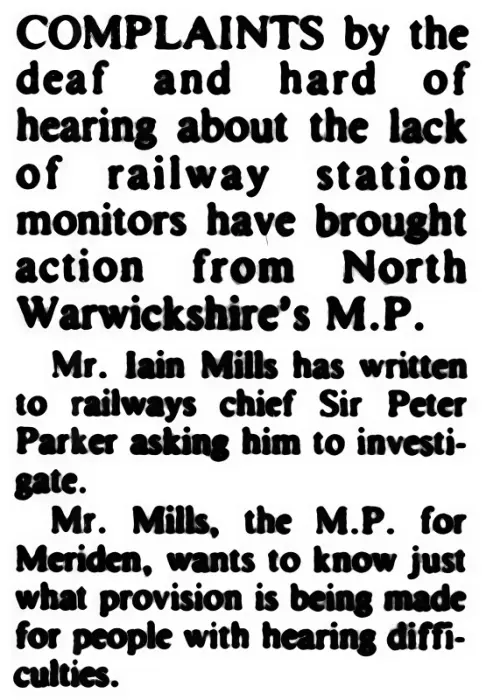
Sadly by the 1980s there was no doubt deaf people were being excluded from vital train information. Few stations, especially rural ones, had visual information of any sort. In 1982 MP Iain Mills wrote to Sir Peter Parker expressing a concern that deaf and hard of hearing constituents found it difficult to use most stations for there was no means of knowing whether trains were delayed or cancelled.
The ‘Too difficult’ mindset
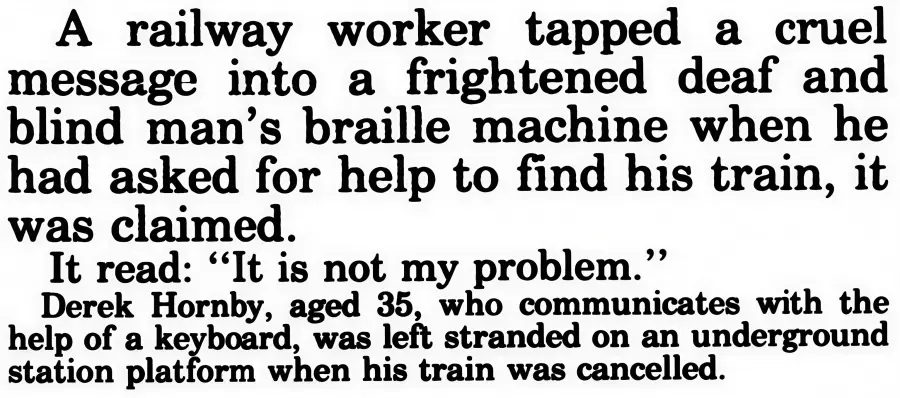
In 1993, Derek Hornby, a deafblind traveller, approached Merseyrail staff for assistance after finding his train home had been cancelled. His communication was by way of a braille machine used to request help. The station staff at Liverpool Central typed a response that evoked outrage. They typed ‘It is not my problem.’ Fortunately, Hornby was able to find some passengers who ensured he caught a different train home.

The matter was referred to the MP David Alton who in turn chided British Rail. It seemed someone higher up had forbid rail staff from assisting vulnerable passengers. “It seems some bloody minded bureaucrat put his oar in. He needs to be told in no uncertain terms that this is not good enough” said Alton. British Rail says despite investigation nothing was found to substantiate this complaint. (Express and Star 15th October 1993).
Five years after the Liverpool Echo (8th September 1998) wrote a full page article on things Merseyrail were still getting wrong. Lack of on-board announcements and platform assistance staff were some of the main complaints. Despite Merseyrail’s assertions it was taking matters seriously, the Liverpool Echo concluded it “had yet to see an improvement in communications between Merseyrail train staff and passengers.”
The deafblind would like a word
Its not just the D/deaf or hard of hearing but also the deafblind that face discrimination. Sense says:
Deafblindness affects people of all ages, including children and young people. It is more common in older people, because we naturally tend to experience loss to sight and hearing as we get older. There are more than 450,000 deafblind people in the UK. It’s thought there will be more than 610,000 by 2035 due to our ageing population. 13
In the instances we are discussing here, the more severe of those who are deafblind no doubt have a reliance on visual communication if they can see sufficiently or tactical communication if they are severely blind. That may also involve BSL and fingerspelling on one’s palm. There’s also other methods that give deafblind people varying degrees of communication. Some use very specialised communication systems such as Tadoma which takes time to learn.
The more common format is the deafblind manual, involving touch fingerspelling using the hands. How the railways would deal with customers who required that is not properly known. Would they, like Merseyrail did with Derek Hornby, say it wasn’t their problem? Its known that rail staff are hesitant to touch and would likely frown upon such endeavors.
In terms of the deafblind the IMechE put it quite well their latest report:
People with multiple impairments are particularly important to consider. For example, someone who is both blind and deaf may need information given to them in embossed text or braille. If this is unable to be provided, it is important to have accessible, realtime digital information available so that personal digital braille displays that instantly translate text into tactile information can be used. 14
As regards touch, even Deaf people use touch to an extent, for example to get attention or when there is an emergency. Touching (tapping on the shoulder or arm) is in lieu of shouting or warning yet others because how does one get the attention of others? Many do not understand that.
The status quo continues
Because UK railways haven’t caught up with full accessibility, many companies, managers, and staff are quite happy to use the existing systems of information dispersal – because they can. If they have other systems offering assistance of some sort, there seems an apparent inability to use these! Alas it seems many continue to prefer to use speech. The Hammersmith, Fulham and Shepherd’s Bush Gazette (31st December 1998) highlighted that “many underground booking clerks do not use the induction loops which are already provided in their ticket booths to assist people with hearing aids.”
The railways often get it wrong because they have an auditory legacy that cannot be easily shaken off. The highly esteemed ‘Speak here’ windows that were a feature of British Railways’ ticket offices during the 1960s, 1970s, and 1980s are now closed. Possibly one example remains at Paignton for historic purposes. When irate staff attempted to make themselves heard upon realising the passenger was D/deaf or hard of hearing, they would place their mouth right up to the grille in an attempt to make themselves more loudly heard. Ironically it blocked any possibility of one being able to lip read what was being said!
There are numerous loops available for the hard of hearing but that is it. They don’t work for the profoundly deaf or BSL user, nor the deafblind.
The earlier mention of the RNID report indicated the levels of assistance the deaf would receive. Even in 2025 TfL still fails to make the grade. A recent meeting (recorded on video) had staff admitting TfL has a very poor record in this regard. One TfL manager says he “understands that it can be frustrating that our staff do not know BSL, but we aren’t taught that in training, not even the basics of BSL.“.
Public transport journeys are still too long and difficult for some groups in London. Today’s report from #AssemblyTransport examines how TfL is building its understanding of how and why Londoner’s travel. Read the report in full: https://t.co/6O07QieYsu @EllyBakerAM pic.twitter.com/BH3JoOJPo7
— London Assembly (@LondonAssembly) February 13, 2026
The London Assembly in its recent report (February 2026) said:
“TfL collect a significant amount of data on its passengers, but this is lacking depth and nuance around issues concerning accessibility and inclusion…”
Exactly! Its a half hearted effort!
Railways are often noisy places and aural integrity can degrade easily
One must deem the ability to hear ought not to be taken for granted. Anyone can become disabled, deaf, or blind at any time – and that through work even. Indeed train guards have become deaf through the constant use of whistles! Noise on London’s Underground is a huge problem and one that exceeds safe levels. Not just rail workers but passengers are affected too. Even constant and loud announcements can severely affect transport users and workers.
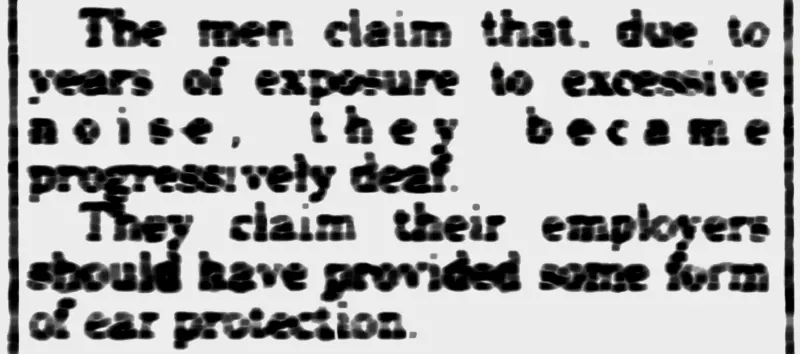
A report in the Shropshire Star (16th June 1983) divulged there were more than 3,000 claims being made by former rail staff against British Rail for damage to their hearing. One claim involved two workers based at Shildon (ironically, the home of Locomotion/Rail 200). QC Christopher Rose represented staff who had been employed at Shildon railway engineering works, Co. Durham:
The men claim that, due to years of exposure to excessive noise, they became progressively deaf. They claim their employers should have provided some form of ear protection.
A BBC Horizon programme, ‘The Curtain of Silence’, 1973, highlighted a need for protective wear in noisy environments. Excessive noise is an unnecessary burden and lack of protection put vast numbers of workers at risk of becoming deaf.
Frequent announcements are part of the problem
Sadly, the one common bugbear this being ‘noise’ in the form of loud announcements and the likes appears to be preferable to a greater use of visual information. It is not just the Deaf, but autistics and hearing people that can be severely affected too – that’s a reason why the Elizabeth line recently proposed a trial of quiet rooms at its stations. 15
The UK’s rail networks legacy is to function with a level of ‘auditory assault’ which ironically gets to be the preferred mode of communication. It is easy to make announcements and assume everyone can hear what’s been said. However, the legislation for accessibility indicates that visual communication systems should also be employed equally. Whether these are used or not, the railways sadly find both aural and verbal communication far too convenient. Even Chancellor Reeves, as explained in the very first paragraph on this page, had chosen to assault Network Rail’s customers with announcements that their fares were being frozen! Visual communication systems are often seen as expensive especially for lesser used stations.
There’s no doubt the whole ethos of information destined for those who are D/deaf or deafblind and hard of hearing tends to fail. It is hard to qualitatively describe the various experiences of being D/deaf and how one gets compromised in terms of travel information. It must be considered that even others, like older people, too become D/deaf – and for fear of social stigma many prefer to be called hard of hearing or hearing impaired even.
That is because society actively seeks to avoid deafness thus ongoing social stigma perpetuates. Nevertheless, many who become affected later in life they’re still deaf to varying degrees and have to rely on other modes of communication. No doubt a sizeable portion of the populace have difficulty in using transport because it is a nightmare trying to discern the different announcements, interspersed with other sounds such as people chatting, stuff being moved, clattering, and the noise trains make.
One wonders why the railways wish to perpetuate what can only be a continued, indeed, unnecessary assault upon the ears? Clearly there is also resistance against those who specifically require visual or signed communication. There’s no doubt transport operators regularly opt out of using information systems that would be of considerable benefit.
Recall the London Assembly (February 2026) which said “TfL collect a significant amount of data on its passengers, but this is lacking depth and nuance around issues concerning accessibility and inclusion…”Again its indicative of a half hearted effort.
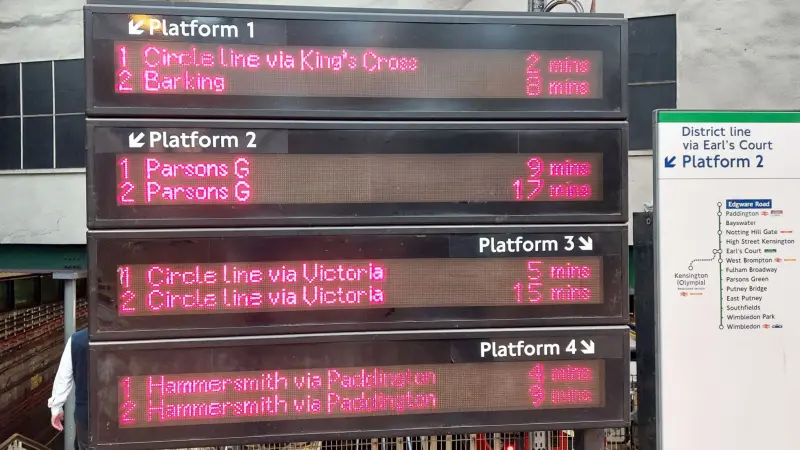
Everyone gets it wrong (even the best vloggers and bloggers) about these indicators at Edgware Road (District/Circle). They were established in the late 1980s because so many deafblind people were getting confused at this station as to which trains they ought to take (or change to). The red actually stands out better against bright backgrounds (in this case that was the sky) thus a blind or a deafblind person would have to be close to the signs (especially those on the platforms) and almost directly look up with the sky constituting an enormous background. LU considered other stations where similar conditions might prevail, however numerous complaints ensured no further examples were installed apart from those at this station. This was almost certainly a case of a ‘power’ of ability winning over disability.
The full nature of the accessibility problem
Clearly the London Assembly holds a view that TfL, for example, does not fully understand the issues at hand. Evidently many who use transport prefer concise, clear, and legible visual information compared to the cacophony of assault sound that bears down on their ears.
There’s no doubt its a street that works both ways – people who hear well don’t like being bombarded with loud and constant announcements either! Hence its not only the D/deaf et al who benefit from visual information.
It is clear rail transport has a struggle providing a proper service for most disabilities. Increased visual information means additional safety plus awareness of when services go wrong. Yet operators seem to prefer bombarding transport users with announcements!
The nature of the auditory problem
Railways were built in a bygone era where verbal announcements were the fastest way to reach many. Any visual information that existed was entirely analogue, such as notices hurriedly written in chalk, finger boards, flip boards, timetables, fares and notices. The earliest examples of digital information were perhaps those on London’s Underground from the mid 1980s onward.
Those numerous years were a time when disability rights was not any sort of concept. It wasn’t until 1995 that the UK’s Disability Discrimination Act first came into use.
The result is railways largely rely on the use of public address systems. Not only that, conductors, station staff, and train dispatchers relied on whistles, shouts, platform announcements, and verbal instructions. Its a ‘default mode’ of railway communication.

This series of bells on the wall at Hampstead tube station is a reminder of the railway’s need for an auditory medium.
Warning noises, bells, horns, and pings or tones preceding announcements were widespread. Sound carries information quickly thus every railway leaned heavily upon such means. Information screens, where any existed were very rare, except in London where visual train indicator screens had been employed since the early years of the 20th century.
Railways don’t have a philosophical commitment to speech. Its not to say they believe speech is the system they must abide by. Rather its that these systems have perpetuated largely due to convenience. Old habits die hard thus accessibility is often an afterthought.
Deaf/deaf and Hard of hearing – the oft unseen and ignored disability
Those who are D/deaf or deafblind need access to the same level of information as everyone else. Not only that, staff should be available and well informed, allowing them to assist various people with differing needs.
The IMechE in its latest report (March 2026) also add, more importantly:
Not having both audio and visual information means passengers who are D/deaf and blind or partially sighted may miss their stops, end up in unfamiliar places, and in some cases experience distress due to poor treatment by others. 16
There’s numerous BSL screens on the railways now, however there’s still a gap in information especially in terms of enquiries or assistance. When such communication requests have arisen its often that
1) railway staff have no training or awareness, and
2) some staff even turn their attention to someone else (preferably hearing) who is also asking for help/assistance. Its a subtle means of ignoring BSL or deaf people by prioritising those with speech instead.
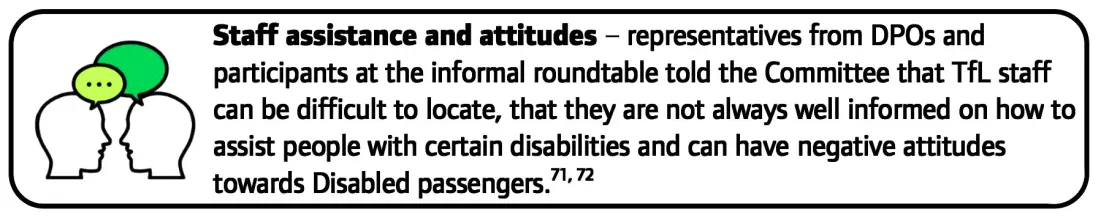
The London Assembly February 2026 report acknowledges that staff can have negative attitudes. Link.
If it is shouted or broadcast, there is a belief everyone can hear that thus its easier for staff to pick up a microphone and make announcements. Its why London Underground regularly employ platform dispatchers at rush hours whose announcements are far easier than prompting any information on the visual screens. There’s no doubt these announcements reaches people who can’t see the screens but they also exclude many who may not hear the announcements well, if at all.
The current situation
There are apps that have emerged to give greater assistance, however its still often a one way street. Indeed the current GBR proposals appear to discount the lived experience of those who require accessibility or assistance. (Disability News and New Civil Engineer). For too long the railways have been run by people who have, besides the needs of the disabled, also have not understood the needs of deaf BSL users or the deafblind and the hard of hearing. Even many autistics would want to see a greater use of visual information because the noise that emanates on public transport is just so unsettling. A comprehensive visual information system no doubt gives huge benefit right across the board.
To raise awareness of Deaf Awareness Week, we’ve partnered with our sister DFTO operators — @LNER , @northernassist and @Se_Railway to highlight the range of accessibility features available for deaf and hard of hearing passengers.
— TransPennine Express (@TPExpressTrains) May 9, 2025
From BSL announcements on departure boards, on… pic.twitter.com/oGXBUTfftX
TransPennine are evidently doing a great job, nevertheless there are still gaps.
The biggest problem is often front line staff who simply have no training or awareness, and that deflates the whole point of what accessibility entails. The London Assembly in its February report on transport accessibility acknowledged staff needed to be ‘available and well informed’ to assist passengers with specific needs. Without effective staff support or understanding any notion of a comprehensive visual information system fails.
One example of an excellent recent initiative is SWR’s BSL service. Deaf people were involved in its development plus carrying out real world testing on its trains. Here’s a video of a BBC news report where transport correspondent Paul Clifton extols a new concept in accessibility. The service was put into use last summer.
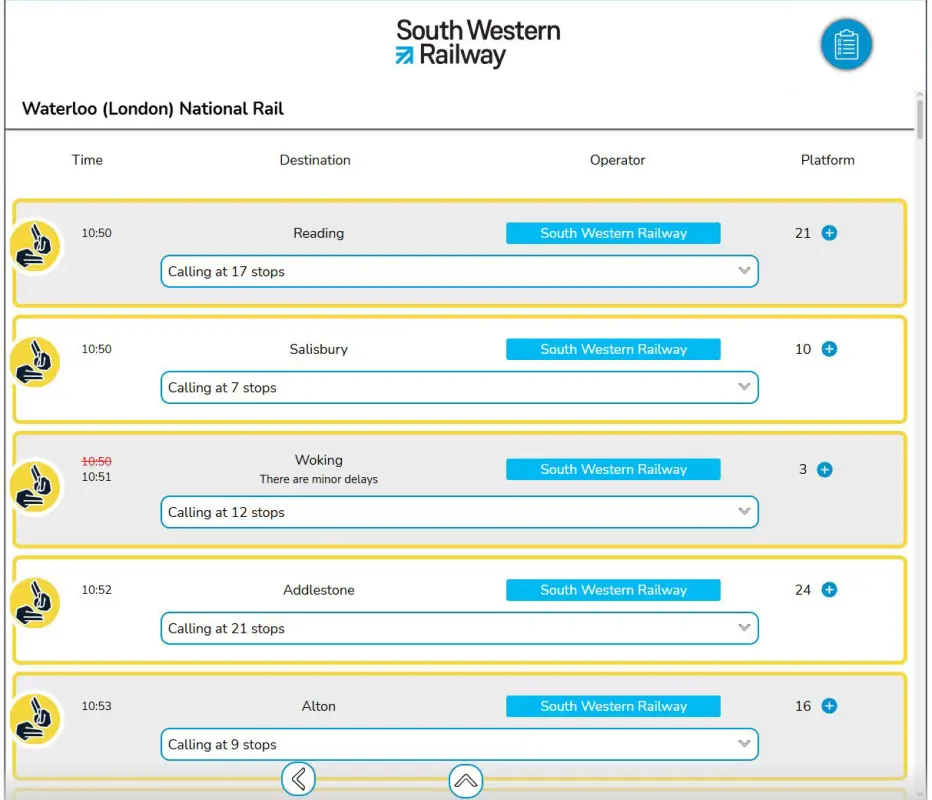
SWR’s BSL friendly application. 17 One clicks on the hands at left and an AI generated video pops up to describe the train service, and any other detail needed. There are other emerging apps/services too however this one looks great. No doubt its success will be realised over time.
The next video shows staff from Hull Trains communicating with the Deaf. As the film shows, Gordon is appreciative of the fact inclusion very clearly works both ways.
Hull Trains’ Gordon says: “I think if you make an effort you show that you’re wanting to include them. I know very little sign language, but I’d like to think I can get by and communicate with somebody. Everybody’s an equal. If I can make their life a lot easier, I feel included too.” Hull Trains, 18 as an open access rail operator, is endeavouring to ensure D/deaf people are included and what Gordon says is spot on.
Let’s hope 2026 gets to be the start of a positive transport experience for D/deaf, deafblind and hard of hearing transport users!
Acknowledgement and thanks:
The author is grateful for the assistance given by by Long Branch Mike, deputy editor from London Reconnections. This London Rail article was overseen and edited in part by Long Branch Mike.
Terminology:
**D/deaf is used mostly in the text and the Capital ‘D’ (Deaf) is a term used to refer to people who have been deaf all their lives – sign language is their first language. In specialist terms (eg audiology) it means someone with a loss of 71 to 95db (classed as severe) or over 95db (profoundly). Sometimes Deaf means total also (this being nothing at all can be heard). The lowercase ‘d’ (deaf) refers to anyone who has hearing loss (and that includes the hard of hearing). D/deaf has been a term used for quite a number of decades and it was in fact coined because in fingerspelling one could use a capital ‘D’ to denote those profoundly or totally Deaf, whereas a a lower case ‘d’ was used to describe those who were not quite so deaf. The IMechE uses the D/deaf term in its latest report published 11 March 2026 19 so it is important to clarify things.
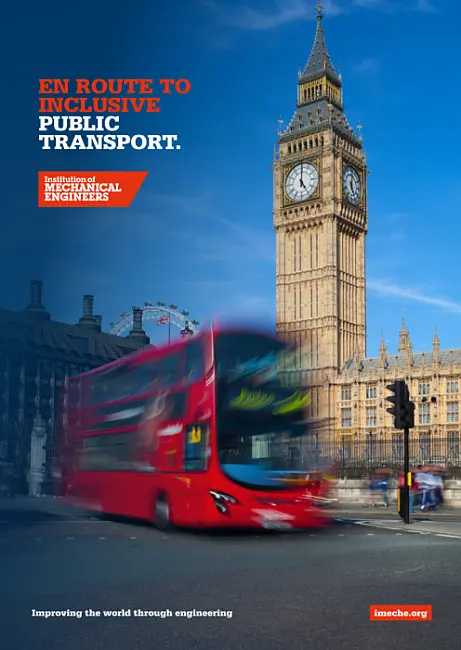
The IMechE’s latest report, published 11th March 2026, uses the term D/deaf.
Hard of hearing or deaf is also used in the text of this London Rail article – and this is because some of the other reports quoted – the RNID, the RDG and the London Assembly use those terms in place of D/deaf. It is a bit confusing however its because the definitions are not exactly standardised and so the various definitions have had to be used in their entirety across this article, including Deaf, deaf, hard of hearing – as well as D/deaf. The one major problem with using deaf (lowercase) for denoting those who are hard of hearing etc is quite a few do not want to be described using the term deaf. They prefer hard of hearing (and further some prefer hearing impaired) because it is thought that being described as deaf is an entirely negative thing and will invoke social sigma or exclusion, even discrimination.
Those who are Deaf/deaf don’t have such qualms and would rather be described as such rather, because to be described as otherwise is seen as an attempt to bring the medical model in and describe people as having a profound hearing loss (fully Deaf) or are partially hearing or adventitiously deaf etc (terms mainly used by specialists including audiology centres and hospitals). The medical model is often seen as part of a historic endeavour by society to eliminate the Deaf, something that is still continuing even under the guise of paternalism. The surprise is, no matter how much medicine advances the number of D/deaf and deafblind continues to rise quite considerably.
References:
- https://www.cityam.com/rachel-reeves-hails-fare-freeze-liverpool-street/ ↩︎
- https://www.imeche.org/policy-and-press/reports/detail/en-route-to-inclusive-public-transport—march-2026 ↩︎
- https://rnid.org.uk/get-involved/research-and-policy/facts-and-figures/prevalence-of-deafness-and-hearing-loss/ ↩︎
- https://www.transportforall.org.uk/blog/2023/12/05/are-we-there-yet-barriers-to-transport-for-disabled-people-in-2023/ ↩︎
- https://rnid.org.uk/it-does-matter-public-attitudes-to-bsl-users/ ↩︎
- https://www.find-tender.service.gov.uk/Notice/069875-2025 ↩︎
- https://directaccessgp.com/uk/news/bridging-the-gap-for-deaf-passengers-and-bsl-users-on-railways/ ↩︎
- https://www.london.gov.uk/who-we-are/what-london-assembly-does/london-assembly-work/london-assembly-publications/accessibility-inclusion-transport-planning ↩︎
- https://www.theguardian.com/uk-news/2017/oct/09/uk-running-200-years-behind-on-rail-accessibility? ↩︎
- https://en.wikipedia.org/wiki/City_and_South_London_Railway ↩︎
- https://en.wikipedia.org/wiki/Tower_Subway ↩︎
- https://www.facebook.com/LondonHistorian/posts/on-this-day-in-1911-london-underground-introduced-its-very-first-escalators-at-e/1399766082152598/ ↩︎
- https://www.sense.org.uk/information-and-advice/conditions/deafblindness/ ↩︎
- https://www.imeche.org/docs/default-source/1-oscar/reports-policy-statements-and-documents/imeche-report-en-route-to-inclusive-public-transport-2025.pdf (Page 20) ↩︎
- https://www.railwaygazette.com/uk/tfl-seeks-ideas-to-provide-calm-spaces-for-neurodivergent-passengers/70318.article ↩︎
- https://www.imeche.org/docs/default-source/1-oscar/reports-policy-statements-and-documents/imeche-report-en-route-to-inclusive-public-transport-2025.pdf ↩︎
- https://www.southwesternrailway.com/travelling-with-us/assisted-travel/bsl ↩︎
- https://en.wikipedia.org/wiki/Hull_Trains ↩︎
- https://www.imeche.org/docs/default-source/1-oscar/reports-policy-statements-and-documents/imeche-report-en-route-to-inclusive-public-transport-2025.pdf (Page 8) ↩︎
Leave a Reply