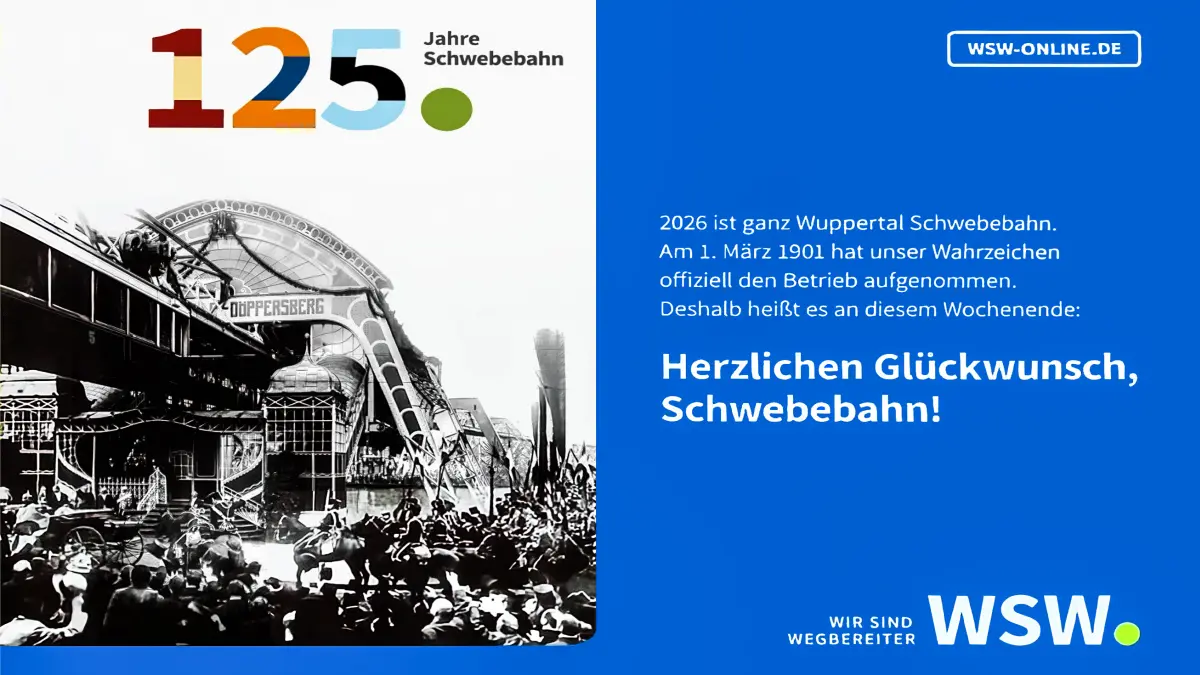
2026 is the Wuppertal Schwebebahn 125th Anniversary! The railway’s first ever test run took place on 5th December 1898, thus the world’s longest surviving monorail system began life much earlier than is often thought. The 125th anniversary is related to the actual opening of the line in 1901 – whilst also not forgetting the Kasier’s earlier visit. Although that was planned for the 13th October 1900, illness prevented Kaiser Wilhelm II from carrying out his duties. Instead the Kaiser visited the line on 24th October 1900.
Kaiser Wilhelm II re-enacts his historic visit to the Schwebebahn! The roles were undertaken by two of the Kaiserwagen’s guides.
The first part of the line was opened on 1st March 1901 between Kluse and Zoo Stadion. By 24th May 1901 it had been extended from what is now called Zoo Stadion, and largely above the Kasierstrasse on a near continual rise to Vohwinkel, constituting an elevation difference of over a hundred feet or so.* Just under two years later, on 27 June 1903 the eastern section built entirely above the Wupper river from Kluse to Oberbarmen was opened.
*At Zoo Stadion where the line turns off the river the rails are approximately 151 metres (495 feet) above sea level. At Vohwinkel the line is approximately 186 m or 610 feet above sea level. The figures take into account the Schwebebahn runs at a height of approximately 8 metres or 26 feet above the roadways. There seem to be no official elevations given thus the detail had to be worked out from maps.
One of the changes to the Schwebebahn for its 125th Anniversary has been the ‘rededication’ of one of its Generation 15 trains as an earlier Generation 72 train – its a move which has received great approval from residents, tourists, passengers and enthusiasts alike!
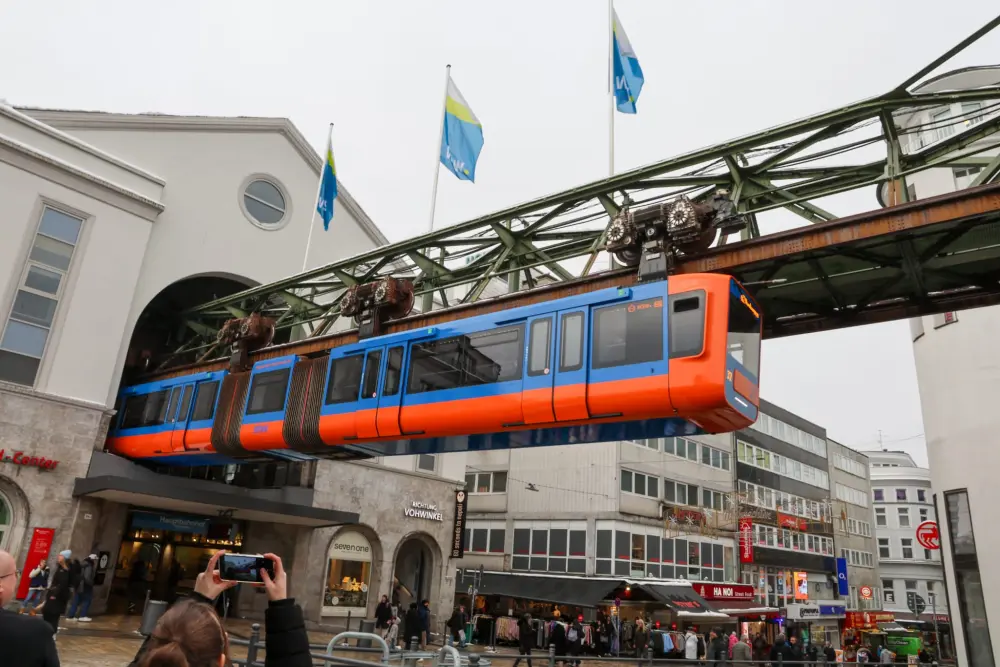
Generation 15 train in the style of the previous which were the GTW72 stock. Hauptbahnhof station March 2026. Facebook.

How the city’s former trams and the older 1972 Schwebebahn stock looked with similar liveries. This was 1987. Wikipedia.
This post to celebrate the line’s 125th anniversary is merely a compilation of various miscellaneous stuff – nothing too specific – except maybe the sections on the wagenhalle at Oberbarmen and the Schwebebahn’s turning systems. Some memorabilia the author has in his collection is also shown. A fuller detail on the history of the line can be found at Wikipedia.
LondonRail has featured the Schwebebahn in seven previous posts. These were: A Schwebebahn Anniversary (2018) which commemorated the line’s first ever trial run in 1898. Schwebebahn to reopen mid 2019 (2018). The Schwebebahn’s Loher Looping – a satire on the railway (2019). The Schwebebahn reopens (2019). The Schwebebahn to close for a year (2019). The Schwebebahn has a big problem! (2020). Flying Train 1902 (2020).
The Schwebebahn in 1971
A couple of photos and leaflets from the Author’s archives. 1971 was a special Schwebebahn anniversary year – special because that was 70 years since the opening of the line and 25 years since its reopening following WWII. It had been debated whether the Schwebebahn should be demolished given the vast damage it received. It was however recognised that the rebuilding of the railway would help boost the area’s economy.
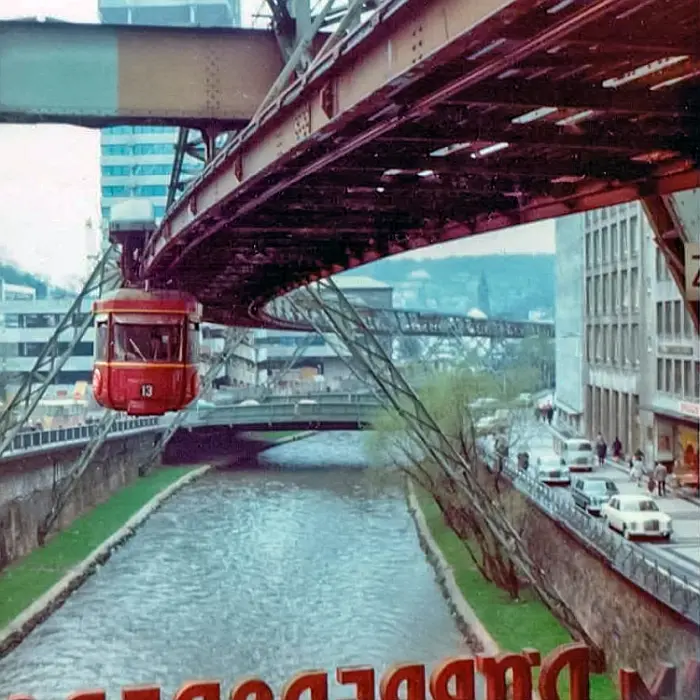
The Schwebebahn at Doppersberg as the station was previously known. April 1971. Part of the name ‘Doppersberg’ can be see at the bottom of the picture. The unit seen is an unmodified Series 50 introduced from 1950 onward. The modified Series 50 units (two in total converted to articulated pairs) became Series U62 and U65. Author’s photograph.
In the above view the old order at Wuppertal could be seen. Nowadays the scene to the left is occupied by the Bundesalle – the city’s inner ring road. The tall office building seen just above the train still exists. This is the Wuppertal Savings Bank, otherwise known as the Sparkasse Tower. It was still under construction at the time of the author’s visit in 1971.
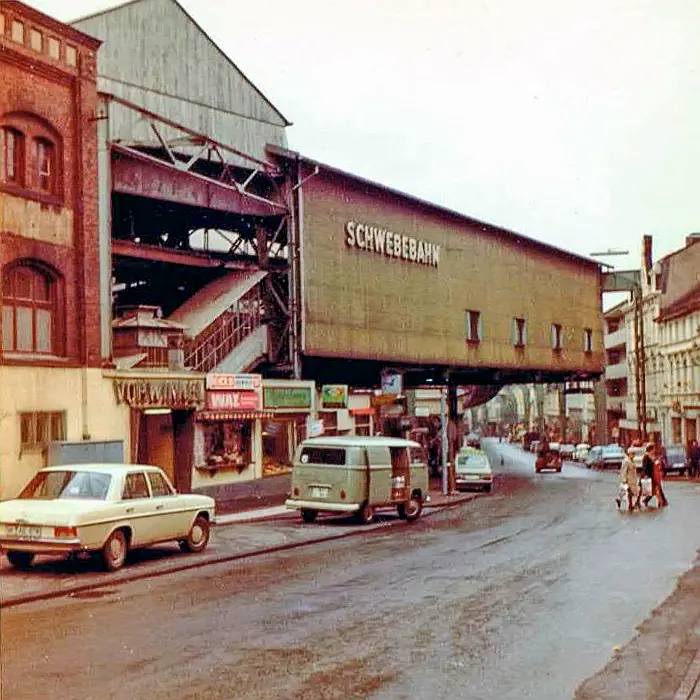
The Schwebebahn depot and terminus at Vohwinkel in 1971. Author’s Photograph.
The above view barely shows the junction here with the Rubensstraße. This is where the Solingen trolleybus (the largest system in Germany) had been extended to Vohwinkel Schwebebahn station during October 1958. If one looks at where the Schwebbahn station overhangs Vohwinkeler Straße, the deflector for the trolleybus wires directly beneath can just be seen. A comparable modern view of the above can be seen on Google Streets.
Interestingly the Solingen trolleybus system has been extended again. In August 2014 the trolleybuses, running off wire, were able to reach the area’s main line station – Vohwinkel bahnhof – a little further to the north.
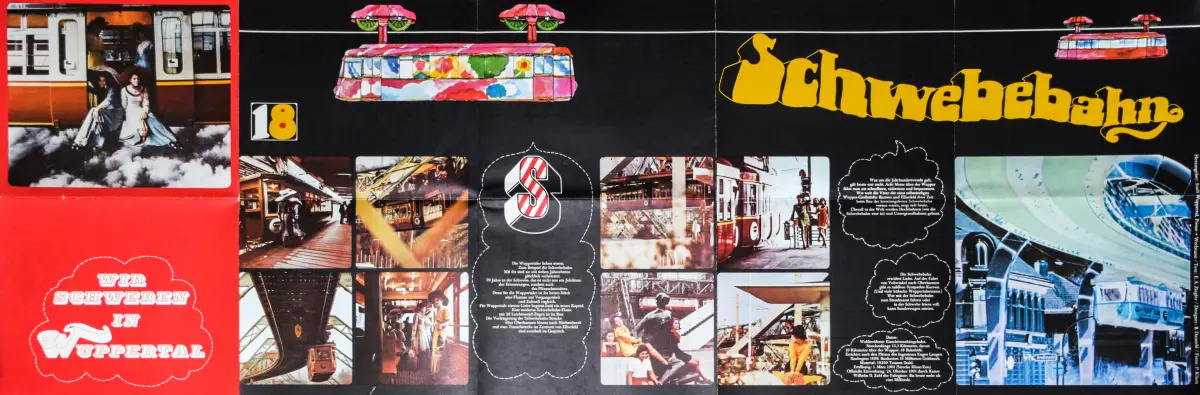
Wir schweben in Wuppertal or ‘We are floating in Wuppertal’. Large poster (four feet long) celebrating the line’s 70th anniversary in 1971.** Author’s collection.
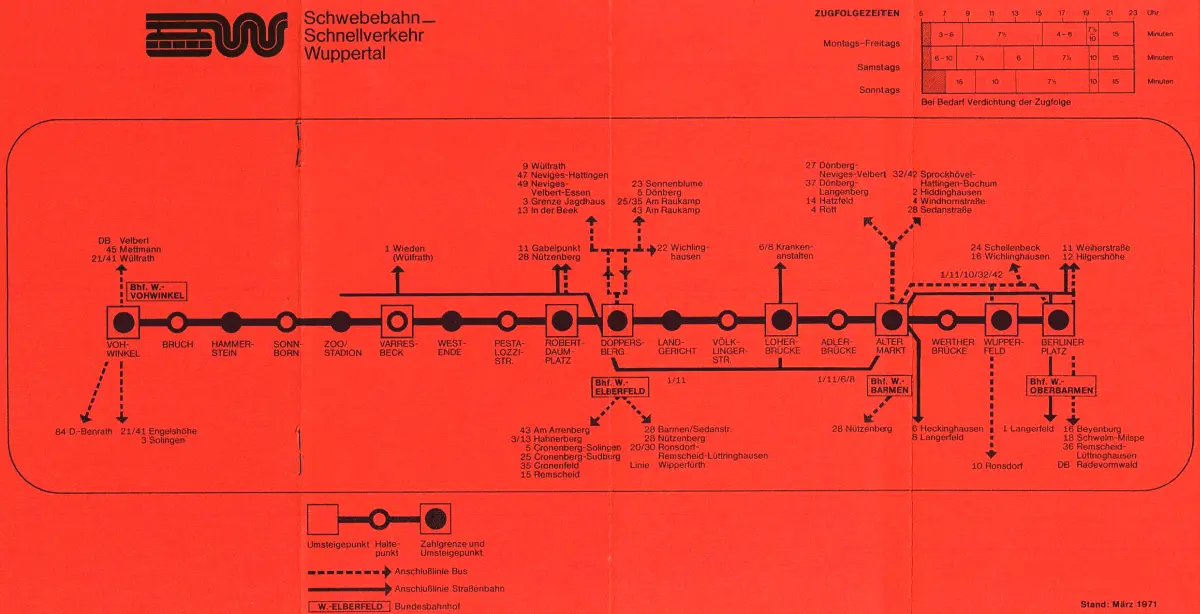
Line map from the 1971 Schwebebahn timetable leaflet. Even in the 1970s the line was classed as Schnellverkehr – eg rapid transit. Author’s collection.
As the author recalls, the stations were fewer in number – some with different names. Doppersberg was initially changed to Wuppertal Elberfeld before becoming Wuppertal Hauptbahnhof, whilst Berliner Platz became Wuppertal Oberbarmen. These changes reflect the fact there is an adjacent station on the DB. Varresbeck is now Varresbecker Straße whilst Sonnborn is Sonnborner Straße.
Stops such as Ohligsmühle or Kluse didn’t exist in 1971. The former, originally known as Alexander Brücke and the older Kluse station were both destroyed in WWII. The Schwebebahn received considerable damage during that period. The Daily Express for 1st July 1943 reported the Allies had undertaken bombing raids on Wuppertal. One of those occurred on the 24-25 June and focussed on Elberfeld. The section through Barmen was destroyed during 29-30 May 1943. The line was rendered inoperable for most of WWI however it was rapidly rebuilt and services restored from Easter 1946.
Ohligsmühle, opened in 1982, is on a new site slightly to the west of the old one. Kluse was originally known as Kluse-Bembergstraße. The original, badly damaged, was demolished along with its defunct turnback system sometime during the early 1950s. Photographs show trains running through the partially destroyed Kluse station during that period. The station’s turnback apparently escaped damage but was no longer used thus its rails were removed. The present Kluse station was opened in 1999.
The Schwebebahn’s wendanlagen or turning systems
This section covers the turning systems (or turnbacks) employed at Zoo Stadion and Kluse. These two locations employed very unusual designs compared to the standard turnbacks employed at Vohwinkel and Oberbarmen.
Kluse was perhaps the more interesting example because it enabled trains to either head along the main line or to rotate and pass through the superstructure on the same level and at practically right angles to the main route. The system was enabled by a set of rotating sections that allowed the track to be set one way or the other.
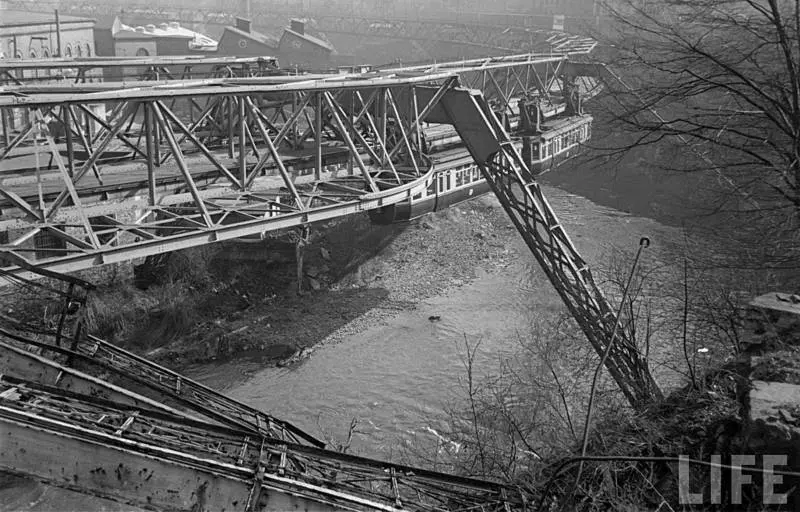
The turnback system at Kluse in 1951. Schwebebahn.de
The track at the juncture of the two alignments was able to rotate to permit trains in either direction. If it rotated to let a train turn, the arrangement worked in such a way a gap was maintained within the structure through which the train’s bogies and hanging arms could pass. The diagram below explains the operation of the Schwebebahn’s turning system at Kluse.
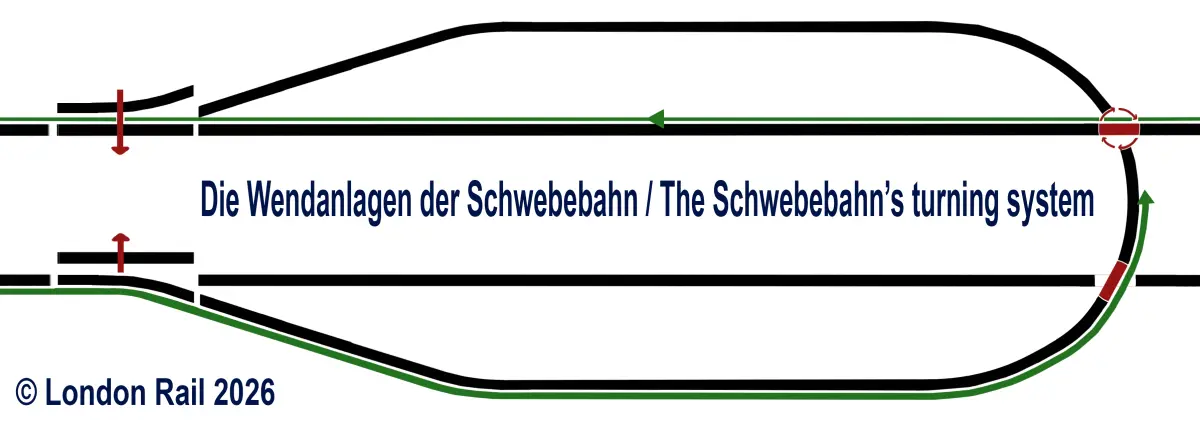
This diagram was prepared specially by the author and shows how a Schwebebahn train’s bogies and support brackets could traverse the main superstructure. The lower half of the diagram shows the route the bogies would take. This is marked with a thick green line. The upper half shows the normal route (a thin green line) taken by through trains. Depending on which direction the train was going the available route would no doubt be duplicated in the other half. In both cases one can see how the rails rotate to facilitate one direction or the other and if a train was turning both rails marked red would be rotated to permit that operation. Often what happened would be that a train would move off the main route and then wait on the approach track for the system to be ready for its traverse. The train would then turn through the superstructure and then await its next service duty allocation towards Vohwinkel.
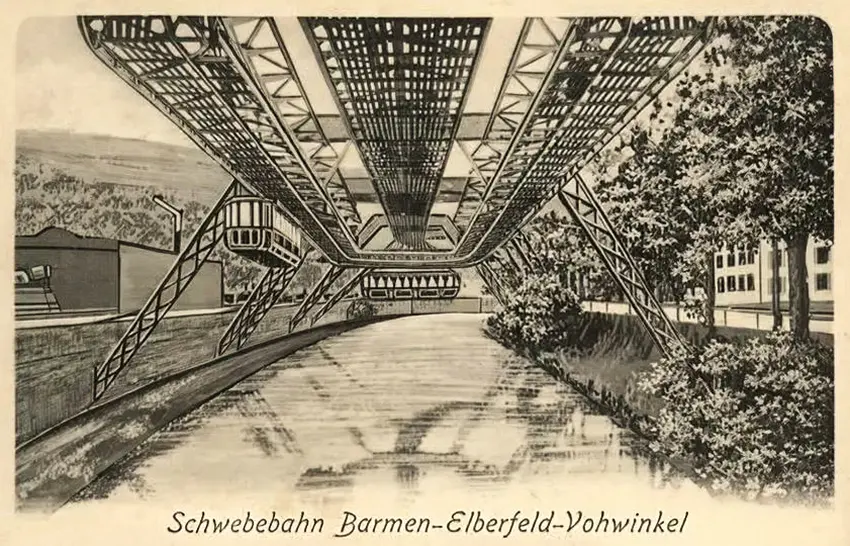
Single cars only! The Schwebebahn’s wendanlagen at Zoo Station is depicted in this view dated May 1904. Image cleaned up from one found at Oldthing.de.
The system shown above applies to Kluse. That for Zoo Stadion was different. The arrangement there was similar to the diagram above – except the line for turning trains back in fact dropped down sufficiently on a gradient so as to to pass under the main route, giving enough clearance for any trains passing across. That very arrangement is shown in the postcard view depicted above. No rotating switches were needed here, however traversers were employed to switch the single cars onto the turnback route. The difference in terms of both systems was that at Kluse enabled both twin and three cars to turn, whilst that at Zoo Stadion permitted single cars only, because the gradients were severe. A number of photographs of both systems (plus the later turntable) can be seen at Schwebebahn.de.
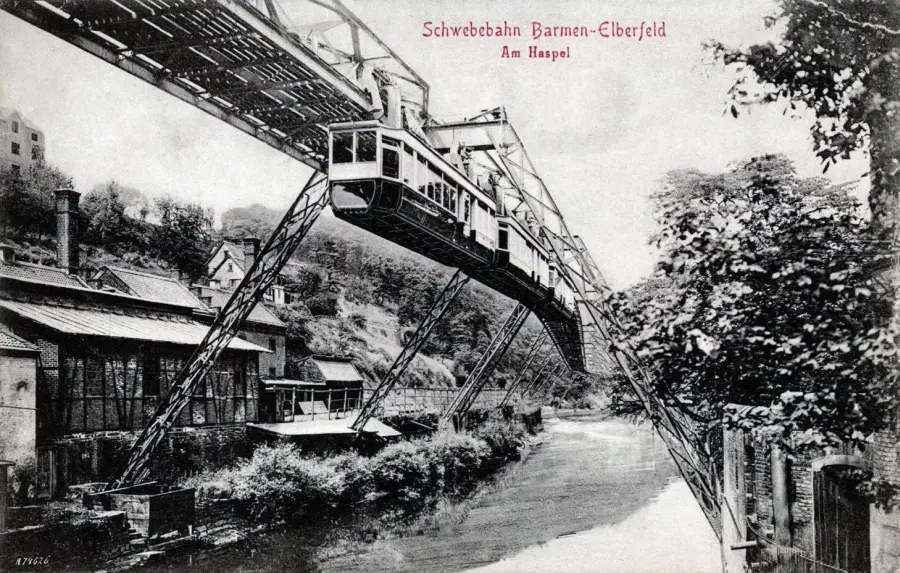
Three car Schwebebahn unit seen in this view from Farbmühle bridge, Haspel c1907. The unit is a Series 03 (twin cars) plus a single Series 00 car. Image found on EBay.
Photographs do show that three car (and even more rarely four car) trains were operated in the early years of the Schwebebahn as were single cars too. The example shown above was captured heading west towards Völklinger Straße station. By 1912 the twin car arrangement had became standard practice, even though three car trains had continued to be used at times until then. Single car units lasted til 1912 despite the decommissioning of the Zoo Stadion turnback in 1903. This structure remained in place until 1951 or thereabouts when it was demolished. Very surprisingly a modern turntable was built on the same exact site 1974. The reason for its installation was the section beyond to Vohwinkel was very lightly used outside busy periods. The turntable proved to be most unreliable and that negated any positive benefits. It was taken out of use during 1994 and demolished in 2002.

The Zoo Stadion turntable was in operation 1974 – 1992 and removed in 2002. Picture shows it under construction. Westdeutsche Zeitung.
In terms of the construction of the Zoo Stadion turntable, it was first assembled below the tracks (as seen in the above picture). It was then raised up and a new and detached permanent way attached to the underneath of the moving section. This Youtube video shows it in operation and one can see how the section pictured in the photograph above constitutes the means by which the turntable operated. If one looks at the above photograph more closely rails around the inner edge of the ring can be seen.
Basically it was like a normal railway turntable in its operation – except the trackage and trains being turned were beneath the structure instead of above it.
The rebuild of Oberbarmen depot
The Schwebebahn has seen an intensive replacement of its superstructure and tracks this last twenty years or so but its actually nothing new. Wholesale replacement of large sections of the line first began in the period after WWII. Some of the more recent and biggest projects took place in 2012 when considerable lengths of the structure were replaced including the entire section at Oberbarmen. Any superstructure replaced is, in most instances, a faithful copy of the original design.
One of the Schwebebahn’s biggest projects in the 21st Century was the rebuilding of the entire section of the eastern end of the line at Wuppertal Oberbarmen. The entire line from Schöneberger Ufer to the site of the new Rittershauser Brücke was rebuilt entirely. Not only that a lengthy section of the railway at Werther Brücke was replaced in the same period too as this video shows. The project entailed a brand new Schwebebahn station and depot (wagenhalle). Essentially these look like the older, except the new station is considerably larger and the tracks are further apart. The new depot is bigger and can accommodate more trains. With the old depot the trains had to turn at the far end of the building, however with the new there is a turning circle just indie the western end as well as one at the eastern end. This permits far greater flexibility in stabling trains within the depot as well shorter turn round times and this arrangement complements the one at Vohwinkel.

The older Schwebebahn depot, next to what was originally known as Berliner Platz station. Google Groups.
Youtube video showing a Generation 72 train entering one of the stabling roads at the old depot. This is a rare video of a train being driven from the other end.
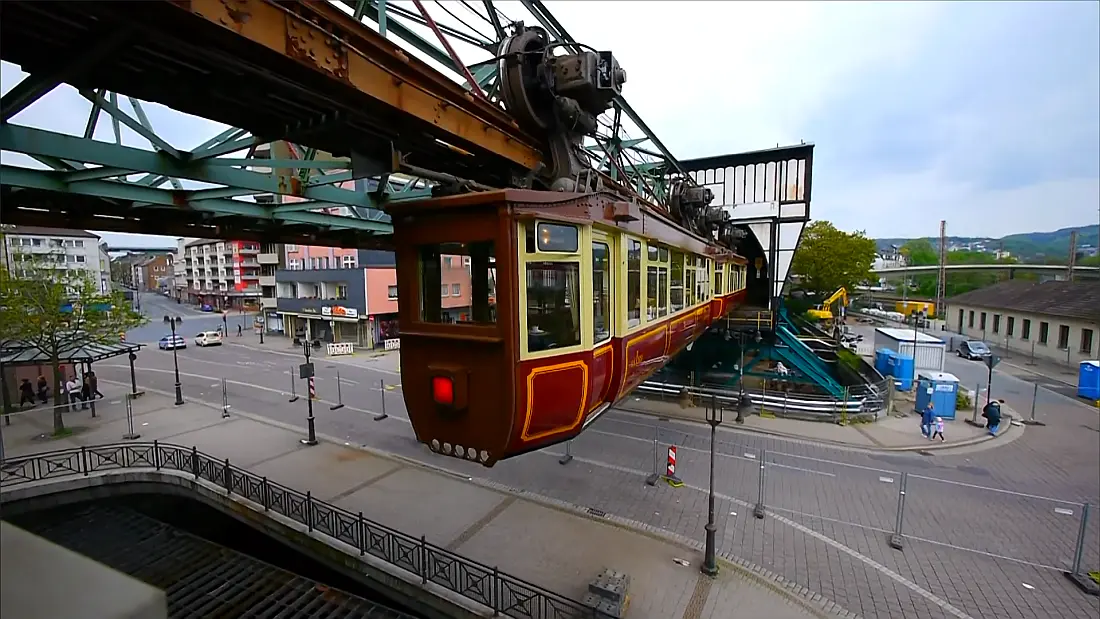
The Kaiserwagen making one of its last ever runs into the old Oberbarmen depot, early May 2012. Screencap from Youtube.
The work enabled the new Oberbarmen depot to be substantially larger thus it could have a turn back loop at both ends compared to the old which only had one turn back loop. The work necessitated the rebuild of Oberbarmen station because the tracks were too close to permit a new turn back to be built, so the new station was built with the tracks further apart in order to achieve the additional turn back necessary at the western end of the depot.

The older Wuppertal Oberbarmen station and depot being demolished to make way for the new. July 2012. Flickr.

The old Oberbarmen depot being demolished. The picture shows it had a double tracked line either side. The outer track was generally the through route whilst the inner track was for stabling.
First trains testing the new turnback at Oberbarmen wagenhalle (plus other ongoing work to complete the project).
The Kaiserwagen using the new, yet incomplete, wagenhalle.
By way of installing a turn back loop at the western end of the new depot, the rebuild more than doubled the stabling capacity of the new depot.
The old carriage shed of the suspension railway is disappearing (Alte Wagenhalle der Schwebebahn schwindet). This is a film featuring the old depot at Oberbarmen including its traversers, mechanisms, controls and how the trains had to travel the entire length of the depot just to turn around.
The Kaiserwagen
Having briefly mentioned the Kaiserwagen in terms of the Kaiser’s re-enactment and one of its last runs to the old Oberbarmen depot, here’s some more detail on the Schwebebahn’s historic train.
The Kasierwagen, what was used to transport the Kasier in 1900, has not been seen on the railway for a number of years. It was meant to be back in service during 2020 however COVID and other problems ensued. It has also been undergoing major work to make it suitable for ETCS operation. The Schwebebahn has been using ETCS since 2019 hence the Kasierwagen must follow suit. The Schwebebahn is the only metro system in Germany which uses ETCS.
The National Railway Museum released a special video on the Schwebebahn the other week. That entailed a look at the Kaiserwagen (no.5) and the work to convert it to ETCS operation. Not mentioned in that film however is the fact the Kaiserwagen rear car (no.22) had to be taken away for some work to be done. Evidently the NRM couldn’t spend too much time explaining the amount of work done – the video below does fill in several gaps however.
The Kaiserwagen made its first run on the Schwebebahn in a long time on the night of 5th September 2025.
Below is what I consider one of the best POVs from the Kaiserwagen. The film was taken in 2012 just before the major works were undertaken at Oberbarmen. The actual Kaiserwagen section starts at 3.15 minutes into the video. The highlights are no doubt the driving of the train and how the original stock employed a unique offset controller. There’s also an exciting run filmed as the train sped high above the Kaiserstrasse!
A history of the line is also related – including the obligatory elephant story! See Wikipedia and Schwebebahn.De. I’ll leave it at that as there’s simply no need to discuss the elephant in the room… sorry… the river!
A comprehensive summer of 125th Anniversary events is planned for the railway. More here at the official Schwebebahn website.
The Schwebodrom is the first ever museum dedicated to the history and operation of the Schwebebahn. More at Wuppertal Schwebodrom.
Leave a Reply