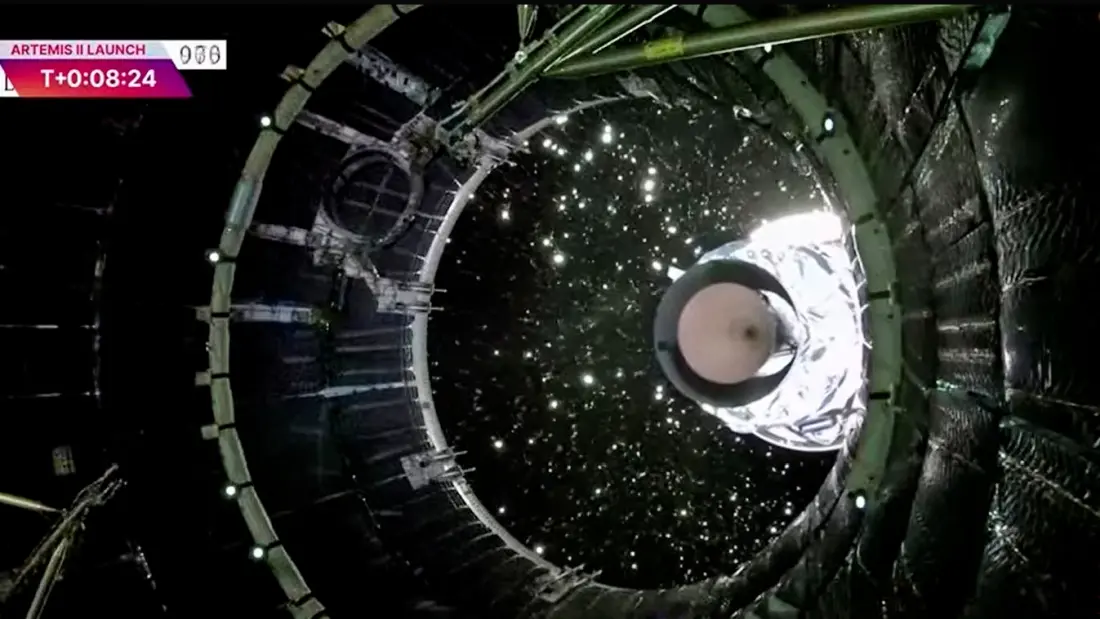
Its more than 50 years – 57 to be exact – since Apollo 11 landed on the Moon – July 21st 1969. In fact it wasn’t the spacecraft itself but rather its lunar module, with Neil Armstrong and Ed Aldrin that landed whilst Michael Collins stayed up in orbit aboard the command module itself. In the UK at 03.45am I watched the moment those legs slowly worked their way down the lunar module’s steps and that became ‘one small step, one giant leap for mankind’. Now we have Artemis 2, which is a sort of rehearsal similar to the even earlier Apollo 8 (December 1967).
With Artemis they’ll break records by venturing further than Apollo 13 (April 1970), but only negligibly. And that given the scale of the solar system indeed the universe itself. Not only that, the preceding spacecraft that had orbited the moon were done in high anticipation of the actual lunar landing which followed quite soon after. With Artemis, even though numbers 3, 4 and 5 are already being built, its simply not known when these will be launched. Thus the question of when an actual lunar landing will take place does sort of dampens the enthusiasm. Seemingly its 2028 maybe before we get to see humanity on the moon once again.
Artemis is no doubt a great endeavour and I am watching it live. However the euphoria and immense sense of excitement is somewhat missing. Going back to the moon seems sort of an anti-climax. It was great to see the launch itself and it was an excellent operation despite some very last minute hitches including batteries that read out wrongly and a perhaps longer than necessary pause before officiating the final ten minutes of countdown. Certainly they were just making doubly sure nothing was amiss. Artemis launched just ten minutes or so after the launch window on April 1st 2026 began so that was good. There was no doubt hesitancy in the preceding moments but when it came to the actual launch it was certainly impressive. The four shuttle engines initially fired and then a short moment after the two booster engines also fired and the lift off was spectacular.
The difference in the moon projects was the Saturn Five no doubt produced a far more dramatic lift off than Artemis.
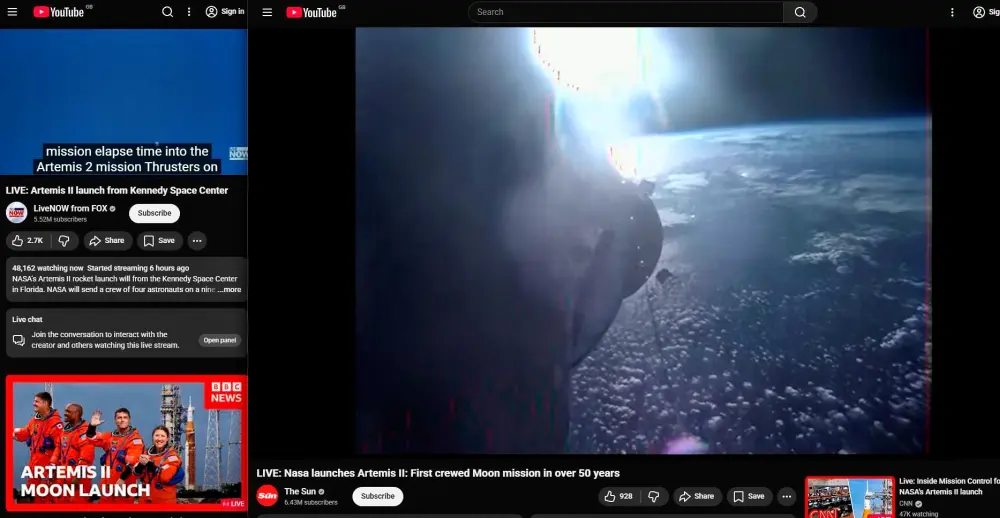
I watch the Artemis program with two or more live streams present and resize these accordingly.
Curiously, while the Apollo program was under way there was also another space program too underway. This was devised to explore mysterious floating objects in the orbit of Jupiter. Such objects had first made their appearance on the Moon itself when one was discovered in the Tycho crater.
And currently while Artemis 2 ventures through space along the short distance to our celestial neighbour, another parallel space program too happens to be underway. That’s the Hail Mary, sent to Tau Ceti to investigate the mystery of astrophages and figure out why these are dimming the Sun.
In these scenarios the ones featuring the actual rocket program involves its astronauts returning to Earth after having orbited the Moon, whilst the others (on celluoid no doubt) involved space farers who had voyaged far beyond any possibility of their returning to Earth.
This is the difference. The technology envisaged in those other hugely substantial projects (if only they were) is how things are way beyond anything we have seen in both the Apollo and Artemis programs. Discovery and Hail Mary both entailed spacecraft which could sustain themselves for enduring journeys, whilst Apollo and Artemis entail those that are only suitable for short blips out into space. Not only that most of the control and oversight has to be conducted from Earth.
Its what we call progress!
There’s some who will claim that both the 1960s moon programmes were fake. That is the Apollo and the TMA-1 missions. Evidently Kubrick filmed many shots for the purpose of faking the moon landings. He was no doubt the perfect guy for the job having rendered the moon so excellently for his ‘Journey Beyond the Stars’ epic. Many continue to get totally suckered by claims of the moon landings having been faked. And they use photographs as evidence of the fakery that was involved. If they had lived in the sixties and dutifully followed the Apollo programme, they’d have not thought for one moment that the moon landings had been faked!
And now we’re going back to the moon! Well at least the fakers will have a damn hard time trying to prove Artemis 2 never went to the moon!
Indeed they are out there trying every means to discredit anyone’s notion the Artemis 2 mission is real!
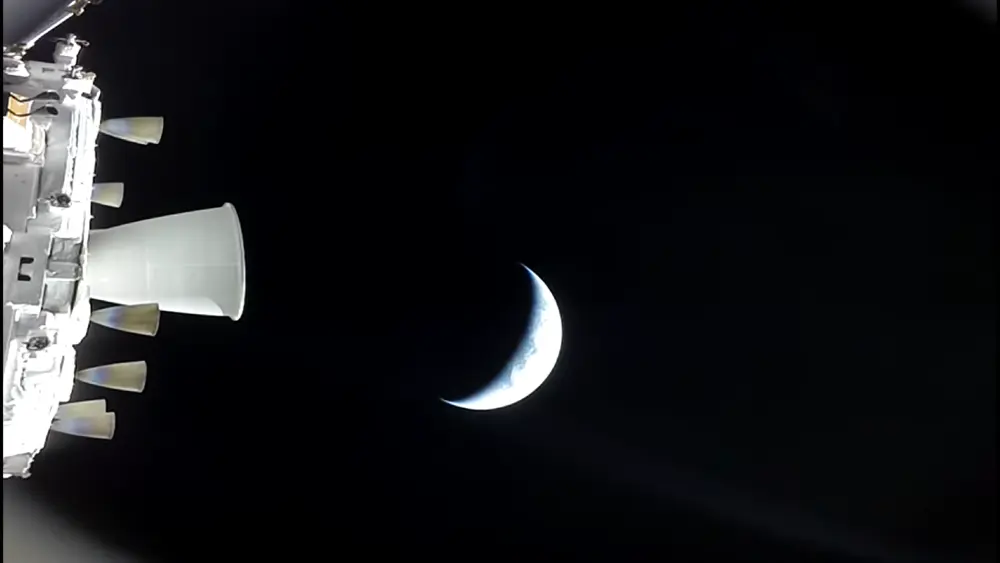
Orion’s thrusters with the Earth visible. Approximately 11.12am BST.
At the other end of the scale, Artemis 2 shows just how slowly the wheels of progress in humanity turns. Both 2001 and Hail Mary showed humanity at the limits of potential technology. Yes we have a space station but its not what was envisaged in 2001, (or perhaps rather, 1966-67, which is when the filming was done), let alone the actual year 2000 when the International Space Station (ISS) first saw proper long term occupancy. It doesn’t even have gravitational potential which is what long term space flight needs. The ISS is soon expected to fall from grace – it has four years of remaining use – and by 2031 it will have decoupled from its low Earth orbit, before being partially burnt up and the remains will drop into the Pacific Ocean.
The next ISS (Axiom, Orbital Reef, Star Lab, Haven 2 and other projects – not forgetting the Chinese already have their own operational space station) seems as if it will be a sort of continuation of the philosophy behind the first ISS. Research, innovation and the rest of it leading up to even bigger projects in the future. As for gravitational potential, well that seems pretty far off still. The big difference is commercialism is now being given a substantial hand in planning and designing space endeavours. Artemis is largely a product of commercial innovation even though NASA still has considerable oversight of the entire project. In the last few years Space X and Blue Orgin have been the most well known. Space X with its returnable boosters and rockets bigger than Saturn 5. Blue Origin with its mini trips to the edge of space. Sadly Artemis did not employ returnable boosters like the others. Instead those dropped into the ocean, to be possibly recovered at a later date, if ever.
One wonders whether humanity will actually get there. By there I mean anywhere. The Moon, Mars, Jupiter, Alpha Centauri, Tau Ceti even. Its an expensive endeavour and as some insist, the enormous expense would serve so much better on Earth benefitting millions – rather than a select few. NASA is going to the moon again because, well, they don’t want to be outshone by the Chinese or any others! In a sense that indicates somehow they’re doing Artemis just for the sake of competition – and not as a passion for exploration and innovation. There’s a big difference!
Retrospectively, any excitement for the Artemis mission is also followed by huge disappointment. Its not even on the scale of the earlier Apollo missions and that because in terms of progress things ought to have been so much more bigger. Artemis is sort of our having once dipped humanity’s toes in the water, we’re getting to do it again. Same difference essentially. Will the ripples this time be much bigger? Only time will tell whether this new moon mission carries so much more than the Apollo project ever did and truly proves its worth.

Artemis II logo. Wikipedia.
Bless the Orion and all who sail in her.
London Rail – other space posts
Other posts have previously covered space topics including Space X, Boca Chica, the 50th anniversary of the Apollo project (two different posts) and several others including one featuring the 2001 ‘hotel room’. These are currently not available – except one done for the 50th anniversary of 2001 A Space Odyssey and another being The problem of Space Travel. One of the 50th Anniversary posts has been reuploaded this week and its this one – The Moon 1969. There are two others – 50 years since we went to the moon – a proper historical account of the 1969 moon landing. The other also found – The Moon Landings Fifty Years Later – is an account of the newspaper coverage during 2019 that looks back at 1969. Have just discovered these drafts that were almost finished (either need a bit of editing or a couple of pictures added). Neither post was ever published back in 2019 and they have since been all but forgotten! I’ll aim to complete at least one of those and publish it for Easter 2026.
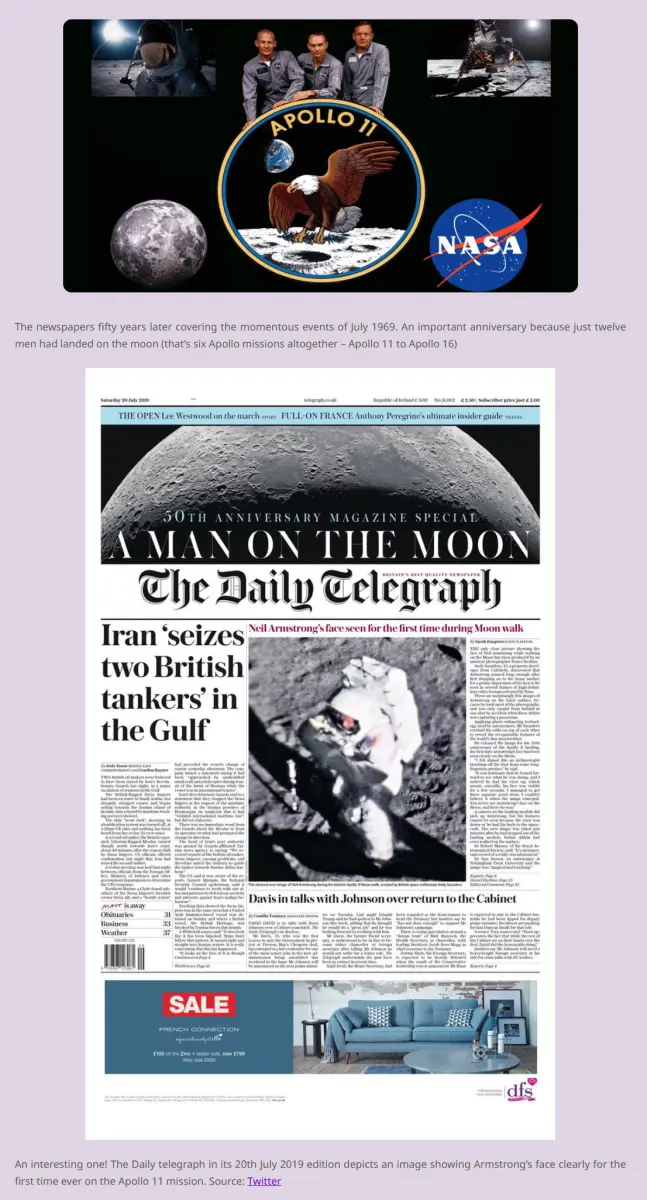
The unpublished Moon Landings Fifty Years Later – covering the 2019 reportage on the moon landings some fifty years earlier. Astute readers might spot that its been written there were six moon landings up to Apollo 16 – which is of course incorrect. That should read to Apollo 17 – because Apollo 13, despite its huge fame in the face of the almost impossible difficulties encountered, was in fact an aborted mission.
Leave a Reply