Remember the post A Revisionist Surrey Iron Railway? This post goes further that the detail featured in the previous one – and that because its not a revision in any way or form. In fact its a prequel of sorts to the Surrey and Croydon to Merstham iron railways. And that means its both factual and historically correct!
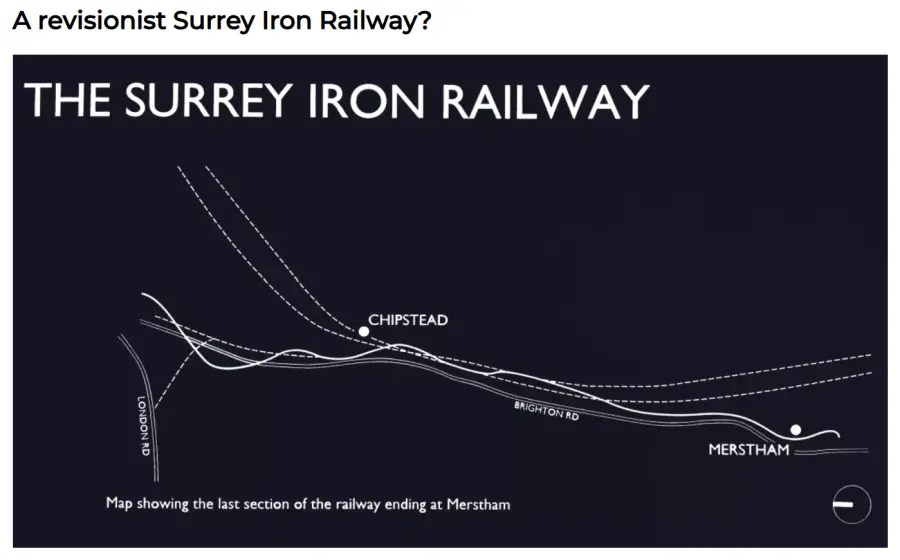
The previous post – A Revisionist Surrey Iron Railway – described the presence of five information boards that carried quite a number of errors in regards to the history of the Surrey and the Croydon Merstham and Godstone Iron Railways. The above image shows one of those boards with the line wrongly aligned at the Merstham end.
The history of railway development in Britain is a tapestry woven with threads of innovation, ambition, and sometimes, unforeseen challenges. Among the many lines that contributed to the nation’s industrial and social transformation, the Surrey Iron Railway holds a unique, albeit often overlooked, position. History is not always about the grandest nor the most famous lines, but also about smaller ventures that paved the way ahead.
Whilst the Surrey Iron Railway was a pioneer no less, its sibling route, the Croydon Merstham and Godstone Iron Railway could not be more in contrast. The former was considerably built upon a flat and undulating route, whilst the latter had to be built through hilly country – which involved engineering work to keep the line reasonably level.
In terms of ‘flattening’ something, well that could no doubt be done with the Surrey Iron Railway but not as easily with the Croydon, Merstham and Godstone line. Curiously some remarkable remains of the Croydon to Merstham route exist when compared to the other – which has none to speak of. The most historic remains are those at Coulsdon that forms of what once a substantial embankment stretching right across the Chipstead valley – but there are also cuttings and bridges that remain extant.
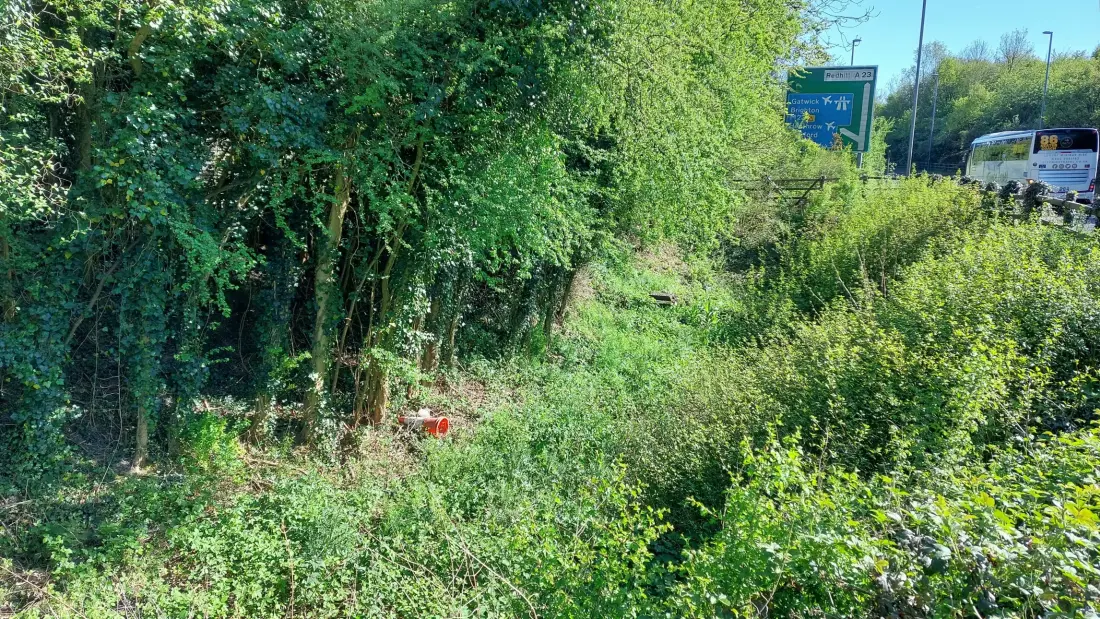
Oh to be beside the seaside! Or maybe off to Malaga for a sunny holiday! Thousands daily pass this section of railway cutting dug 1803-1805.
For example, thousands of drivers, trippers, passengers aboard buses and coaches will no doubt catch sight of a short section of declivity that serves no apparent purpose as they speed towards the start of the M23. This is the first of four detached cuttings belonging to the Croydon, Merstham and Godstone line that remain. Unlike the Coulsdon embankment, none of these cuttings or their extant bridges are classed as historic of any sort. Its a shame because during the 1950s there were moves to get the cuttings listed as a national monument due to their quite considerable age in terms of UK railway history. And that sadly because with the advent of M23 the cuttings got chopped, reshaped and had deep shafts sunk at various locations in order to fill in bits of mine workings that had threatened to halt the M23’s construction. Not only that, the M23 has a length of motorway that cuts right across one of these cuttings but goes nowhere in fact! Oh the irony of roads!
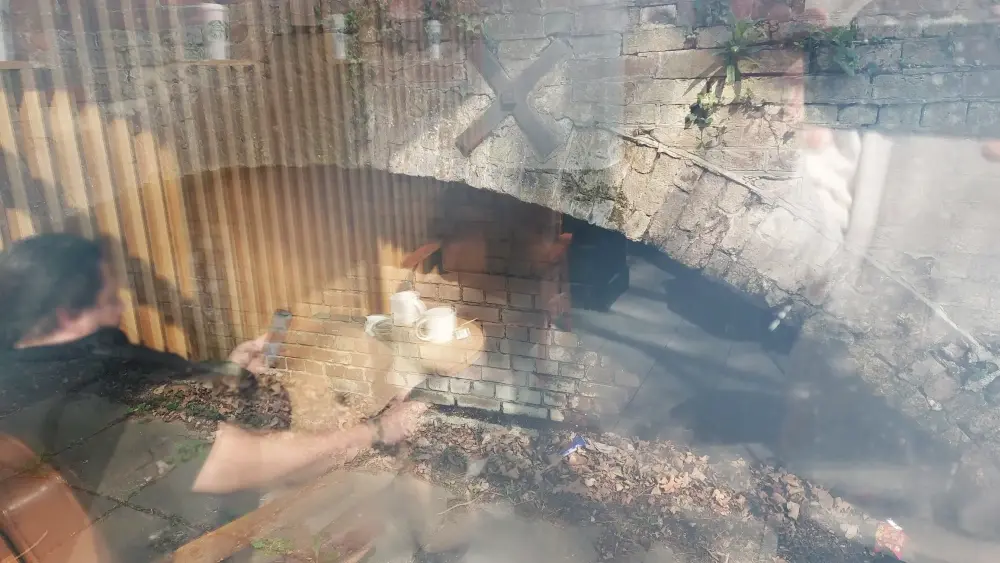
The modern affliction of caffeine repose whilst attentively scrolling smartphones, yet a railway bridge of 1805 warrants no attention of any sort…
Besides mysterious motorway stretches that lead nowhere, advocates of coffees and other beverages can use an opportunity to lighten the pressure on the gas pedal – and whilst they repose at a certain Starbucks in Hooley, they can sample the delights of one of the iron railway’s remaining bridges. That is if they even know what its for! There’s nothing to describe or denote this even though its practically the one and only earliest remaining railway structure in the south of England and built 1804-1805. But what is a largely buried railway bridge when viewed through the confines of a coffee house’s glass veranda anyway? The coffee is no doubt more important as are the laptops and constant scrolling that most would get up to. Indeed, few, if any, would turn their attention to this mysterious structure that stands before their very eyes.
And its back to Coulsdon… but first a map. Mustn’t get lost! And that because it’s not exactly easy to find the more important and undoubtedly historic remnant that once carried the iron railway to the quarries at Merstham. This location is where those ‘revisionist’ information boards mentioned earlier are to be found.
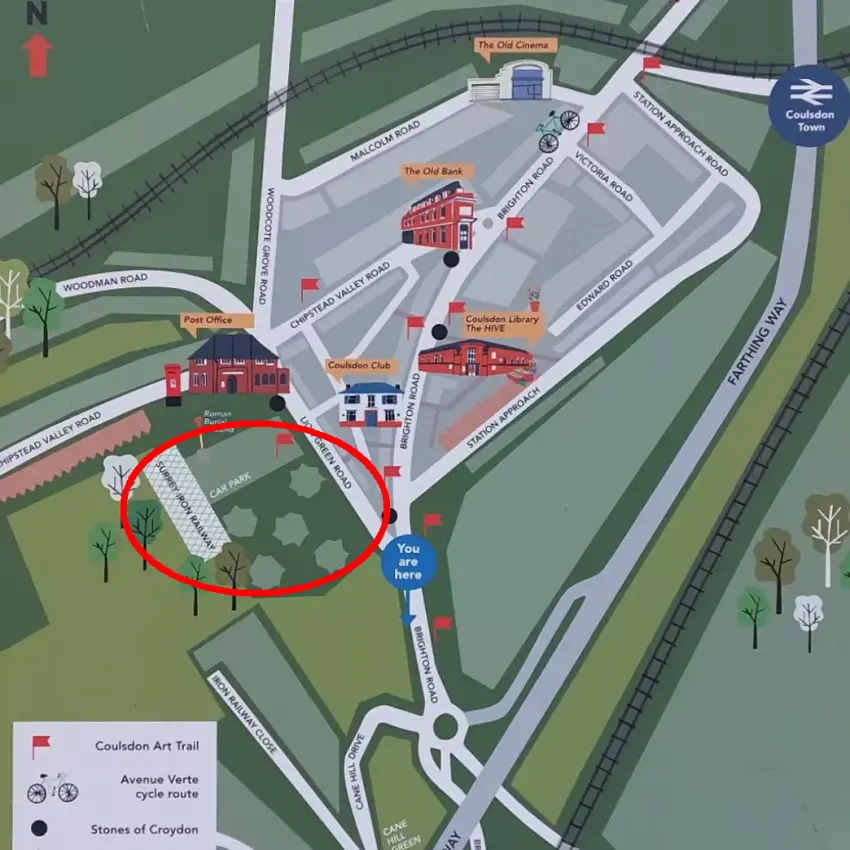
Map of Coulsdon centre showing the location of the new housing and the iron railway’s embankment.
In terms of that revisionism, what is is is the previous London Rail post had highlighted a series of information boards that were quite grossly wrong. These are to be found at the Red Clover Gardens just off Lion Green Road, Coulsdon. This modern housing development has the remains of one of the country’s earliest embankments which forms a substantial background to the properties. Take a mooch around the development and one’ll find five information boards on the iron railways that are quite grossly erroneous.
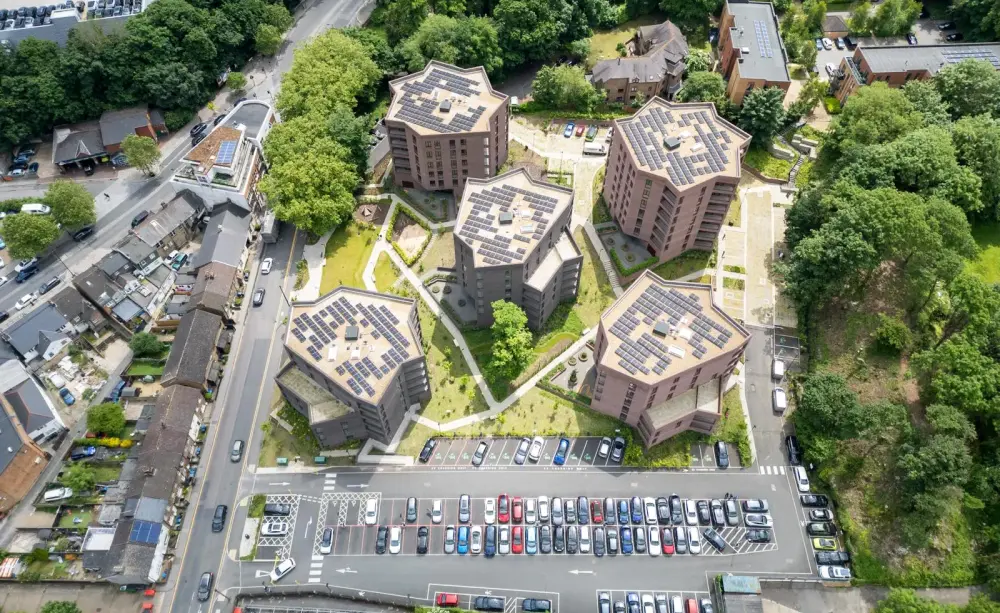
Red Clover Gardens in Coulsdon with its five star shaped blocks visible. Lion Green Road is at left and the former railway embankment is at right. At the bottom is the car park depicted in the next picture. The estate has five of these Surrey Iron Railway panels – one for each of the blocks – and every one of these contains errors. Aerial image from Regen Capital Limited.
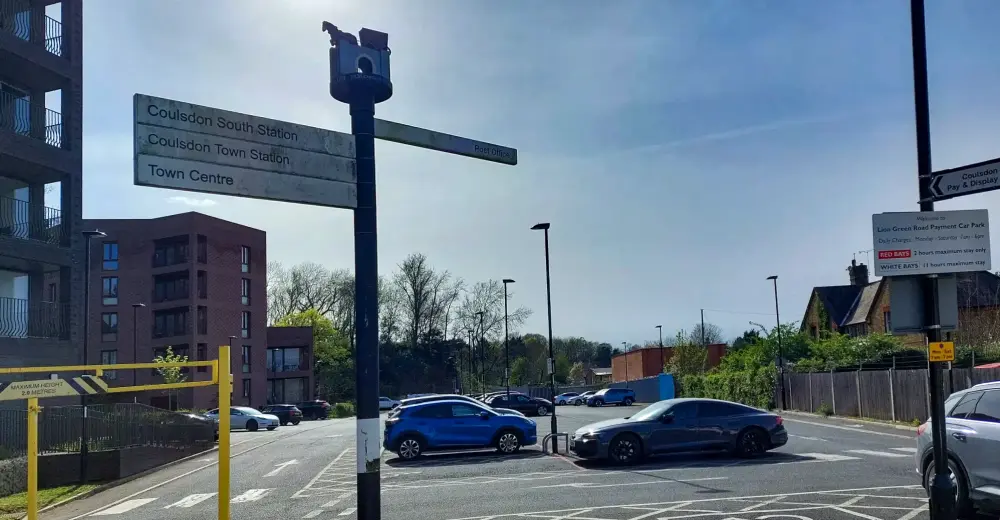
Adjacent to the car park hereabouts on Lion Green Road can be seen this signpost with a miniature model of the tall archway that was built through the iron railway’s embankment. At the far end of the car park can be seen part of the embankment.
What are the actual anniversaries of the two iron railways?
Its generally agreed the The Croydon Merstham and Godstone had closed during the autumn of 1838. However in the picture shown below, some insist it was 1839. There is nevertheless considerable indication the railway operated at least until the end of the first quarter in 1839 in order to facilitate construction for the new London and Brighton line. The original ‘tramway’ stock, by being too high sided, was replaced by lower sided rectangular shaped waggons suited to the needs of intensive railway construction.
The Surrey Iron Railway officially opened in 1803, however it was operable from mid 1802. Both archival records and railway historians give either one of two dates, so its not certain when that pioneering line had first opened. In converse to that, there’s no doubt the Croydon Merstham and Godstone line had opened on 24th July 1805. As for its closure, well that’s once again another matter. It could have been as early as October 1838 or at some point in 1839. Some (eg Croydon Council) use 1838 as the year the line closed, whilst others (eg Surrey County Council) use 1839 instead.
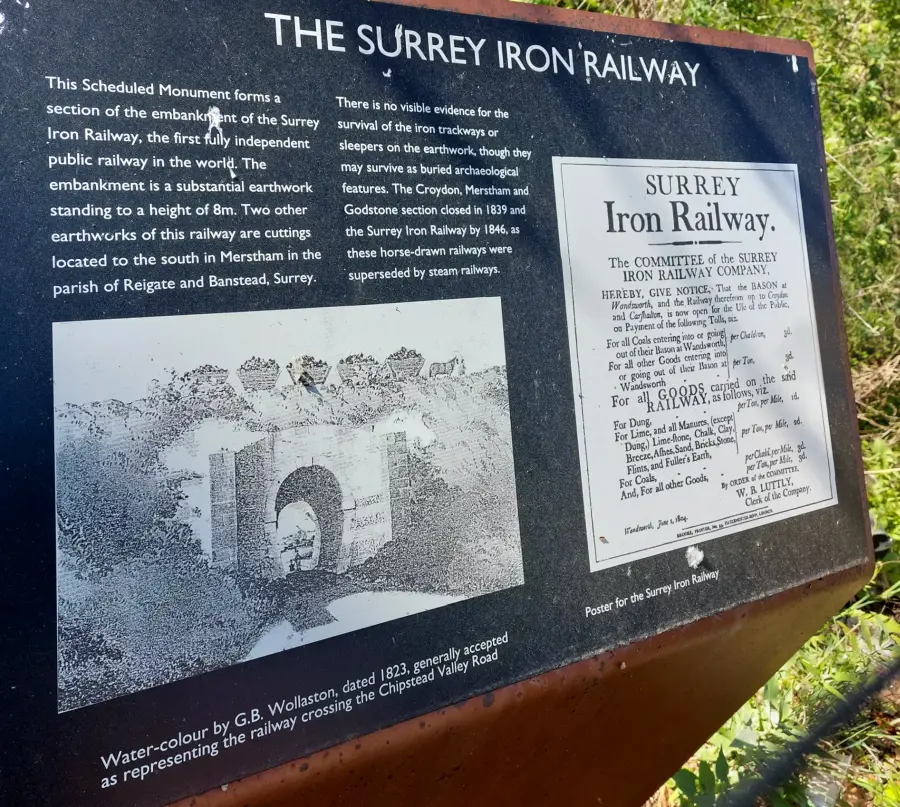
Up on the embankment itself there is a viewing point of sorts which is reached by a flight of steps. A sixth information panel is sited here. Its an older one and is essentially free of errors. ‘Surrey Iron Railway’ is no doubt a common name used for both lines, even in history when both lines were referred to as such. On this board one can also note the years the railways were closed – the Merstham line in 1839 and the Surrey in 1846. Only the latter is the definite article.
The one other certainty in any respect of either railway’s closure happens to be 31st August 1846 when the Surrey Iron Railway ended operations. The only other definite date for any of the iron railways happened to be that for another – for there were three of these in fact. That other was the short lived Croydon canal tramway that formed a triangular junction with the other two lines at Pitlake. This line ventured north east to reach the canal’s terminus where West Croydon station now stands. As mentioned in the Courier newspaper for 30th January 1812, the opening of this line took place on 17th January 1812. The Croydon canal tramway was a horse drawn waggon plateway very much like the other two, however there is some thought it employed a rope worked incline on part of its route. If that is indeed the case, then Surrey not only has some of the earliest public railways but also the very first rope worked example to be found in the south of England.
A preamble on the Croydon Merstham and Godstone Iron Railway
Authorized from Croydon to Reigate, with a branch to Godstone and Bletchingley, the 4ft 2in gauge plateway reached the quarries at Merstham but no further.
The railway was horse-drawn, designed primarily to transport heavy goods like chalk, lime, and stone. After thirty three years of use the line was closed to the public and purchased by the London and Brighton Railway Company. The original company was dissolved in 1839. In that same year too after being used by the London and Brighton company for the construction of its new railway, the iron railway was dismantled.
The construction of the Croydon Merstham Godstone Iron Railway was a testament to the engineering challenges of the era and it opened in 1805. It was primarily designed for horse-drawn wagons which were no doubt considerably faster and more efficient than traditional cartage. In comparison to the Surrey Iron Railway which relied on various animals including donkeys, the more strenuous Merstham line relied entirely on a sturdy fleet of horses. Either way the system was still subject to the limitations of animal power, including the need for frequent rest and physical strain on the animals. The infrastructure, with its cast iron rails, was also susceptible to breakages and wear, requiring constant maintenance.
The mid-19th century was a period of explosive growth in railway construction. Numerous companies were formed, laying down extensive networks of lines that crisscrossed the country. The Croydon Merstham Godstone Iron Railway, while an early pioneer, found itself a relatively small and isolated entity in this rapidly expanding railway world. Its original route, while functional, was limited in its reach and its connections to the wider network. The development of larger, more ambitious railway companies, such as the London and Croydon and thence onward to Brighton began to have impact. The iron railways had no means of countering the faster and more modern steam hauled railway thus there was no alternative except to cease operations.
The Croydon, Merstham and Godstone and the Surrey iron railways will be looked at in forthcoming posts.
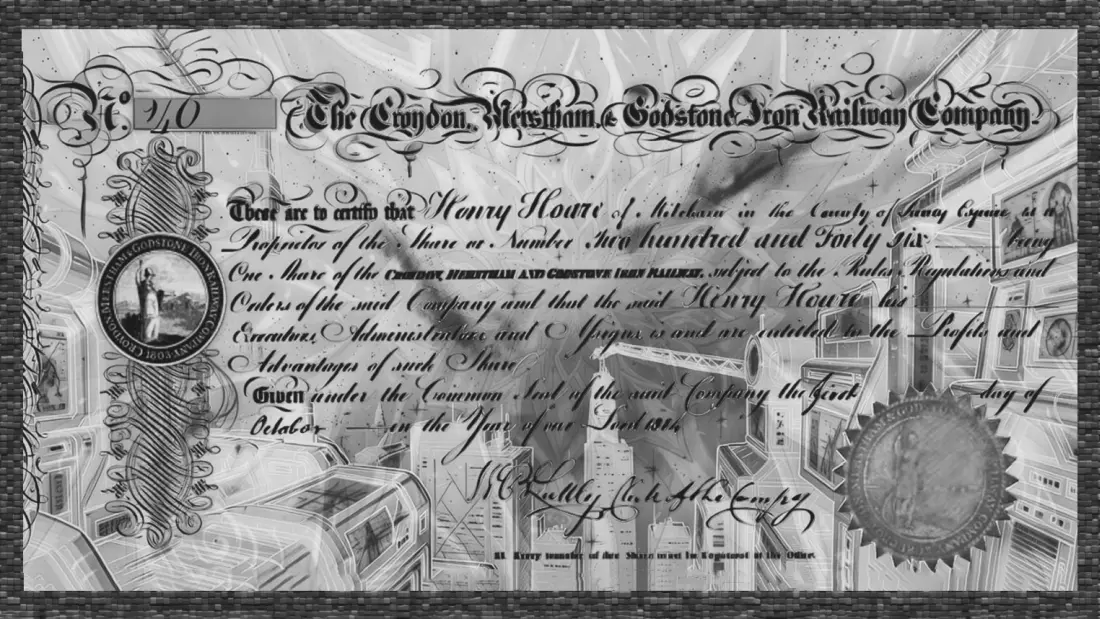
The highly stylised feature image by the author shows a Croydon Merstham and Godstone share – and altered as such because its provenance/copyright isn’t known. Factual and historic illustrations of either line are almost non-existent and barely any are to be found in the public domain, thus this from Surrey Archives Centre was used as the basis for the feature image.
Leave a Reply