This is the third instalment that contains a history of the Surrey iron Railway. A hundred and eighty years ago on this day, this being the 29th August 1846, notices were put out that the railway was to close with almost immediate effect. The iron railway shut its doors a mere two days later. Let it be said that the line from Wandsworth to Croydon wasn’t exactly a free-for-all even though it was denoted a public railway. Wagon owners had to comply with certain aspects and even before they could run any wagons on the line they had to first pay their tolls. There were efforts to maximise the carrying potential of the iron railway by way of having a multitude of wagons in one train and also building the largest possible wagons that would be capable of using the line. There were also special wagons that were designed for quick loading and unloading.
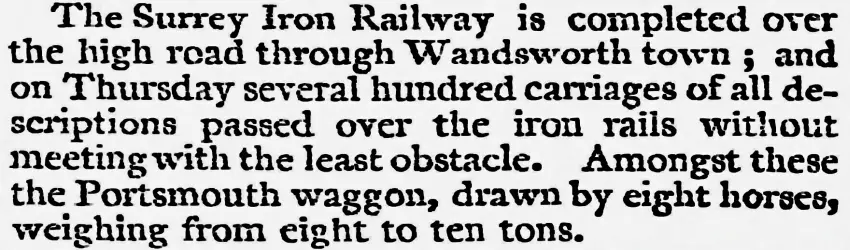
The Portsmouth waggon mentioned in an account of the opening on 3rd June of the railway at Wandsworth. Bury and Norwich Post 9th June 1802.
This wasn’t the only effort at attaining herculean amounts of tonnage on the line. In 1805 a bet was made by Edward Banks that a common horse could pull a set of wagons with thirty six tons of goods for at least six miles on the iron railway. The Sutton and Epsom Advertiser (28 May 1959) says it was no ordinary horse, known by the name of Atlas.“That he should draw this weight from a dead pull, as well as turn it around the occasional windings of the road”.
The challenge was made on Wednesday 24th July when twelve wagons were employed. The consist was towed from Merstham to Croydon in an hour and forty one minutes. En route a further four wagons were added, giving a total weight of over 55 tons. The date of 24th July is confirmed by a report in the Morning Chronicle on 27th July 1805.
Its been said this feat influenced Richard Trevithick’s idea of a steam locomotive for hauling lengthy trains upon a iron plateway. A successful experimental run took place on 21 February 1804. Some, including Samuel Smiles’ Lives of the Engineers (1879) and Rupert Sargeant Holland’s Historic Railroads (1927) suggest Trevithick had built his famous steam locomotive for the Penydarren tramroad as a result of the Merstham wagon event. Since the feat occurred at the opening of the Croydon, Merstham and Godstone line on 24 July 1805, its impossible for Trevithick to have been inspired by an event that had occurred in the future!
One curiosity regarding the stock used upon the Surrey iron road appears to be a type whose detail appears to have been missed out. Generally the style of waggon depicted is a typical four wheel type that has a fair commonality across the numerous plateways or iron tramroads of Britain. In terms of the Surrey, it appears to have had an unusual type in use besides the normal style of waggon: “Some of the waggons hereon have their fore-wheels placed quite forward, and the hind-wheels nearly under the middle of the waggon, by which means stones, etc. can easily be shot out of them when required.” (Cited from The Cyclopaedia Or Universal Dictionary of Arts Sciences and Literature, 1819. Available at Google Books).
When it was first built the iron railway had been the best way to convey goods between Wandsworth and Croydon. From the 1820s onward roads began to be improved and allow heavier loads. These consisting of either macadam or asphalt meant that the SIR faced serious competition well before the advent of the railways proper. Paying tolls for the right of use upon a plateway limited to where one could go was a no-brainer compared to an improved road network which was also toll free.
Joseph Priestly describes the Surrey Iron Railway (SIR) in his celebrated book ‘Historical Account of the Navigable Rivers, Canals, and Railways’ of 1831 as a communication between the Wandsworth basin in Ram Field and Pitlake Meadow in Croydon, connecting with the Croydon, Merstham and Godstone Iron Railway.
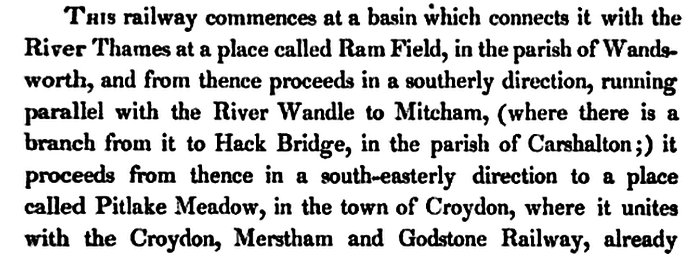
Priestly describes the Surrey Iron Railway in his ‘Historical Account of the Navigable Rivers, Canals, and Railways’ 1831.
This railway commences at a basin which connects it with the River Thames at a place called Ram Field, in the parish of Wandsworth, and from thence proceeds in a southerly direction, running parallel with the River Wandle to Mitcham, (where there is a branch from it to Hack Bridge, in the parish of Carshalton;) it proceeds from thence in a south-easterly direction to a place called Pitlake Meadow, in the town of Croydon, where it unites with the Croydon, Merstham and Godstone Railway, already described in this work, and called in our map the southern part. The basin is about a quarter of a mile long, with a lock next the Thames, and is sufficiently spacious to hold thirty barges or more at once. The length of this railway is nearly nine miles, with no where a greater ascent than about 1 inch in 10 feet. It was the first public railway constructed near London, and the expense of its construction, including lock, basin and branch, was estimated by Mr. W. Jessop at £33,000. (Google Books).
As early as 1809 there were concerns that the iron railway was not paying its way. Traffic was said to be very light and generally if there was any it was mainly in one direction with empties in the other. Several contemporaries put forward theories why the railway was not the success it had been hoped. One of the reasons was that the wagons were extremely heavy and too small also. Not only that, the cost and effort in transfer of goods from/to the railway appears to have made people prefer the use of an improving road network as opposed to using these on a fixed, inflexible route, for which a fee was payable.
“Sanguine hopes were entertained of the undertaking, but it never realised any adequate profit for the proprietors.” 1
As for sanguine, no-one was flocking to buy shares in the Surrey iron Railway. In the earliest days there was no doubt shares were bought – but soon enough people were trying to flog off their worthless shares. After 1825, judging by the advertising in the newspapers, attempts to flog off any shares in the railway increased considerably.
The company itself confirmed that a dividend hadn’t been paid since 1825. The Official Act that was made law on 3rd August 1846 in order to wind up the iron railway cites “traffic along the said line has ever since the completion thereof been very small, and has of late years been gradually diminishing, and since the year 1825 no dividend whatever has been declared upon the shares in the undertaking.”
In 1830 the London and Paris Observer said of the iron railway that “weeds and grass had grown over it, and there appeared to be no traffic”. There were complains the lack of maintenance caused problems at the line’s many crossings where broken track caused difficulty for road users.
The expense of using horses to draw the wagons led to further economies and donkeys, or mules, being used. These were less efficient – but could endure more abuse. In a sense the line’s fortunes became so precarious that anyone who ventured upon it preferred the use of animals that could be dispensed easily. It was even said that‘ lean and half starved horses’ (Google Books) were a means of haulage. Doubtless these half starved horses were soon substituted by less agile animals that faced greater abuse.
As to the motive power of the establishment, it was not of an imposing order. Miserable teams of half starved and worn-out horses, donkeys and mules constituted the locomotive department. What little traffic there ever was, and the line was a deplorable failure from first to last, consisted of coals and manure brought to Wandsworth by river, and in the other direction lime, fuller’s earth and stone carried down from Merstham to Croydon by a similar railroad belonging to a different company. (Railroad Gazette 1901).
The Surrey Iron Railway railway soon came face to face with the rumblings of the steam railways. In September 1845 the northernmost extremity of the Surrey Iron Railway was truncated for the purposes of building the Richmond and West End Junction Railway. Curiously the adjacent canal would be provided for in terms of a viaduct consisting of twenty arches, each twenty six feet wide, and one of those would cross the canal itself. The iron railway company had already seen another line, the London and Croydon Railway, opened in 1839 and that had snuffed out any remaining traffic at the Croydon end, its own extension to Merstham having already succumbed to the London and Brighton Railway.
The Surrey Iron Railway too was nominally bought the railways – that is purchase for a minimal sum pending a decision on what to do with the railway and its land. According to Charles Lee (author of The World’s First Public Railway) the South Western Railway acquired the Surrey Iron Railway during 1844 with a view to effecting use of the route for a new railway to Croydon. Those plans were dropped and in 1845 the iron railway was then passed to the Brighton railway who then intended the iron railway be used for an alternative route off the Brighton line to London. These nominal purchases were rather more a claim to ownership of the line pending subsequent agreements and actual purchase of the business.
The Surrey Iron Railway hung on in the hope some new railway company would make use of its route but neither the Brighton nor the South Western companies found the route of the iron railway suited for any expansion plans. The Wandle Museum details these to and fro activities the old order had been subjected to during its final years – as shown below.
On 1 October, 1844, the L.&S. W. R. directors signed an agreement for the purchase of the Surrey Iron Railway, and on 5 October they instructed their engineer, Joseph Locke, to make a survey of the Surrey Iron Railway, “with a view to an application to Parliament for power to convert it into a railway applicable for Locomotive Engines and Carriages.” The L.&B. R. directors became more involved in the scheme when on 4 November they instructed their engineer, John U. Rastrick, to prepare plans, based on Locke’s proposals, for the connecting line, and ordered their solicitor to prepare the Parliamentary notice of intent. This, dated 8 November, 1844, was duly published a few days later. There was no specific mention in the notice of an alliance with the L.&S.W.R. Company, and this may be indicative of an impending rift between the companies that was soon to open.
In pursuance of the arrangement with the L.&S. W. R. Company for the purchase of their line, the Surrey Iron Railway Company published a notice of their intention to apply to Parliament for a Bill to enable them to abandon the railway, sell the property, and dissolve the company. This was also dated 8 November. [Wandle Museum – The End of the Surrey Iron Railway].
In view that none of these prospective purchases had materialised, during early 1846 B. C. Luttly, Clerk and Solicitor to the iron railway company put out numerous notices in the various newspapers advising of the company’s intent to end all operations. This would take the form of a bill to repeal the three Parliamentary acts it had been bound by and to seek powers to enable it to sell its entire inventory of assets plus extinguish all rights that had been conferred upon the said railway.
After approximately 44 years of existence all traffic was to come to an end. The sought for act was duly passed to enable the railway’s closure to take place and the company to be wound up by 1848. The end came quite suddenly for the Railway Times for Saturday 29 August 1846 held a brief announcement amongst its pages: “SURREY IRON RAILWAY – The passage of waggons on this line will be stopped on Monday”.
It seems it took a while for the railway to even be taken up. Legal matters no doubt had to be seen to. In early December 1846 the company duly announced its permanent way would be taken up and stacked at Wandsworth for inspection and possible purchase.
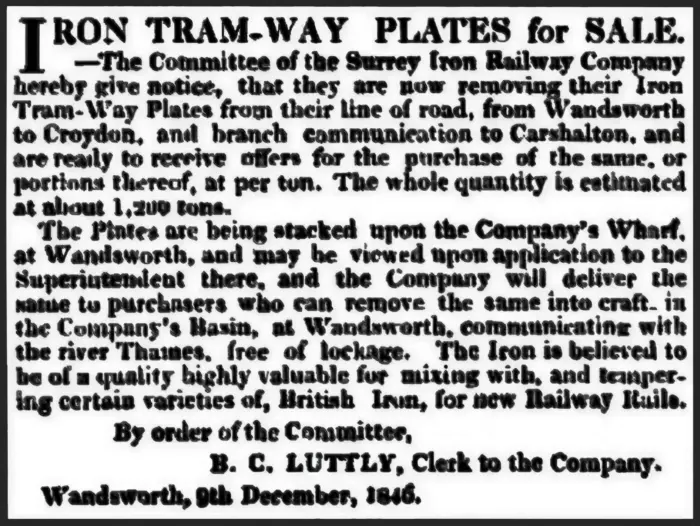
The Surrey Iron Railway declares its permanent way is being made available for sale. Railway Times 19th December 1846.
- A Handy-Book for Investors; comprising a sketch of the rise, progress, and present character of every species of investment, British, Colonial, and foreign; including an estimate of their comparative safety and profit (1869) ↩︎
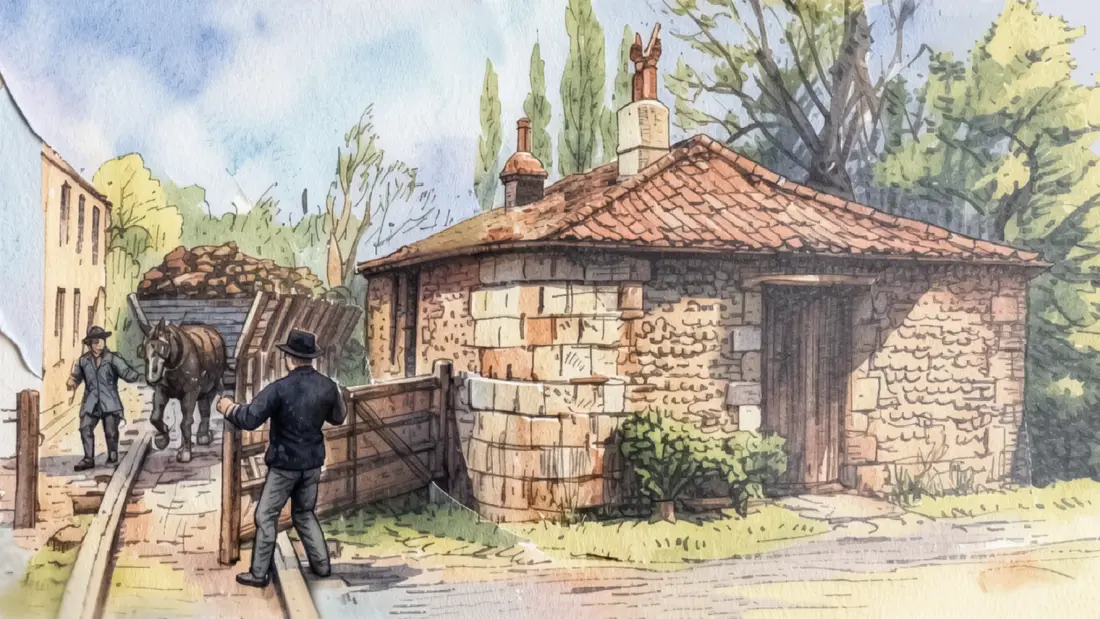
The feature image is by the author and represents a combination of two very different representations of the crossing at Colliers Wood, presented as a watercolour.
Leave a Reply