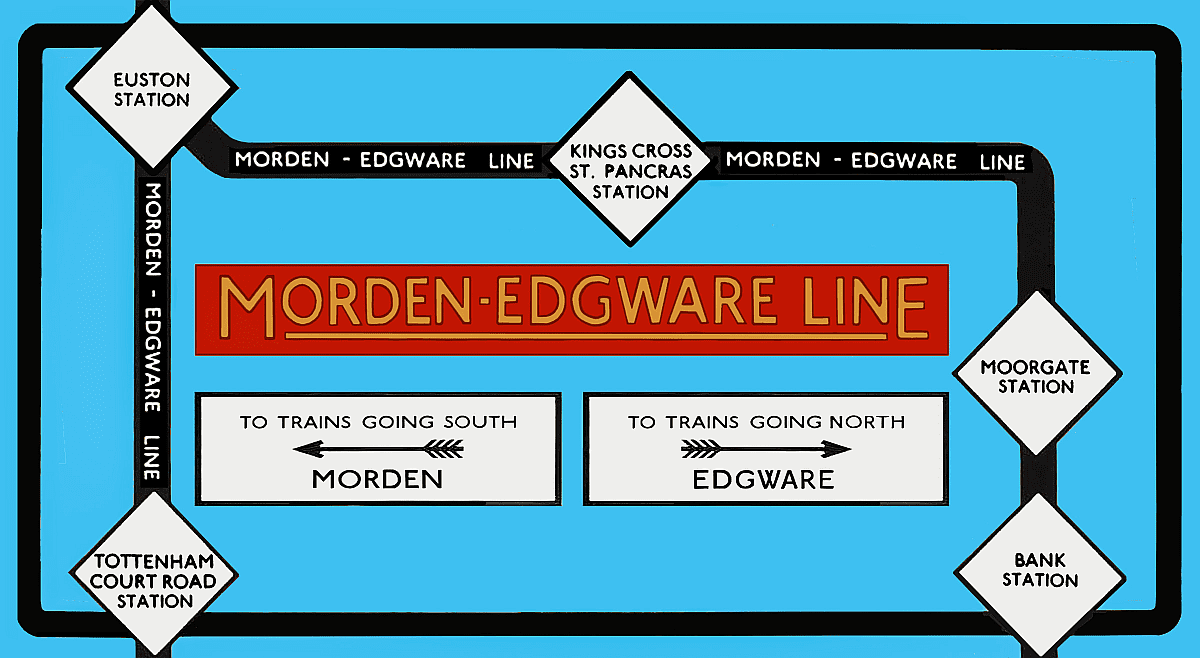
When it comes to the history of the London Underground, the Morden-Edgware Line is essentially unknown. It is undoubtedly mentioned in a variety of historical sources, both online and in books, but only briefly. There is absolutely no thorough history of that tube line. In its original presentation, this had been the first in-depth write-up of the Morden-Edgware Line’s brief history. The reason few have bothered to write solely on the Morden-Edgware line is because the detail is more easily presented as a history of the Northern Line.
Since the Northern Line is the tube’s furthest south, many people generally consider it an oddity in terms of its denotation. Many people find it fairly perplexing that the Northern is the sole Southern tube line! It’s a lengthy tale that begins with the City and South London, and the reasons behind that peculiar name are pretty much lost in the annals of time.
When the world’s first tube line opened in 1890, it was always intended to service South London, as evidenced by its name. However, this was combined with the later Charing Cross, Euston, and Hampstead Railway to create a new network of subterranean lines that no doubt fell considerably short of their adoptive namesakes.

The North London network of lines as they would have looked if the LPTB plans for the Northern Line had been achieved. Source: Twitter.
Much of North London and beyond would be served by this network of new tube lines – including a new extension to Elstree and Bushey Heath, as well as routes to Finsbury Park, Crouch End, Highgate, Muswell Hill, Alexandra Palace, and Mill Hill. Frank Pick projected that the line would carry about 3,795,000 people annually during the first five years of operation. These lines, also referred to as the ‘Northern Heights’ were partially executed with new electrified track and signals, and other sections, including a portion of the Bushey Heath route, were partially built.
London’s Northern Line was essentially a result of all that incomplete work. The near full abandonment of most of the new extensions means the Northern Line never fulfilled the London Passenger Transport Board’s (LPTB) ambitions. There’s no doubt the Morden-Edgware Line was the most complete iteration of the former City and South London and the Charing Cross, Euston and Hampstead lines.
The aforementioned diagram appeared in Northern Wastes (1987) after being first published (apart from its original source) in Rails to the Palace (1980). Although there was much more information about the complete designs, it essentially shows how the new construction would have appeared. The building of Bushey Heath depot was the most distant project completed outside of Edgware. There were also plans for an additional extension to Watford, but that is a different matter. These redevelopment plans were eventually abandoned, and the Aldenham Bus Overhaul Works were built on the site of LPTB’s one and only incomplete Northern line tube depot.
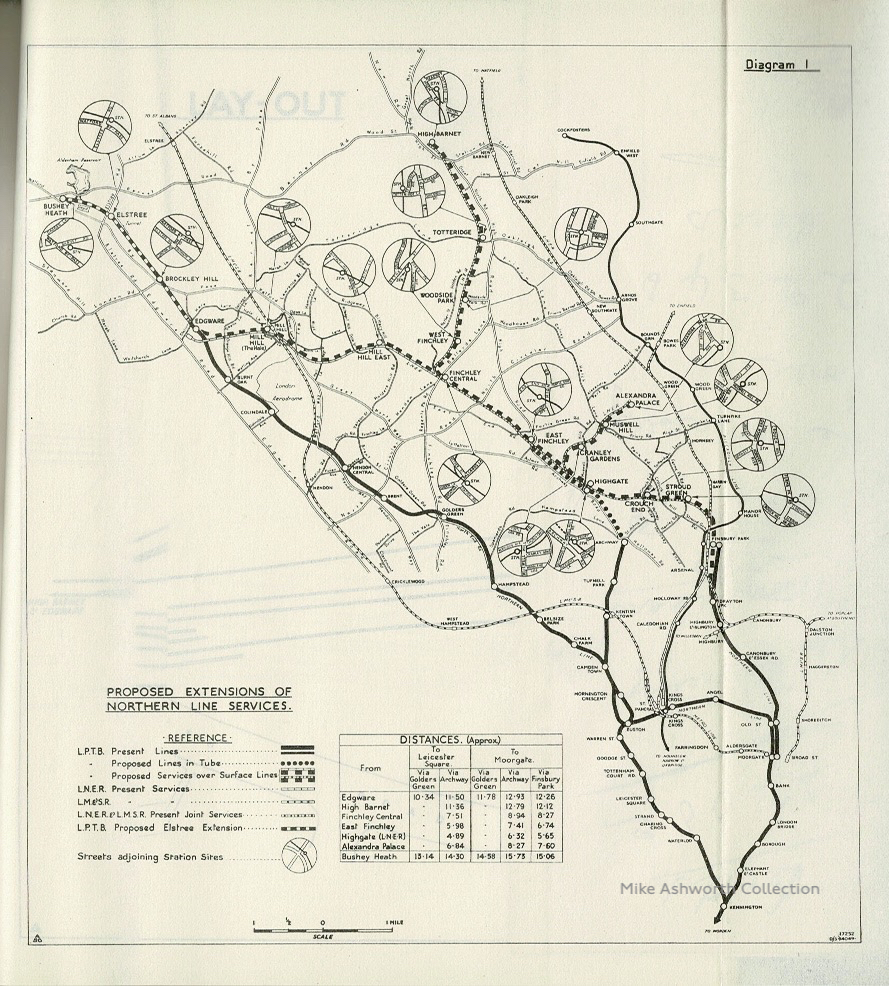
Geographical rendering of the Northern Heights proposals. Source: Twitter.
The unfulfilled expansion of the Northern Line means for example there are deserted platforms and tunnels at Edgware, and there are what seem unused track heading south from East Finchley. Not forgetting Highgate’s abandoned LPTB station, which has never seen a public tube train!
In a literal sense ‘Northern Heights’ refers to areas north of London more than 300 feet above sea level. At about 354 feet above sea level Bushey Heath would have been the highest tube station of all. High Barnet, at about 320 feet, was the one and only true ‘Northern Height’ to be attained.
Much has been written about the Northern Line’s original purpose (including the complex Northern Heights scheme) and books have also been published. But in actuality, not a lot has been written on the period before the Northern Line was established, so there are considerable gaps in the history of that particular line.
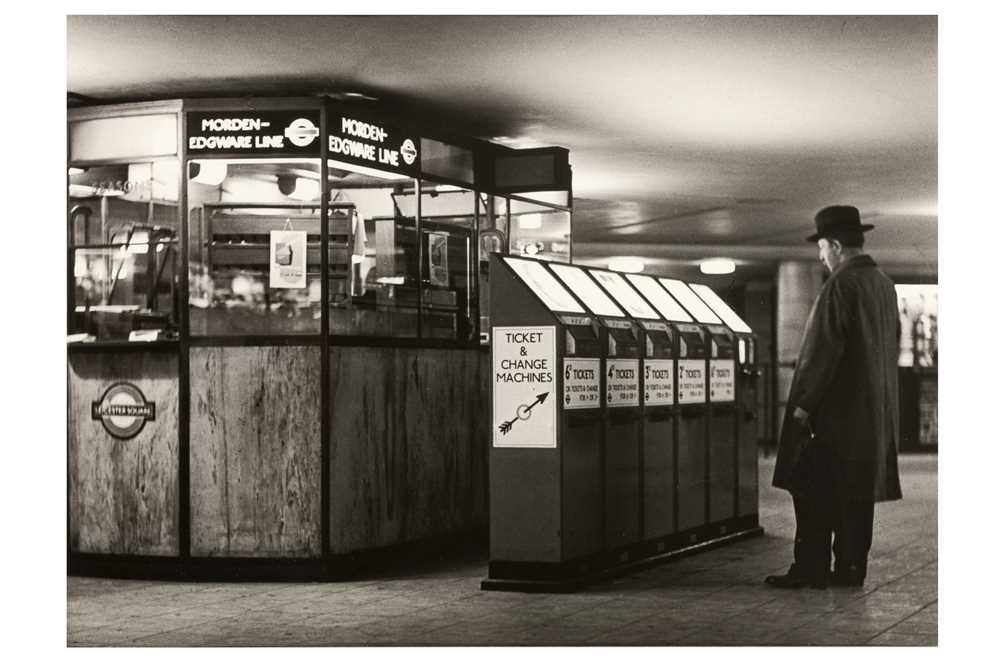
Leicester Square station in c1936 clearly showing its Morden-Edgware Line branding. Photography is by the noted photographer Wolfgang Suschitzky. Source: Chiswick Auctions.
The Morden-Edgware Line:
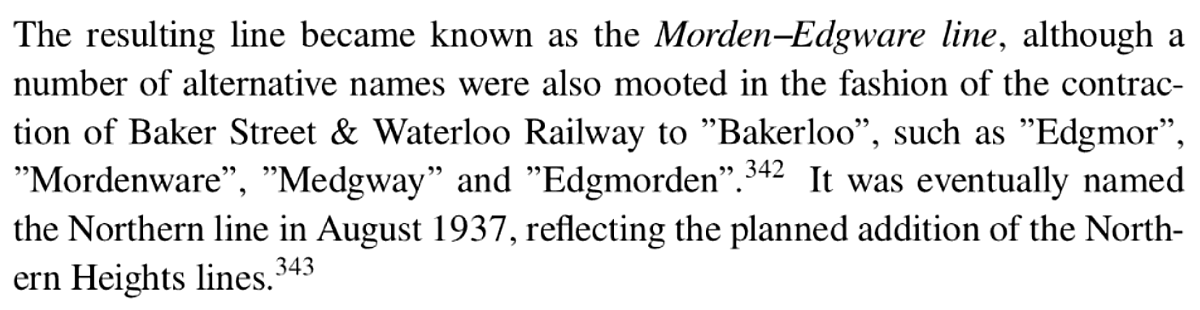
Edgmor, Mordenware, Medgway, Edgmorden, some of the alternative names for what would eventually become the Northern Line. Source: Google Books – London Underground.
There was an aside in Punch (September 1928) shortly after the new lines to Edgware and Morden opened that the line be called the Hampstead, Highgate, City, South London, and Morden Tube in order to retain the original City and South London titlage and also that “the place called Morden somewhere near the Sunny South Coast!” should not be forgotten either.

Golders Green depot on the Hampstead tube in 1929. All the trains visible in this aerial were in the new red and cream London Underground livery of the time – but it would be four years before they received their one off Morden-Edgware Line branding. Source: Twitter.
The City and South London and Charing Cross Euston and Hampstead Lines were the older independent names of the newly expanded and integrated tube train for a while. Renaming the lines in any way and getting them to stick was really challenging. The official opinion that the railway should be dubbed the Edgware, Highgate and Morden even resulted in the installation of appropriate line signage at stations following the opening of the extension to Morden. However, the people never really took notice of that and as a result the older names persisted.
The Edgware, Highgate and Morden Line officially appeared when the first of the now-famous Harry Beck tube maps was released in 1933. (David St John Thomas claims the renaming occurred in 1932, although Mary Vivian Hughes’ book London at Home, 1931, states a competition had been held “but nothing was successful,” thus in honour of its termini, it became the Edgware, Highgate and Morden Line).
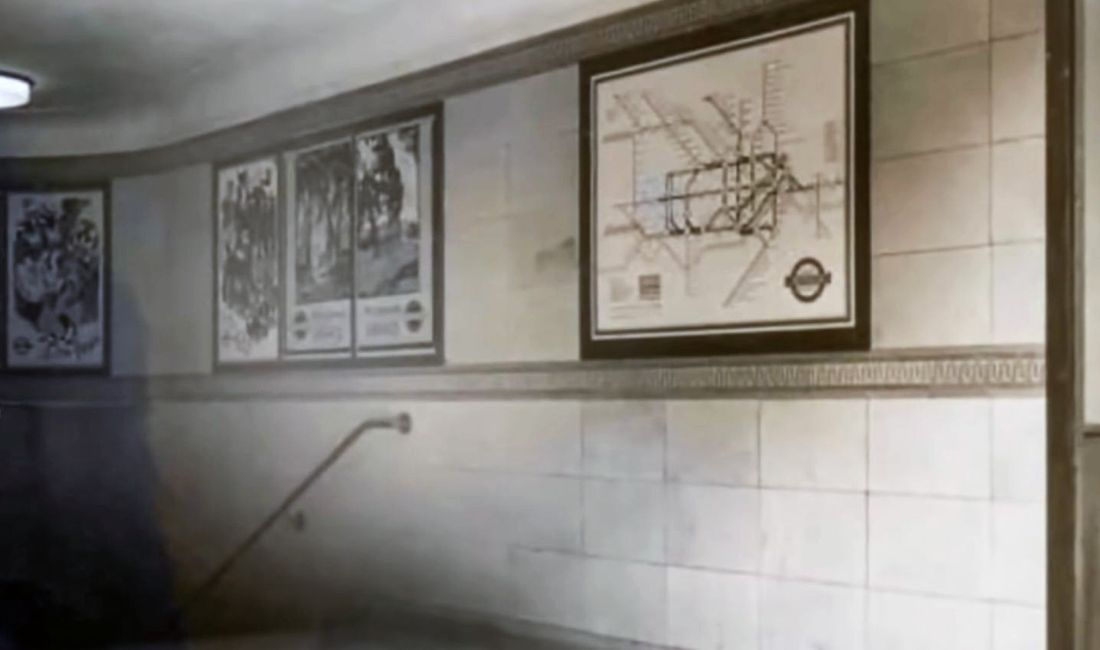
This is a screencap from the Hidden London Hangouts episode on Leicester Square. The tube map shown inside the Cranbourn Street entrance is Beck’s later version (in poster format) c1935 – and its without a doubt one that shows the Morden-Edgware Line! Source: Youtube.
Many authors are unaware that the Edgware, Highgate and Morden Line was only temporary. The LPTB saw it as a trial with little chance of achieving permanent status. The next version of the well-known Beck tube map, which was published in 1934, saw this changed to the Morden-Edgware Line.
As part of the LPTB’s 1935 new works program, the Northern Heights project was approved during the Morden-Edgware Line’s existence. As a result, it has been asserted the Morden-Edgware had been a “masquerade” and that Edgware-Highgate-Morden Line was the correct name (as Trains To Beyond maintains). Some said the title was “clumsy” (Rails Through the Clay: A History of London’s Tube Railways, p. 185) or even “poorly named” (London Underground by Design, p. 199). However, none of these authors have suggested that Edgware-Highgate-Morden was a temporary moniker while a better one was being considered.
The busiest, most prosperous line was the Morden-Edgware. As the LPTB hadn’t adequately considered the capacity issues on the Morden-Edgware Line or how best to resolve these, a number of MPs were rather worried about the LPTB’s desire to build new extensions. This is because the Morden-Edgware line was already extremely popular and any extensions would put enormous pressure on the existing sections. In the eyes of Parliament, the LPTB was undoubtedly attempting to run before it could walk. By renaming the Morden-Edgware as the Northern line, the LPTB had got ahead of itself in terms of promising London a substantial network of new tube lines.
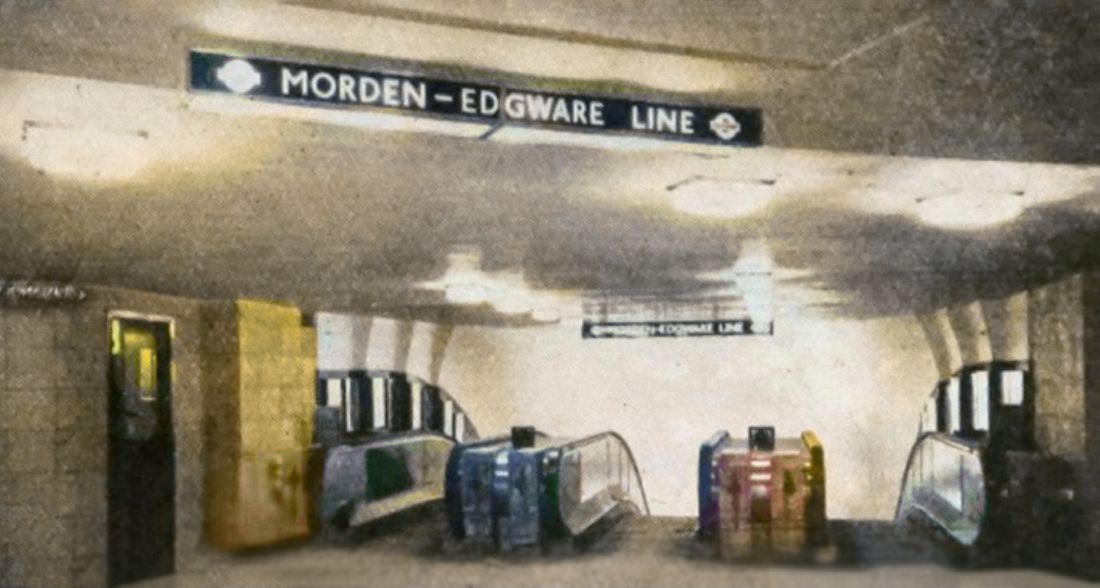
Screencap from Pennyfare June 1935 is this view of the top of the escalators, which I’ve colourised. The Morden-Edgware Line branding is very evident.
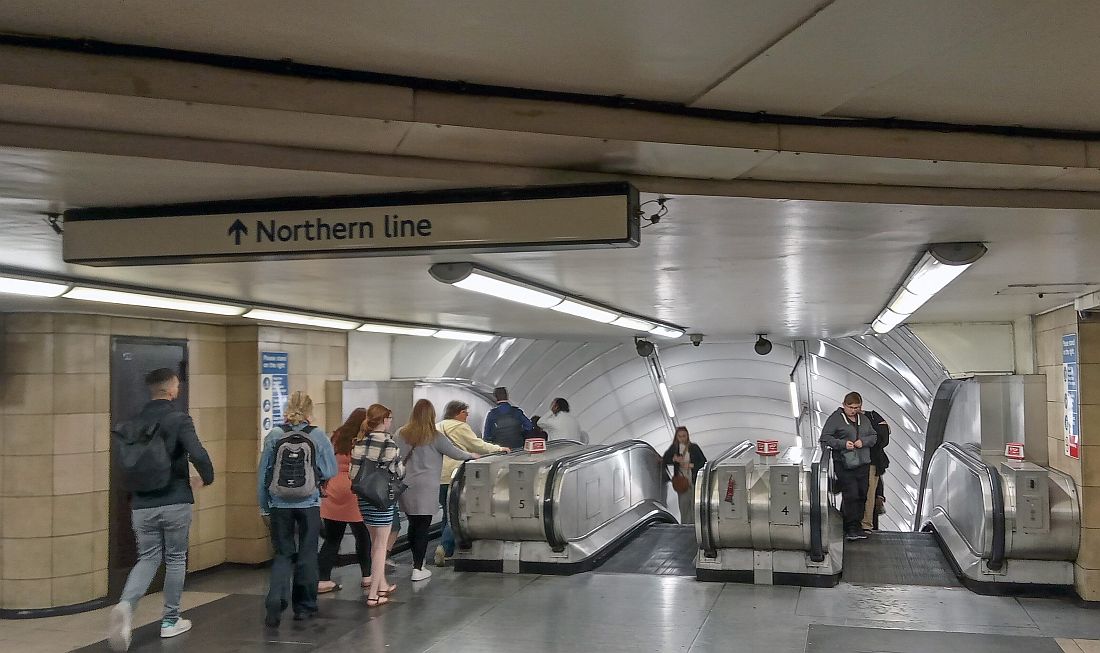
2023 – and this is how the 1935 scene now looks! Its the Northern Line of course – but will that even exist if it gets split up?
In any case, these discussions demonstrate that the new tube line name was widely accepted across the political spectrum as well. In addition, the politicians’ concerns were predisposition that things wouldn’t be resolved appropriately – as was the case when the Northern Heights scheme was abandoned – and miles of new tube line, stations, tunnels, bridges and electricity installations scrapped. With no hope of a post-World War II resurgence, it was a huge waste. “The greatest blot on the history of the London Underground is the abandonment of the uncompleted extensions to the Northern Line,” as stated succinctly by Jim Blake, author of Northern Wastes.
The LPTB didn’t really want the Northern Line. The LPTB considered it a default since it proved the only suitable one in a completion. Strangely the LPTB already had a decent line name, so they ought to have resisted the choice of Northern Line. In light of the widespread abandonment of that line’s extensions, there’s no doubt the Morden-Edgware Line was one the LPTB had invested a great deal of money and time in – and that would have kept the original tranche of tube lines intact under what had been a clearly popular name.
Compared to other renamings, Morden-Edgware was instantly recognisable. It was more than that because it could be found in official LPTB papers and documents, numerous tube stations, on the tube maps, tube posters, and the name also formed part of the trains’ branding. The ‘Morden-Edgware group of lines’ was often used as part of internal LPTB jargon, however from a passenger perspective, it was simply the Morden-Edgware Line. More importantly, Ordnance Survey maps also identified it as the Morden & Edgware Line, and Underground literature (like as pamphlets and maps) clearly illustrated the Morden-Edgware Line name.
Leicester Square tube’s 1935 renovation was arguably the Morden-Edgware Line’s greatest showpiece. Its opening in time for the Silver Jubilee of 1935 no doubt complemented the new identity. The LPTB had an opportunity to showcase its lines at their best with the creation of the new (or possibly reformulated) tube line. Warren Street and Tottenham Court Road were also upgraded, in addition to Leicester Square. But Leicester Square was the newest and greatest example – with some of the longest escalators in the world in addition to a ‘new’ tube.
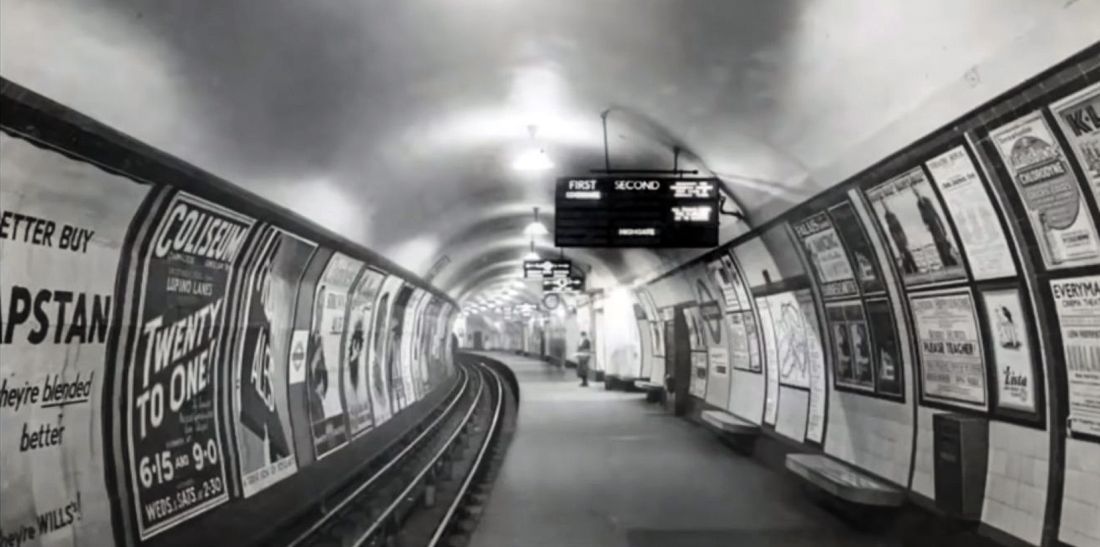
This picture is from the Hidden London Hangouts feature on Leicester Square station. What can we view from this? The line’s designated Edgware and Highgate trains stopped at the current Archway station. However, there is more—the big Royal poster at the train signal on the right—the Hidden London Hangouts crew never discussed this. Yes, it’s a tube map, but not the typical variety. The “bubble map” from Stanford’s London Underground was used at its key stations and was official LPTB merchandise. Unmistakably there’s a lot of Morden-Edgware line designation that can be seen in higher quality versions of the above image. Source: Youtube.
This series of LT Museum pictures from 1935 and 1937 clearly show further indications of the LPTB’s Morden-Edgware Line branding at the new Leicester Square ticket hall. 13 May 1935 (1); 13 May 1935 (2); 25 June 1937; 5 October 1937.
A tube map with the Morden-Edgware Line can be seen inside the station’s ticket hall during 1935 – LT Museum.
Continued in Part Two.
This is a complete re-write of a post first published in June 2023.
Leave a Reply