A while back some pictures on Facebook featuring the railway at Weybourne related to the Dad’s Army episode The Royal Train were spotted. Since this is the 50th anniversary of the North Norfolk Railway’s (NNR) first ever public trains, it seemed appropriate to publish some similar pictures taken before and around the time the Dad’s Army episode was filmed. The first ever pictures I took of the NNR were about 1968/69 when it was just a Sheringham operation (trains barely ventured further than the station environs and some of these utilised the NNR’s two Waggon & Maschinenbau railbuses. In due course these were able to go as far as the golf course crossing. Services could not go to Weybourne because the tracks were not physically connected (BR had took up parts of the line before any rights were gained – thus there were sections partially dismantled on the approach to and within the station environs. It was around late 1972 before the first trains could even reach Weybourne.
The reason for the existence of the NNR was because the M&GNJR Preservation Society had acquired various pieces of infrastructure and rolling stock from the former M&GNJR (Midland and Great Northern Joint Railway) and were looking for a location to store and operate trains. The original intent, upon inception in 1959, had been to take over the M&GNJR from North Walsham to Yarmouth Beach. Various other options were sought before focus turned to the current Poppy line route. It wasn’t a straightforward move however because BR had been there first and begun demolishing and dismantling whatever they could find of the line between Melton Constable and Weybourne.
BR’s work had progressed through Weybourne station itself thus there was a fair bit of the track in the station area had fishplates removed prior to anticipated removal by BR, so there wasn’t any immediately useable track in the Weybourne area anyway). Besides the rights and indemnity to work on the tracks the NNR also needed a Light Railway Order before it could operate public trains, and to enable engineers trains to reach Weybourne, the track had to be put into useable condition.
More of that in a moment. Here’s the ‘Royal Train’ pictures:
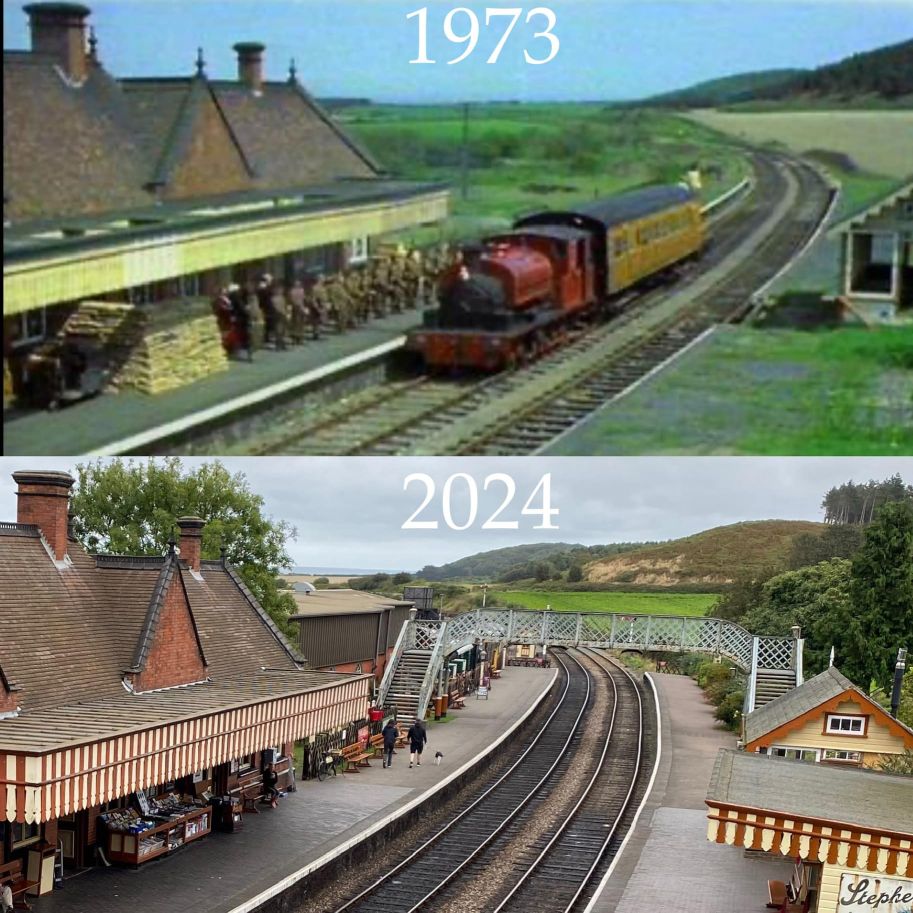
‘The Royal Train’ at Weybourne, 1973. Facebook. (The view of the station is a classic – Google Streets faithfully shows a person at the appropriate location on Sandy Hill Lane).
Dad’s Army was of course a popular British sitcom comedy series and Weybourne (and the NNR) were used for at least one episode of the series – The Royal Train. Weybourne doubled as Walmington station. More of that can be found at Wikipedia and also at David Croft featuring a number of pictures of the trains.
I was a fully paid up member of the NNR at the time of the Dad’s Army episode and I had also been a volunteer for at least a year or more. Why that is happens to be quite simple really. Our family had in fact lived next door to one of the stations on the system hence any interest in the M&GNJR had to be no surprise. In 1972 I bought a Honda C50 and when I had time off, I rode to Sheringham to work as a volunteer for the NNR. In those days I often bumped into the pioneers of the NNR – Bill Harvey, Bernard Amies, Bryan Newman, David Madden, Hugh Willins, then there was Brian Fisher the noted railway photographer and Sir John Betjeman – the line’s patron. The NNR was used for at least one of Betjeman’s films. This took place in 1974 using the line’s Gresley Quad-Set and the film was ‘A Passion for Churches.’
The NNR track department was that which I was allocated to thus gained a direct experience of the state of the tracks between Sheringham and Weybourne. Our job was to maintain the existing track as far as the golf course (which was used for member’s specials or other non-public trains) and also to reconnect the rails between Weybourne and Sheringham. Some of the early work also involved preparing the yard at Weybourne for trackage that would later form the carriage sidings and locomotive sheds.
The traction we had for assisting with our work were the railbuses or Doctor Harry, Ring Haw, Colwyn and John D. Hammer. Initial work was begun using the NNR’s platelayers trolleys and this was because the state of the track at the time didn’t permit anything except those. I have a number of photographs of how the railway developed in those days – that might possibly be for another post. What I do remember is looking over the Weybourne site thinking it was going to be an impossible job. In a sense that was because the rationalisation that had continued throughout the sixties following the controversial closure of almost the whole of the Midland and Great Northern Joint Railway’s vast system had continued with Dr. Beeching insisting the remaining M&GNJR section from Cromer and Sheringham to Melton Constable be shut. West of Sheringham closed in April 1964 and BR hadn’t left the track at Weybourne exactly intact. Indeed direct experience of how BR dealt with the area’s closed railways was it didn’t waste any time (save a few exceptions) in removing redundant track.
I was a volunteer on the line until perhaps late 1975 or early 1976 thus could be in any of the photographs taken in the week of the NNR’s first public services! Soon after that I moved to the Midlands thus I didn’t see anything further of the NNR’s progress until the extension to Holt was opened.

The first public train with Colwyn in charge. 13th June 1975. North Norfolk Railway.
As mentioned earlier the track had been progressively taken up from Melton Constable to a point by Bridge 302 at Weybourne when BR decided to truncate ma further section of the line. This was achieved by replacing the M&GNJR’s Sheringham station with a rather sparse halt of a largely wooden structure on the other side of the town’s level crossing. This took place in January 1967. At a stroke this cut out an entire railway station from BR’s books (plus a fair number of wages including station staff, track gangs and signallers).
The sparse wooden platform sparse compromising the new 1967 halt was built in anticipation of the line’s closure between Sheringham and Cromer. If it had indeed shut the NNR would have no doubt taken over this too. Despite all the UK’s railway closures happening, Cromer to Sheringham somehow managed to avert the same fate. The temporary wooden platform lasted until 2019 when it was replaced by a more permanent structure.
Sheringham station (the replacement rather) survived to become the northern terminus on what is now known as the Bittern Line thus the section from Cromer (approx 3.60 miles or 5.85km) happens to be the last section of the former M&GNJR in use by the national rail system.
In terms of the rest of the now closed railway, BR proceeded to take up the remaining track from Weybourne to Sheringham. Wikipedia says according to Leslie Opitz some track was relaid after 1965 but that isn’t possible because the NNR did not have any rights then – and besides its not even what Opitz says in his book when Wikipedia cites this apparent tracklaying after 1965). What BR’s actions did however was to render Weybourne station practically useless even for engineering trains to reach, thus a lot of good old manual track work had to be undertaken before any of it could remotely be useful.
Sheringham station itself wasn’t too bad because the NNR had taken up residence barely two months after BR had closed it thus the track here was largely intact. Even so the NNR had little in terms of storage for its rolling stock because the track wasn’t exactly generous – and that is because BR had indeed rationalised the track layout in the last years of use. There was just the one useable track which was on the up platform towards Cromer. Despite the speed at which BR often worked to remove redundant railways the NNR was fortunate in getting Sheringham almost immediately it had been closed – thus the station had barely been touched and it was preserved as it had been left. The down track was restored whilst some basic additional sidings and a loop west of the station were added and its how the station is basically today.
In the meantime here are the before the Weybourne before after pictures:
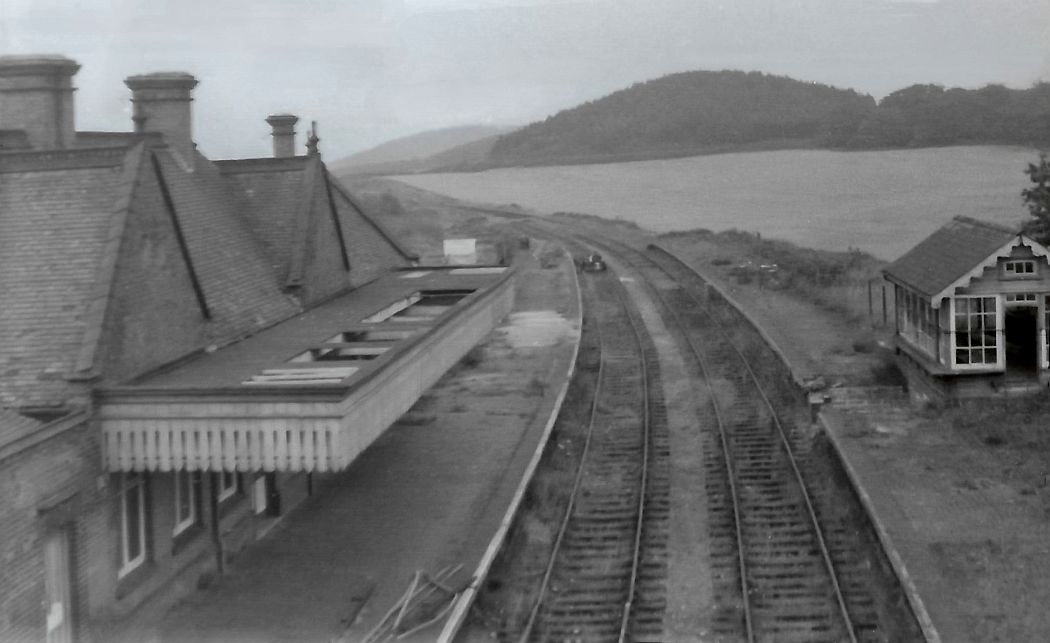
Weybourne in 1972 with the plate layers’ trolley on the up platform line. We were having a break whence I took the opportunity to take the above photo from Sandy Hill Lane (bridge 302). This photograph actually precedes all the others on this page and depicts track work being undertaken at Weybourne in order to sort out the partially dismantled trackwork. Note the weeds growing in the main station platform. Close inspection will reveal track panels with their fishplates removed in preparation for dismantling by BR. Author’s photo.
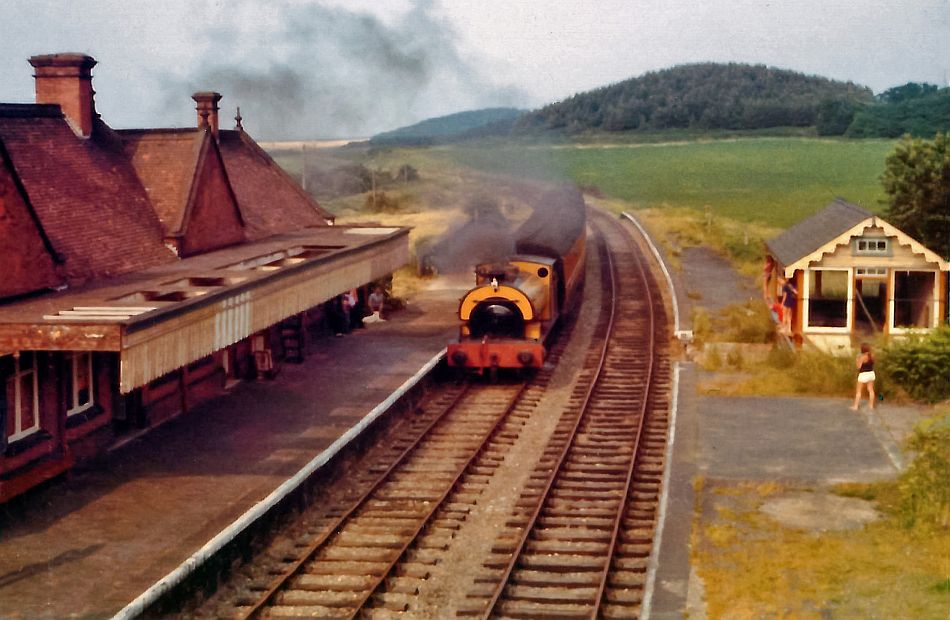
0-6-0 John D Hammer at Weybourne about the time of the Dad’s Army filming. Note the youngsters hanging about the signal box! The locomotive didn’t actually have name plates at the time – those came later. Photo by the author.
Track laying soon began in earnest to create the NNR’s main depot including a new engine shed – except it wasn’t new but was rescued from Norwich City station! It had to be dismantled and brought to Sheringham in lieu of its eventual restoration at Weybourne. Even though I was involved in the restoration of the tracks at Weybourne and the point work to form the new depot yard, it took the NNR quite a while to achieve its objectives. It wasn’t until the summer of 1975 when the Norwich City engine shed was brought by rail from Sheringham to Weybourne, and it was 1979 before the trackwork had been finished. The Norwich City shed was completed in 1980, the same year Weybourne signal box was fully restored according to Joint Line No.29.
It was not until 1984 and later that the railway had a proper signalling system or a footbridge! A good amount of trackage was also acquired. This was made possible by the Great Eastern main line electrification to Norwich. The ‘new’ signals came from Ipswich and other locations on the Great Eastern main line, as did the Weybourne footbridge. That was from Stowmarket and was dismantled in the early hours of 1st April 1984 and delivered to Sheringham the same day.
Some wonder what happened to Doctor Harry – a locomotive that was popular with many of us. (There’s a few pictures I have which might suit a later post). Dr Harry was basically the NNR’s first ever workhorse and was worked intensively. According to Joint Line No.29 Dr. Harry was ‘mechanically a disaster being very run down and badly in need of a complete overhaul. She finally failed in December 1976 and was withdrawn pending full repairs…’ It needed a new engine, radiator, air-system, horn blocks, axlebox bearings, rear buffer beam, exhaust system and gearbox. The journals, connecting rod bushes, wheels and trunions were badly worn. To cap it all the bodywork would have to be rebuilt. Eventually it was decided the diesel was too far gone and it was scrapped.
The author just about remembers the M&GNJR in its final years for he and his family lived next to one of the stations on the system and family members had worked at another. In those days there were plenty of reminders of the M&GNJR where the trackbed, stations and bridges remained in almost full entirety. From the 1970s onward that all changed when new roads and housing or other developments began to obliterate a fair bit of the old M&GNJR system.