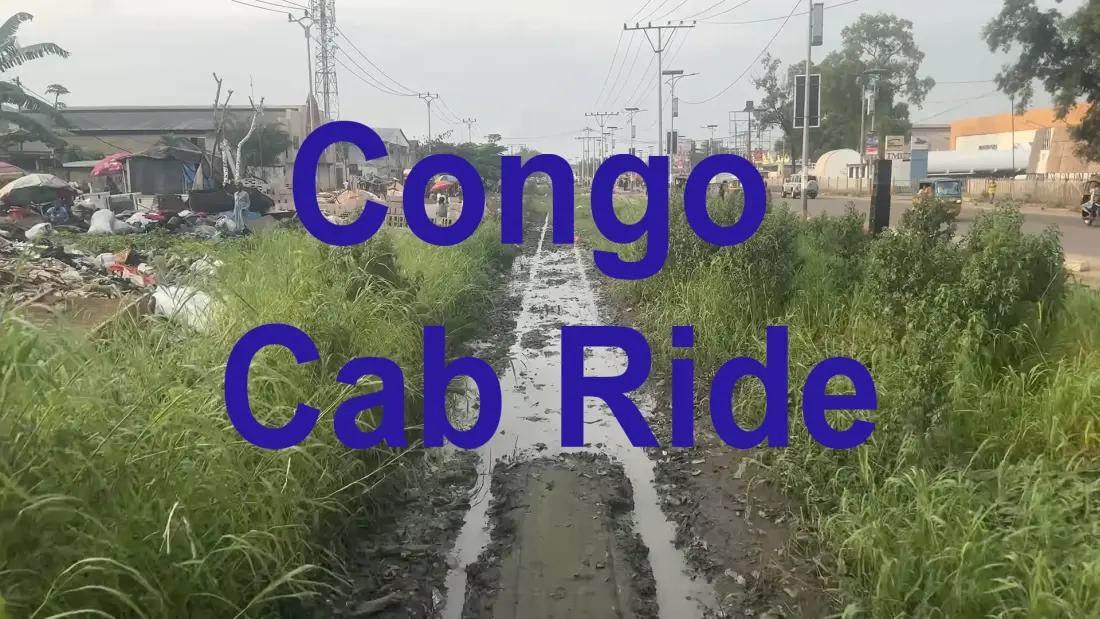
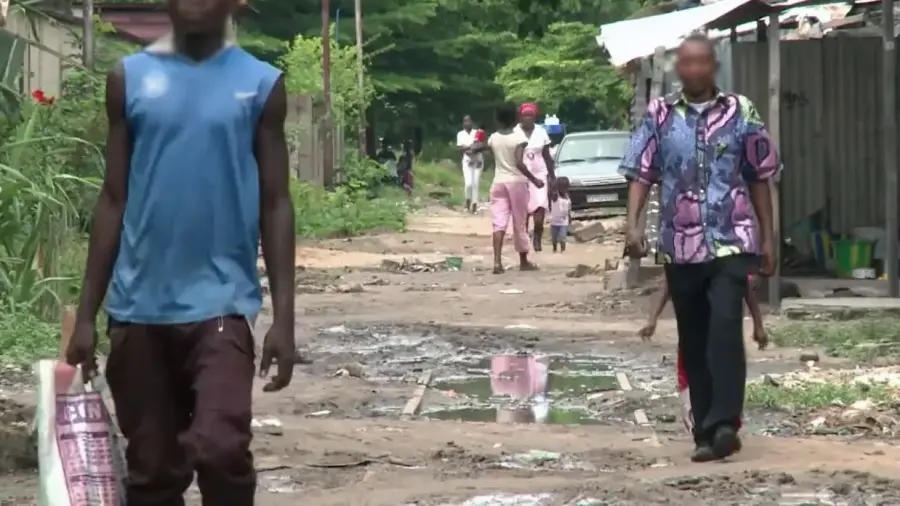
A train cab ride released over a week ago has garnered over three million viewers combined – and that because it shows an incredible urban landscape that must be some of the worst a train could travel through. Its what one Youtuber described a ‘desolate wasteland’ – but nevertheless they used quite a bit of disparaging and negative comment in their review of the cab ride. The dystopian scenes seen in the video no doubt arose from numerous factors – including a civil war that ravaged the country in question.
There’s no denying its shocking, and that even though there are other similar scenes that can be found in other countries. Yet this is one of the more extreme because of the huge numbers of people living alongside the railway. Paradoxically the trains are some of the most modern units – they are ex Japanese narrow gauge stock brought over this year to bolster train services. The consignment includes powerful locomotives for freight – all required to replace what was old and unreliable stock. Yet the trains have to operate in the most unenviable conditions most countries would not even deem tolerable.
The cab ride from Matete to Kinshasa shocks viewers due to the vast swathes of poverty and litter seen. Huge changes have now been brought in.
Since the video’s release on 4th July 2026, huge number of views have been gained. But not only that many Congolese also currently witnessing a vast change in their urban rail corridor. Even the video itself explains some of that in its introduction to the Matete to Kinshasa cab ride:
In February 2026, when authorities forcibly demolished and removed illegal structures on the Kinshasa-Matadi Railway company’s premises (see 09:00 in the video), some protesters armed themselves, leading to clashes with police forces.
That point in the video at 9.00 shows a substantial section of line that had been cleared of these illegal settlements. Consequently there have been other evictions conducted along the railway, as the authorities are determined to make the line a proper functional railway that serves its community. A substantial attempt at clearing the railway was made in the week leading up to the cab ride video and those evictions followed a trip the country’s President had on the railway in order to promote its benefits. There is a lot of debate around the evictions however and it has divided people’s opinions on whether the railway should be brought up to date or not. The main problem of concern is when people are evicted basically there’s nowhere else for them to go.
The railway is the former Compagnie du Chemin de fer du Congo (CCFC) built in the late 19th century. Its now known as the Chemin de fer Matadi-Kinshasa (CFMK) line at 3 foot 6 inches gauge. Formerly operated by the Government agency ONATRA (Office National des Transports) its now part of SCTP (Société Commerciale des Transports et des Ports). The CMFK fell completely out of use in 2003 after a major derailment. That had followed lack of maintenance due to civil war and government inaction which in due course saw large swathes of people encamp upon what was now assumed to be derelict railway property. Substantial buildings were established as well as numerous ramshackle dwellings upon the tracks themselves and the alignment also became popular for waste tippers.
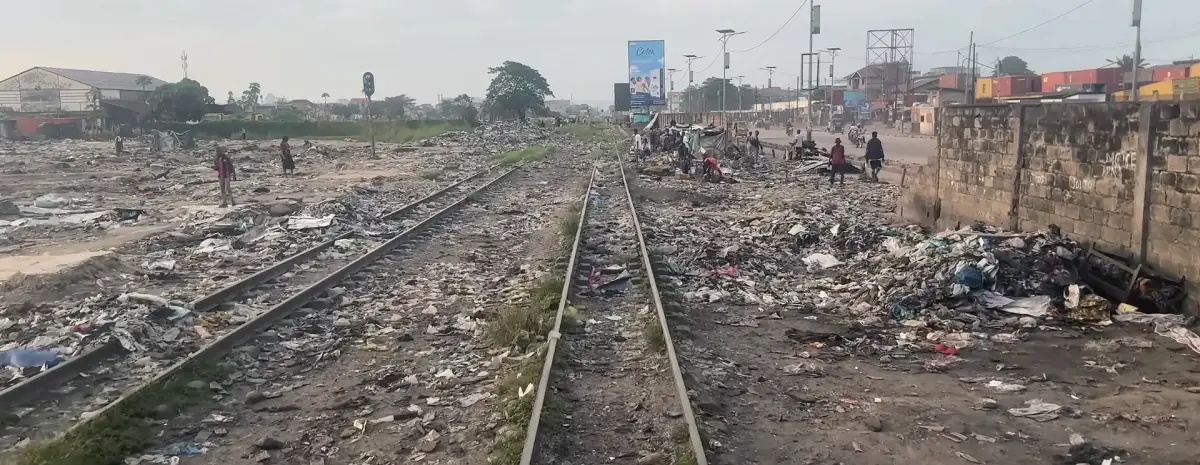
Shocking scenes such as this pervade the railway alignment. Youtube.
The railway reopened in 2011 (not 2015 as Wikipedia suggests) with limited services to the airport. In 2015 the line was reinstated throughout to to Matadi with one service a week. A handful of freight services were introduced in 2019. The line was suspended entirely in 2020 and services reintroduced less than a year ago. Services to the airport were excluded due to the state of the track. A single limited operation route through the many encroachments upon its track had to be secured for the reintroduction of services in September 2025. Its why all the other track and sidings and railway yards are entirely out of use as seen in the video – for they have all been encroached upon.
The railway was once an impressible fully colour light signalled route as well as all the points being power controlled. Now the signalmen have to wave a baton while perched upon a stone or a small box, or stand upon the road where these cross the line. At several locations in the cab ride video policemen can be seen helping to aid the passage of the train – one is ordering people to stay away from the tracks and is also brandishing what seems to be an automatic. Most of the entire urban stretch of railway was formerly controlled from a huge tower signal box sited at Kinshasa Est station.
The CFMK is the country’s one and only operational railway and there’s no doubt the country wants the line to have a prestige that serves a full and proper purpose, especially as an extremely useful alternative to the huge traffic jams that pervade Kinshasa. The trains are smartly presented KiHa 183 units (originally from the the Hokkaido line in Japan) which have been refurbished and accessibility features introduced so they form the most up to date convenience for the railway. Stock was transferred initially in 2023 with further movements during 2026.
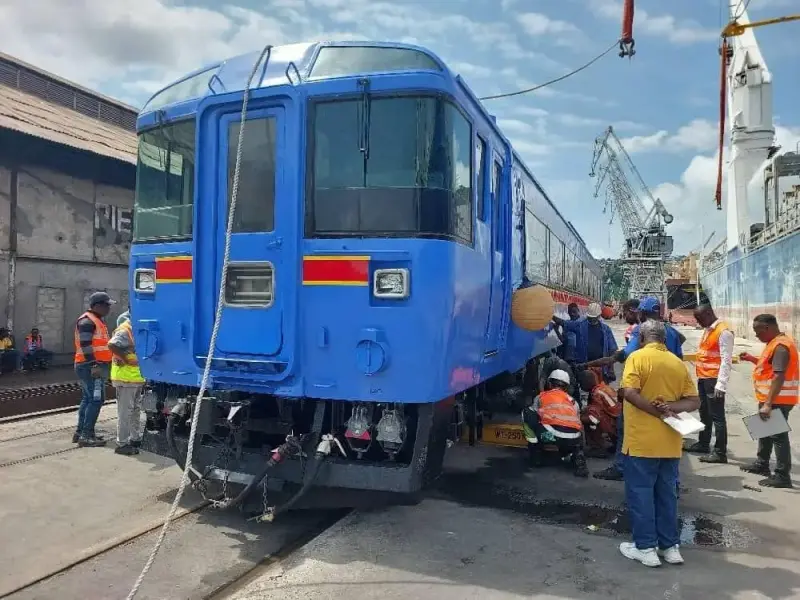
The stock used for the reinstated services are the Kiha 183 from Japan. The first of these were delivered to the docks at Matadi on the Congo River in 2023. Facebook.
The line was a very difficult one to build and that history has been made a part of popular fiction. This is Heart of Darkness – a story later transposed to Cambodia for Francis Ford Coppla’s seminal film, Apocalypse Now. Heart of Darkness reflects the experiences author Joseph Conrad had in the Congo during the construction of the CFMK. In Heart of Darkness Conrad describes a terrible imperialist cruelty and utilises the building of the railway as metaphor for the destructive effects of colonisation.
Before the railway was constructed, African porters had to travel 200 miles around the impassable rapids of the lower Congo River to transport all products and supplies. In order to avoid these rapids and pave a route for the profitable ivory and rubber trade, King Leopold II ordered the railway to be built. Begun in 1890 and finished in 1898 after a huge human tragedy had ensued. Up to 7,000 workers are thought to have died from illness and malnutrition. Thousands more workers were compelled to perform labour under unimaginable conditions. In 1932 the CFMK was converted to 1,067 mm (3ft 6in) gauge on considerable new alignment avoiding the torturous route of the original.
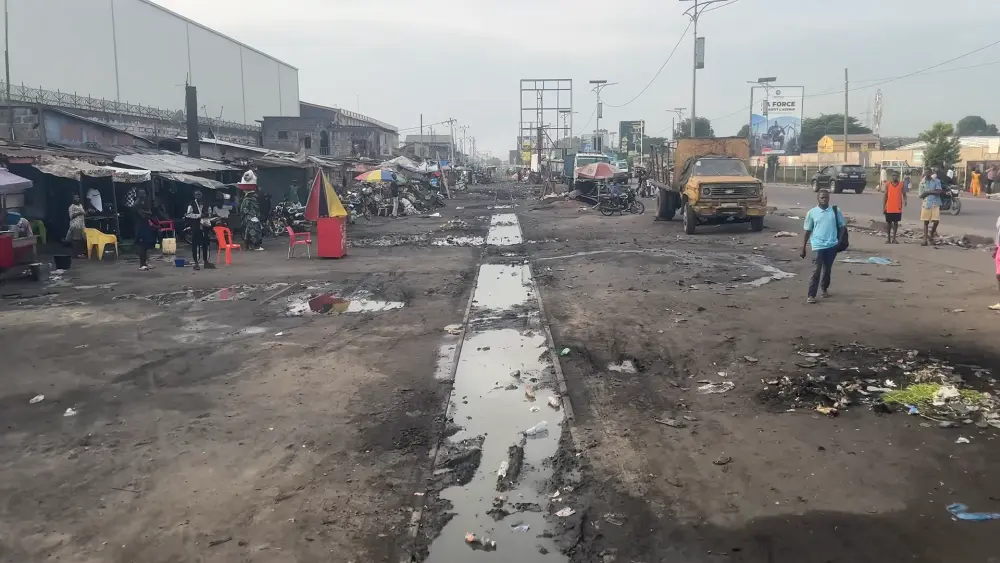
View from the cab ride just north of Pont Matete. Screencap from Youtube.
The cab ride from Matete to Kinshasa, which was filmed in early 2026, is now largely history and that because in the past few weeks the army was sent in along with contractors to reclaim the many acres of railway land that had been encroached upon. Prior to that a project to re-establish the line to N’Djili airport had been established and that has now resulted in a limited train service between there and Kinshasa.
The service was officially launched by the President of the Democratic Republic of the Congo, Felix Tshisekedi, on 30th June 2026 following a two month suspension of train services. Part of that was because of the ongoing evictions as well as the reinstatement of track plus rebuild the junction to the airport route at Limete, by way of removing properties upon the line and a wall built across the tracks. This work also included a reinstated crossing over a wide urban roadway, repair a substantial river crossing, and a renovated airport station.
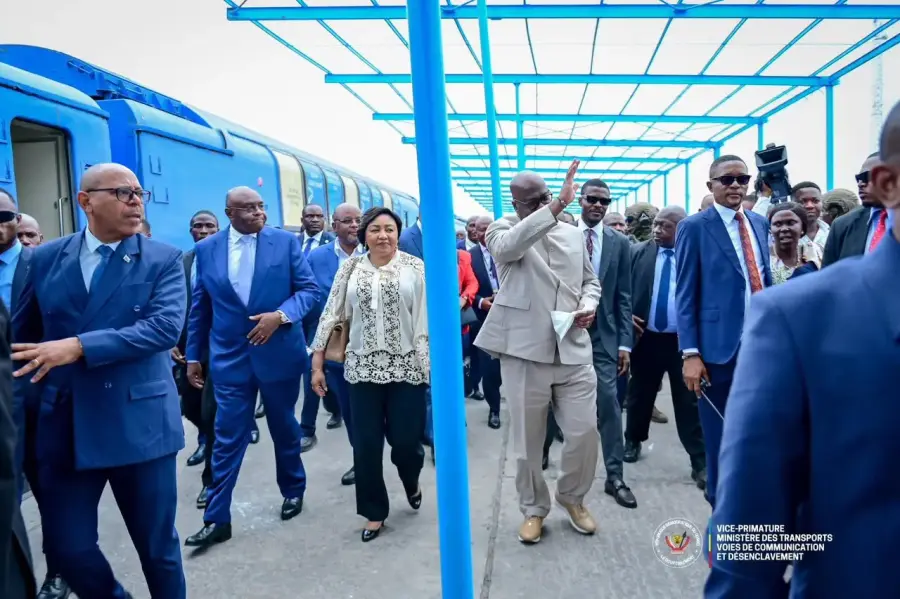
The President of the Democratic Republic of Congo arrives at N’Djili by train – thus promoting rail travel. Twitter/X.
The reclamation of the railway has not been without its problems. The idea was first mooted around 2011 but has been beset with huge logistical problems due to the vast numbers of people living on the tracks. It has been hard enough trying to maintain even a single track route through the urban area towards the airport. Neverthless Kinshasa’s traffic jams are horrendous and the authorities recognised the train was a serious and better alternative – if only the railway could be used properly.
The airport line covers about 27 kilometers with twelve stops serving several densely populated areas. The trip takes about forty minutes (there are plans to reduce it to around 30 minutes with faster train speeds). The fare to the airport is 1000 Congolese francs. The new trains have facilities for people with reduced mobility, and the stations now have announcements. The minister for Transport and Urban Mobility, Jésus Noël Sheke, has also announced a number of new bus services for Kinshasa, with the provision of numerous new buses and there will also a new combined ticket for both bus and train, giving people even more options for public transport into Kinshasa.
Youtube video featuring the President’s visit to the Kinshasa to N’Djili airport line on 30th June 2026.
Quote from the President’s transport official on the restoration of services and the importance of railways:
We were tasked by the Head of State and the government with rehabilitating the urban railway network within the city of Kinshasa. As you know, traffic congestion is a major issue. We needed to address this challenge, so we set to work. We have now established a permanent link between the Central Station in Gombe and N’djili Airport. The President himself boarded the train; we arrived at the airport, and in the coming days, we will announce the details regarding the resumption of commercial service. So, we are actively fighting against traffic congestion. As you know, trains carry large numbers of passengers at once; we will be transporting masses of people at a low cost to relieve pressure on the roads—mitigating the unpredictable delays, pollution, accidents, and all the associated issues. Rail transport offers an alternative way to connect the city center with N’djili International Airport, passing through several municipalities, notably Limete and Masina. The population greeted the President’s arrival at N’djili International Airport with frenzied applause. The railway line is set to open soon. The people of Masina, Kingasani, and Tshangu will soon have the joy of seeing the train depart from Gombe, pass through Limete, and reach N’djili Airport. It is a real pleasure—congratulations to the President of the Republic and to everyone involved in this project. Youtube.
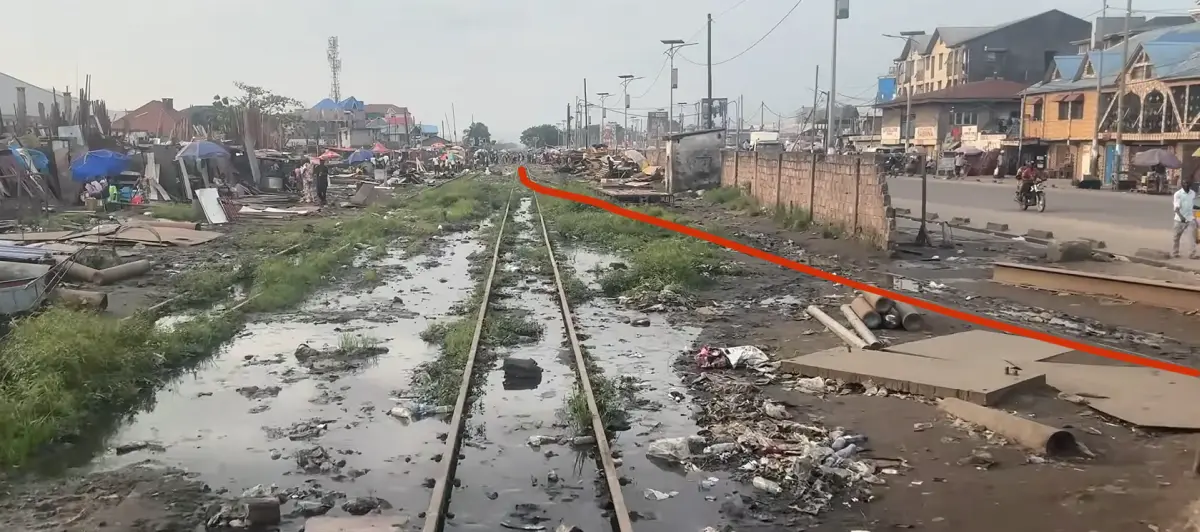
Screencap from the Matete-Kinshasa cab ride video highlighting the barely visible track leading to N’Djili airport. Youtube.
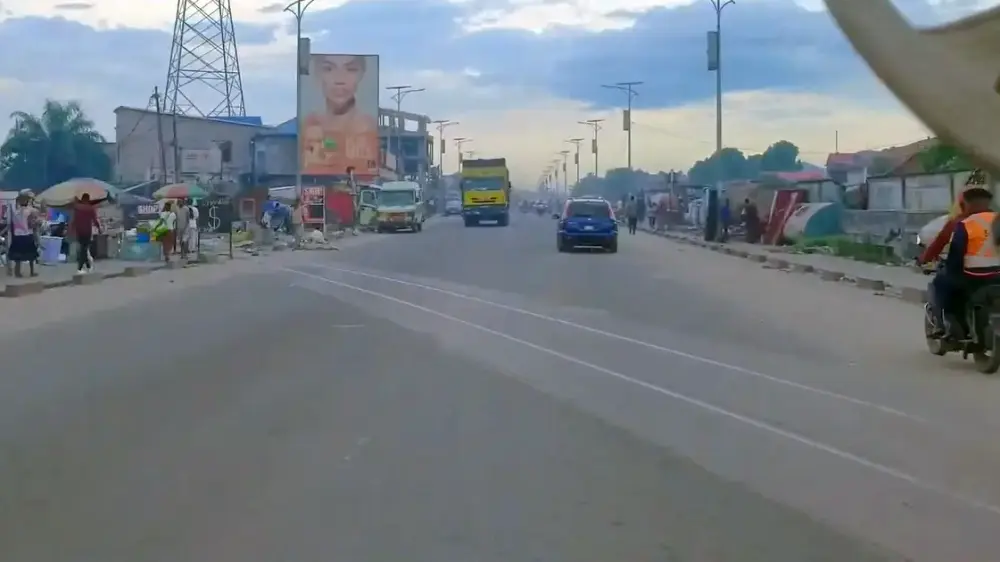
The tracks where they cross the Rue Des Poids-Lourds and seen some years before the airport line was restored. Youtube.
Its hard to find photographs of the reinstated line, however there’s film showing upgrade work on the tracks to the airport. Its all manual labour however and observers ay the railway really should be getting up to scratch by using mechanical tracklaying machines etc. The above pictures show the junction with the airport line at Limete prior to restoration.
This Youtube video features a comprehensive look at the work to upgrade the line to N’Djili airport.
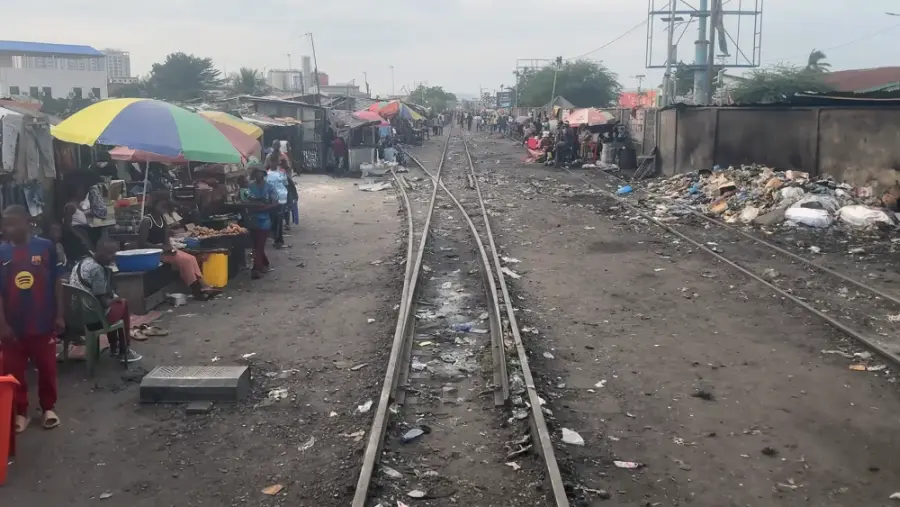
This is the junction with the line to Kintambo at N’Dolo. Almost the entire branch has been occupied by settlements. Youtube.
The Kintambo line has its junction with the main railway at N’Dolo. The is every intent to reuse the branch line to Kintambo and extend this to Ngaliema Bay via an alignment that heads northwards before somewhat following the Avenue Des Touristes and Avenue Des Rapids.
Youtube video showing the evacuations at Kasongo on the line to Kintambo. The video has some distressing scenes.
Huge evacuations were also taken within the rail yards and depot buildings at Kinshasa Est station, plus there was also removal of encroachments upon the freight line leading to the Kinshasa’s docks. Both the line’s termini at Kinshasa and Matadi have also been restored substantially. There’s a Youtube video showing the evictions around the railway yards at Kinshasa Est station. It must be warned however that this has some very distressing scenes.
It must be said one does not know the extent to which repatriations of the railway land have occurred. One can only judge what has gone on from the various Youtube videos that have reported upon the evictions. But certainly these in large have occurred at Matete, Limete and Kinshasa Est as well as the airport route, upon part of the freight only line to the city’s docks on the Congo River, as well as the line to Kintambo.
Further evictions along the railway got underway a couple of weeks ago with the army in attendance. This and other scenes are shown in the above Youtube video.
It appears the authorities had tried at first to encourage people to move but that simply didn’t work. By the time the new services had been established to the airport, the evictions had gained considerable pace. Huge numbers of army personnel, police, government and railway officials were tasked with ensuring the eviction of thousands of people and the demolition of numerous properties, including factories, community centres and a large church that had been built without authorisation upon railway land. To even reinstate the entire line to Matadi during 2015, similar operations had to be undertaken in the many villages and towns en route. In a number of places the track had basically become a roadway linking numerous settlements.
One example of encroachment upon the line to Matadi as seen in 2011. The tracks had practically disappeared from view. Screencap from Youtube.
Leave a Reply