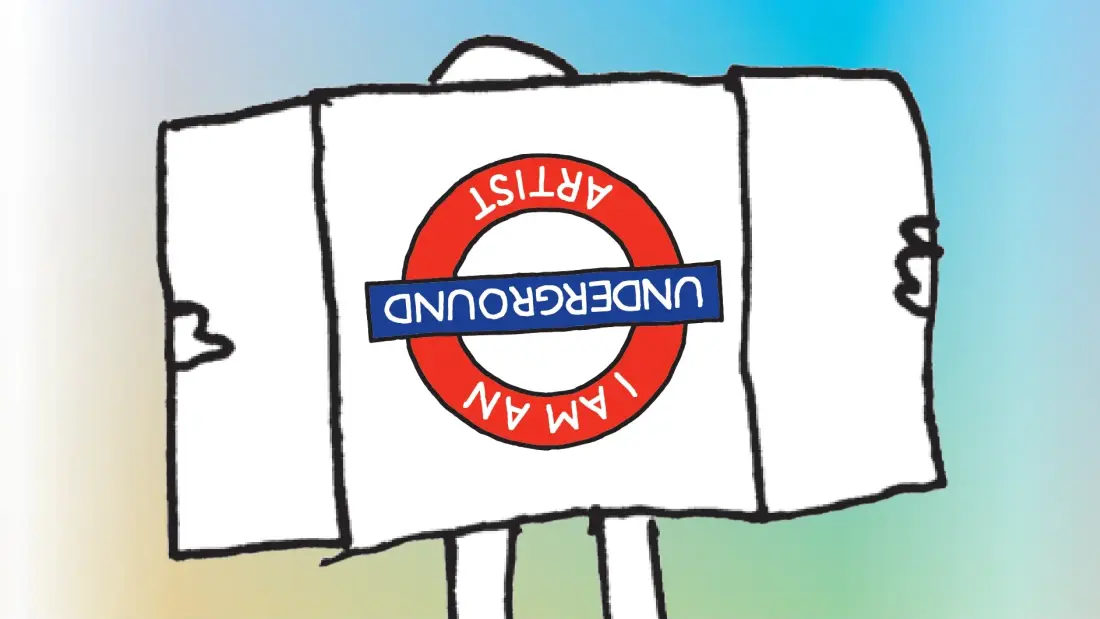
Art on the Underground’s new endeavour has a fun theme for children this summer – and that’s why TfL’s latest ‘tube guide’ is known as the Spaghetti Map.
All so far, so good. Nothing else to say is there – except there is!
But first a brief low down on TfL’s new art venture:
Spaghetti Map is a free interactive leaflet that explores artworks permanently installed on London’s Underground. It invites primary-aged children to think like artists while Underground during the 2026 summer holidays… The new art map for kids features six artworks commissioned by Art on the Underground since 2012. It brings together Jacqueline Poncelet’s Wrapper – a 1,500m vitreous enamel artwork that covers Edgware Road’s Circle line substation – and Larry Achiampong’s 2022 pan-African roundel at Westminster Underground station… Artist and Spaghetti Club founder Michael Crowe, said: “Spaghetti Map isn’t an “A to B” style map, it’s a map for ideas, inviting children to think like artists and put pen to paper while Underground. It’s an invitation to children and adults to get to know a local artwork, and to look out for others while traveling through the city.” (Art on the Underground).
🎨 A new way for families to explore London’s hidden art 🚇
— Marble Arch London (@MarbleArchLDN) July 31, 2026
Discover the Spaghetti Map, a free leaflet encouraging children to discover artworks across the Underground network, including Jacqueline Poncelet’s Wrapper at Edgware Road (Circle line): https://t.co/LrxFtVYXiL @TfL pic.twitter.com/GLaWR8lFWQ
Its evident that Poncelet’s Wrapper at Edgware Road (Circle Line) is the most important installation – for its the largest of all. But there’s a problem…
One would think TfL would endeavour to be certain there were a good number of Spaghetti Map booklets present at Edgware Road (Circle Line) for this is where the art installation in question is. The difficulty is I have never seen any of these booklets at what is one of the Spaghetti Map’s most important locations.
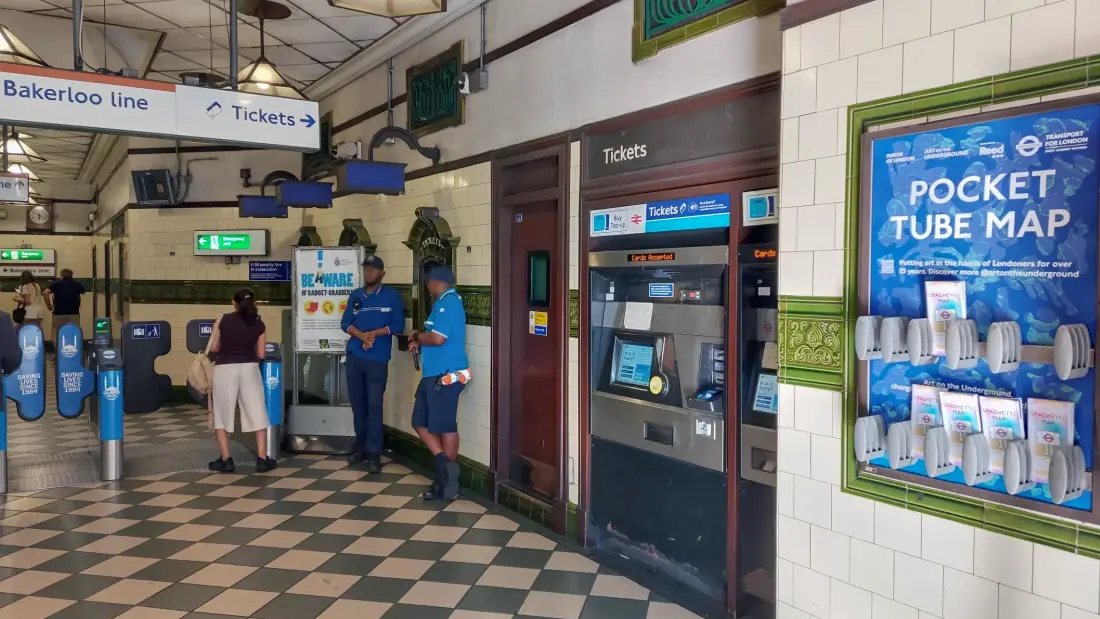
Best make a beeline for Edgware Road (Bakerloo) which has plenty of Spaghetti Maps! These are seen at right on the Pocket Tube Map racks.
Where the cover of the Spaghetti Map booklet is concerned things are certainly upside down – but not by this degree! It must be said that whenever TfL leaflets get to be shown at any of the Bakerloo stations they stick out like a sore thumb – because the presence of tube maps or other information paraphernalia is practically zilch.
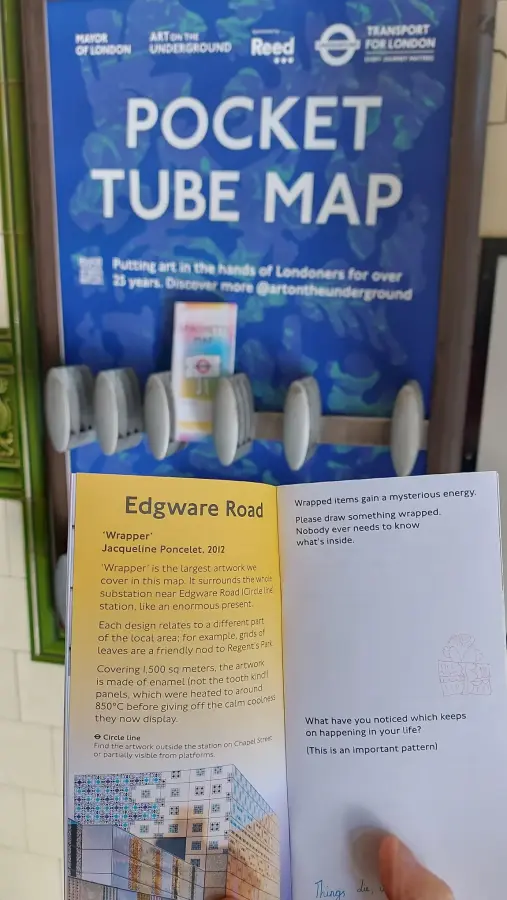
Art for confusion’s sake? Poncelet’s work is clearly labelled as being at Edgware Road (Circle Line). The actual maps are to be found at Edgware Road (Bakerloo)!
Its quite obvious TfL has its stations mixed up! Maybe someone were told to deliver these to ‘Edgware Road’ and they simply inferred that to be the Bakerloo station. The Circle/District/Hammersmith station is the more important of the two by decree of its footfall (more than six million per annum) whilst the Bakerloo station has a footfall that’s more than four million a year. However by decree of its location the Bakerloo station is seen by more millions than the Circle station, thus in a sense the Bakerloo station happens to be the more prominent. Not only that the Spaghetti Map poster here can both be on view to passengers and countless others walking past the station’s entrance. The Spaghetti Map poster rack at the Circle Line station can only be seen by venturing deep into the station itself.
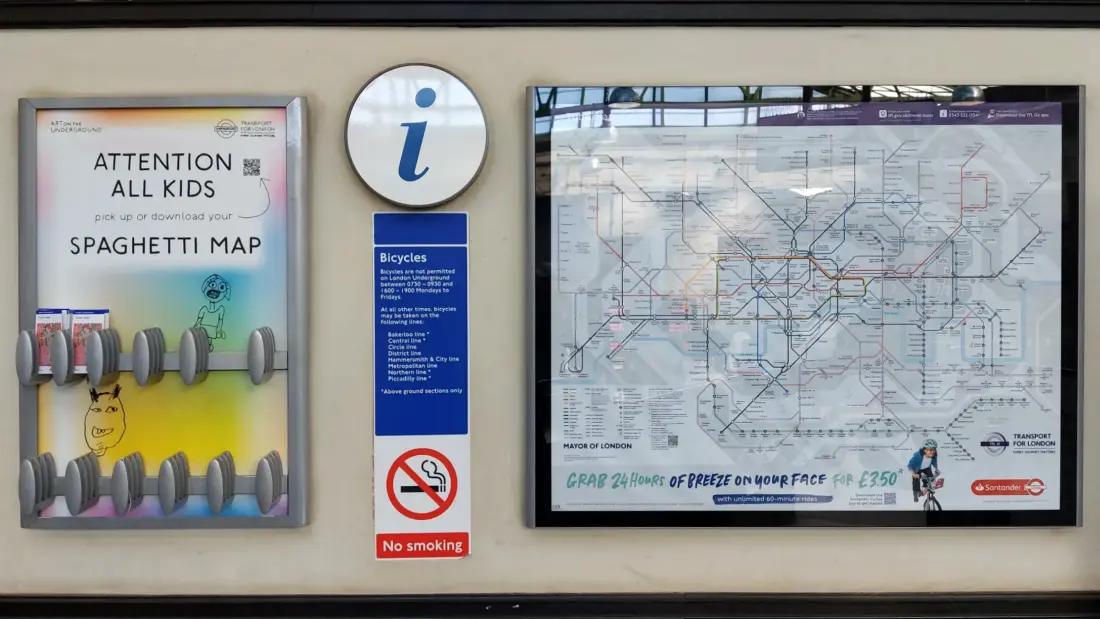
Edgware Road (Circle Line) poster/leaflet rack is totally devoid of the actual Spaghetti Map – but offers some of TfL’s latest tube maps instead.
In a round-about way one can see the Spaghetti Map being at the Bakerloo station instead of the Circle one as sort of making sense – even though Poncelet’s artwork which is nearby and despite its huge size – cannot even be seen from the Bakerloo’s station.
Alas as always in terms of TfL planning, this is contrived because there’s no poster or other signage to denote the Arts installation is at the Circle line station. Wouldn’t it be good if the Bakerloo station had a poster featuring Poncelet’s Wrapper as well as indicating its location nearby? If that was the case then the Bakerloo station would also have a truer purpose in terms of a collaboration with the Art on the Underground installations.
Curiously the Bakerloo station too has an ‘arts installation’ – but little is made of this. Its the green wall sited on the station’s exterior which is one of London’s earliest living walls. A similar example installed in 2016 is to be found at the line’s Elephant and Castle terminus.
Leave a Reply