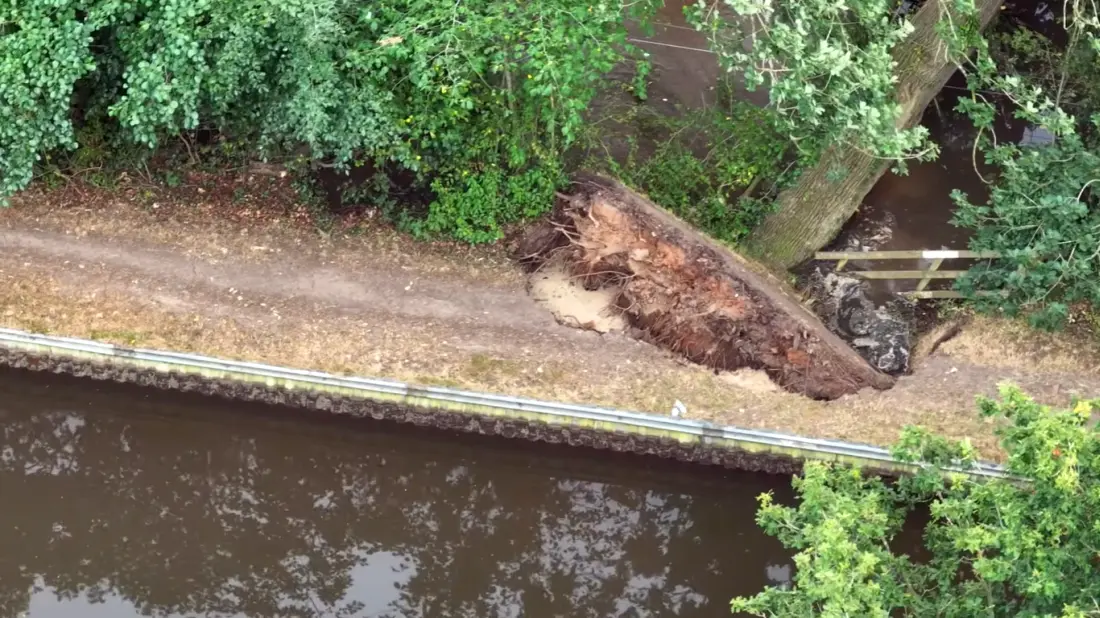
The Llangollen has again entered the foray with another breach. Whether this is a sign of the impending doom that humanity has been waiting for (eg massive forest fires, extreme heatwaves, lack of rainfall etc) isn’t yet certain but there’s no doubt there’s something in the misty horizons that we’re not yet fully seeing or understanding. Sadly, as I have said before, the canals were the real engine to industrialisation and are thus the original harbinger of the destructive and hugely polluting world we have today.
The Duke of Bridgewater had a number of mines near Manchester and he urgently desired an alternative means of transport be made available because the roads of the day were simply muddy tracks in which his carts regularly got bogged. Hence the idea of a canal to link the Duke’s mines and Manchester – and the rest of history is from there onward. The canals accelerated industrial progress exponentially in Britain and the rest of the world soon followed suit with vast swathes of industrialisation.
This latest breach at Swanley isn’t too much of a concern but it might possibly be indicative the world is falling apart at the seams as the cause possibly appears to be a dry embankment and a failed culvert. This very dry summer is certainly affecting everywhere – even the great River European rivers such as the Rhine and the Danube, whilst French Rivers such as the Loire have all but dried up completely. Yet if one looks about everywhere, the motorways and the airways are still choc a bloc with fossil fuel guzzling machines that drink the stuff like there’s no tomorrow. In fact it was pointed out that when the forest fires first began this was a momentous occasion too because the world has begun to see the greatest number of commercial air flights daily. That essentially means more stuff being spewed into the atmosphere! Not only that there’s wars where things are being blown up, including oil refineries and warehouses that have a huge fossil fuel footprint – which means extreme amounts of particulates that result from these incendiary events are distributed into the atmosphere along with the huge fires in France, Canada and elsewhere. Every bit of it no doubt helps the morass that is fast approaching. Those conducting war are dense because they are too contributing towards this very morass. On top of it all there’s the problem of modern live stuff as clothing and computers and furniture and food wrapping, plastic bags, wrappers, and exponentially expanding urban areas – which guzzle consumables like there’s no tomorrow. Where does the stuff all go after its magical one off use? Landfill or it gets blown into the environment or the sea – all of which are a greater ‘effort’ towards the nightmare world we are now seemingly facing.
I’m not too sure what to say about this latest breach on the Llangollen. In many ways its a relief its been stopped quickly and it wasn’t what anyone could call a disaster – rather it had been a fairly substantial annoyance for the authorities involved. But there’s no doubt repairs will be needed and that will involve the canal be drained and the whole rigmarole of pumping water round the site has to be undertaken once again as at nearby Whitchurch.
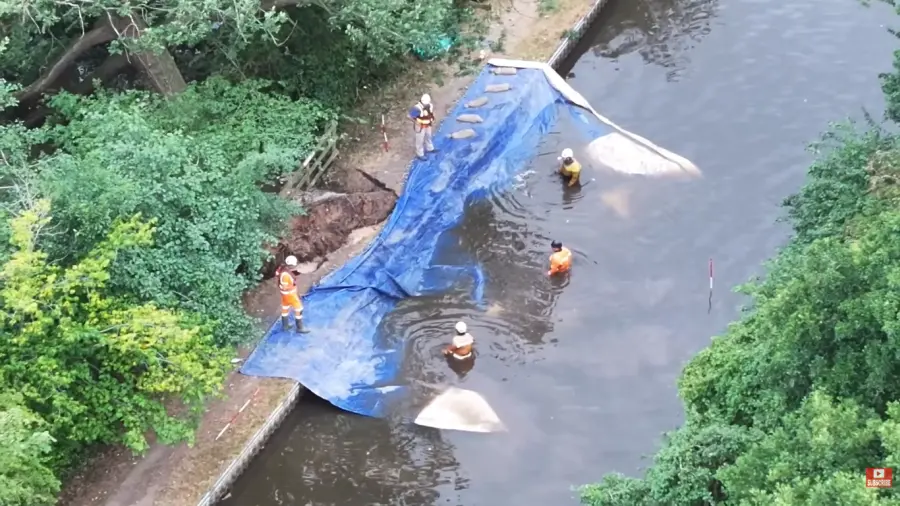
Temporary repairs to the relatively minor breach on the Llangollen canal at Swanley. Youtube.
The site of the current breach is upstream of Swanley village at what is bridge number 10 (known as Stoneley Green Bridge). Its been asserted by people living locally that the breach began when the culvert had collapsed. The tree that fell over was a result of the small embankment being eroded by the failed culvert. Fortunately work was put in place quickly and a temporary cofferdam (well, a large sheet of plastic normally used for cofferdams rather) was placed along the canal towpath and down onto the canal bed in the hope the hole would be plugged in. Interestingly in previous times canal workers would have used sand, ash, clay, sandbags and other stuff to plug the leak but we are now in different times where such skills appear to have dissipated and modern stuff is utilised instead.
Some might assert the canal wasn’t on an embankment at the location in question. It was indeed but these were quite low embankment in fact not taller ones further up such as at Whitchurch, or Hampden Bank, Whixall Moss, Fron, or elsewhere such as the great embankments on the Shropshire Union, Macclesfield or Leeds and Liverpool canals. The canal goes through a series of locks (these are Swanley and Baddiley locks) and the land is quite gentle but even so the canal needs what are stepped sections in order to attain the differences in elevations and it has to be maintained on a level, thus fairly shallow embankments are the order of the day as will be found invariably at many lock flights up and down the country.
The breach site at Swanley which is marked by the fencing seen on the right. The large tree appears to be the one that has fallen. Google Streets.
One of the curious sights of this particular breech was the water that had leaked from the canal was going back into the canal further downstream – and that is because there is a lock nearby which inevitably means the next section of canal is at a lower level than that which the breach occurred. Its not a phenomenon that’s rare on Britain’s canal system but its one that gets to be seen from time to time for one reason or another.
One piece of research I found in regards to Britain’s canals (this is an ongoing project where I have found construction plans and details of the 1982 Llangollen canal breach at Bryn Howell and also a detailed geological analysis as to why that happened) has been the assertion that the country’s canals were basically built by what can be deemed to be very skilled amateurs. There’s no doubt James Brindley had surveyed and built numerous canals and testament is due to the skills he had and the canals he built were stupendous. But these were developed by trial and error and were not by means of any special engineering knowledge. In comparison the French and the German canal authorities employed proficient and qualified engineers to build their canals. One thing they would never do would be to build embankments – unless it had been an absolute necessity. Yet this observation by a German by the name of Johann Ludwig Hogrewe – a highly regarded Hanoverian military engineer – was that Britain’s canal ‘engineers’ were utilising embankments everywhere. Its why Britain’s canal system has a quite unique signature compared to those on the continent. But as Hogrewe observed, despite the innovations and techniques used, these embankments would potentially prove an Achilles Heel for the English canal system.
Anyhow, in terms of the Whitchurch canal breach I have been watching practically every video that covers the works to reinstate the Llangollen canal. This is because I have wanted to do a eventual update on what is happening with the works. Again this is a special interest of mine because as I have mentioned previously, I was in fact involved with the breach of 1982 and its reopening in 1984. In hindsight what we have has been yet another incursion upon the structure of the canal itself – and why this latest post has been written.
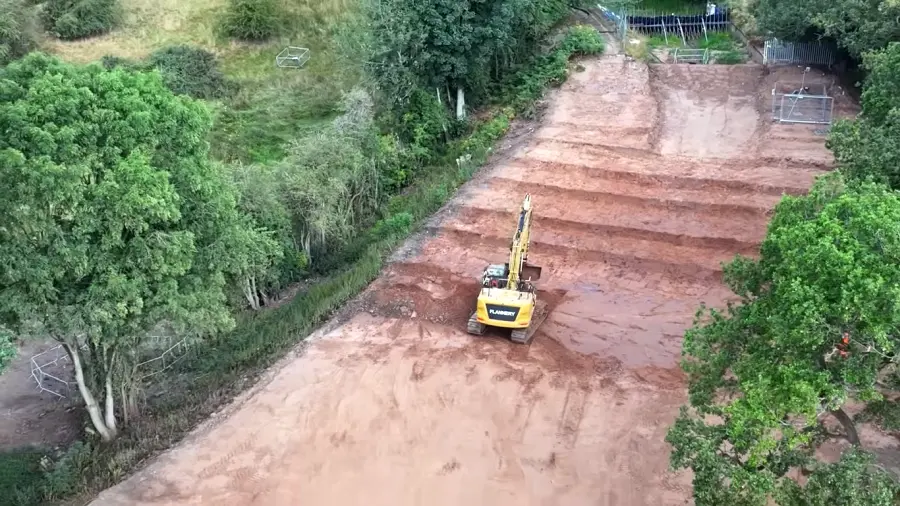
Work has begun to reconfigure the retained and pre-existing embankment as part of the new formation that’s planned. Youtube.
It is quite curious however that this latest breach began on the cusp of the work to commence the Whitchurch canal embankment’s reconstruction (rather than clearing the site, doing ground surveys, reinstating the culverts and drains and restoring the ground levels in the adjacent fields etc). The work this week began with the digging and configuration of the steps that will eventually form part of the new embankment which will have 6F5 limestone aggregate forming a structure along with geogrids at regular intervals to provide a new embankment that will be far stronger than anything else so far seen on Britain’s canals.
Main picture: The culvert collapse & fallen tree at Swanley on the Llangollen Canal. Kieran and Lottie Youtube.
Update 21.00pm
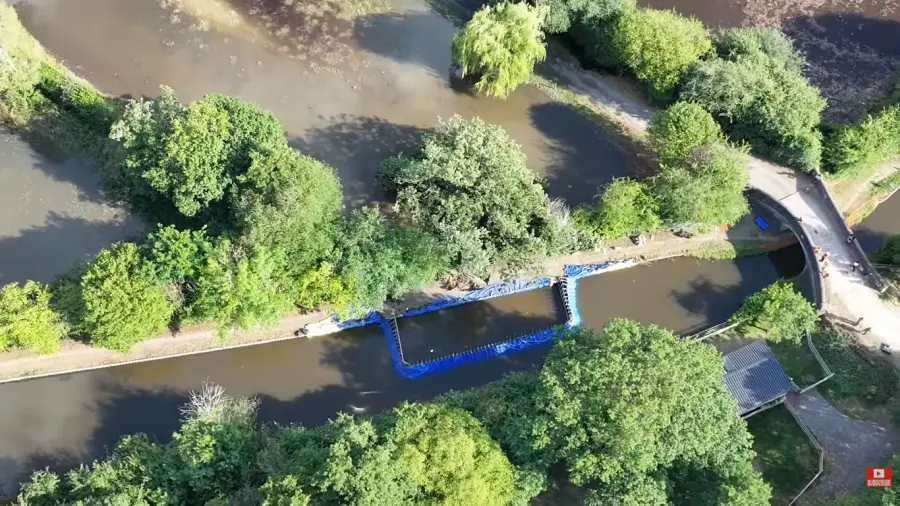
The breach site at Stoneley Green bridge near Swanley showing its temporary cofferdam arrangement. Youtube.
The Swanley breach has been resolved with the use of a side cofferdam rather than a pair across the canal itself. It permits the water to flow to Hurleston reservoir. Its been said the area within the cofferdam will be pumped out and investigations undertaken pending possible repair that will focus on this very location. If it should be foound that more of the culvert than is covered by the cofferdam area is in need of repair too that will unfortunately require the other method which is to close the canal completely and divert the water around the site. Hopefully this turns out to be a simple job and the canal can be restored to navigation quickly because Wrenbury – one of the canal’s important centres with a marina and boating facilities – is now cut off either way.
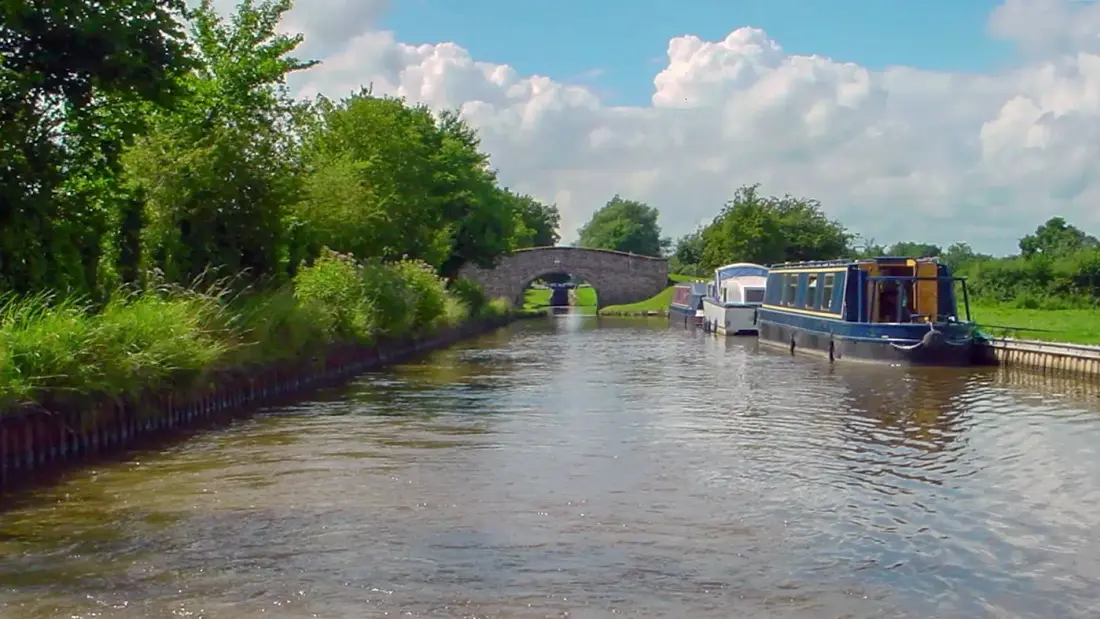
I looked through my photo archives and found this image showing Swanley top lock and bridge. Immediately above the lock is the Stoneley Green breach site. This picture was taken whilst going downstream and is one of the last photographs I ever took of the Llangollen canal, taken almost exactly 22 years ago on 12 August 2004!
Update 8th August 2026
Steve Court on Youtube has some excellent views showing the work at Swanley to install the cofferdam. He also explains that this is a leak that has been present for sometime, not just here but at nearby Bridge number 11 (Bethills bridge) also, and says its because CRT doesn’t have the funds to effect repairs. He has a short interview with CRT’s Project Manager who explains what the organisation is doing and what it hopes to do next. Below are some pictures showing both the cofferdam and pumps being installed.
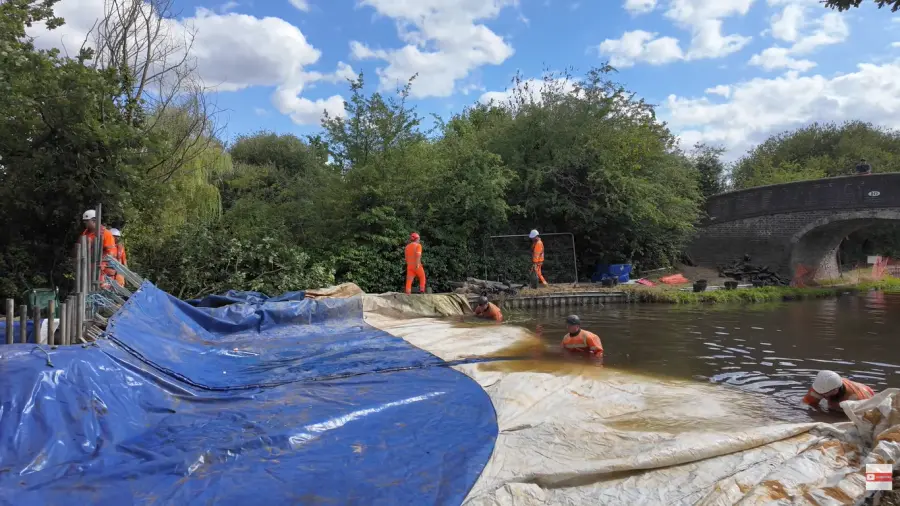
OnSite putting the emergency cofferdam in the Llangollen canal at Stoneley Green. Court Above the Cut Youtube.
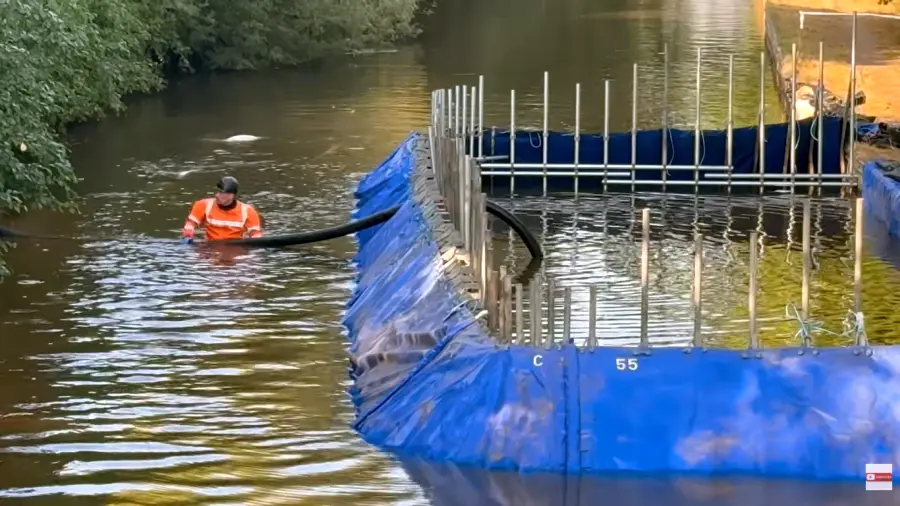
Pumping being installed to drain out the area within the cofferdam. Court Above the Cut Youtube.
As mentioned earlier, the installation of the cofferdam does not permit navigation. Its role is to allow the canal’s vital water supply to flow uninterrupted to Hurleston reservoir around two and half miles distant. Navigation is prohibited and that will remain the case for at least a number of weeks pending progress. As I said before this is quite a vital stretch of the canal because of the marinas and moorings that rely on a continued navigable link to Hurleston Junction, the Shropshire Union, the Middlewich branch and the Trent and Mersey canals etc. The loss of the section above at Whitchurch is undoubtedly a blow to numerous canal orientated businesses, but this at Swanley means further negative impact on the section below. I don’t think CRT will dawdle on any urgency to fix this. The sooner its done the better CRT can focus on the job at Whitchurch.
Leave a Reply