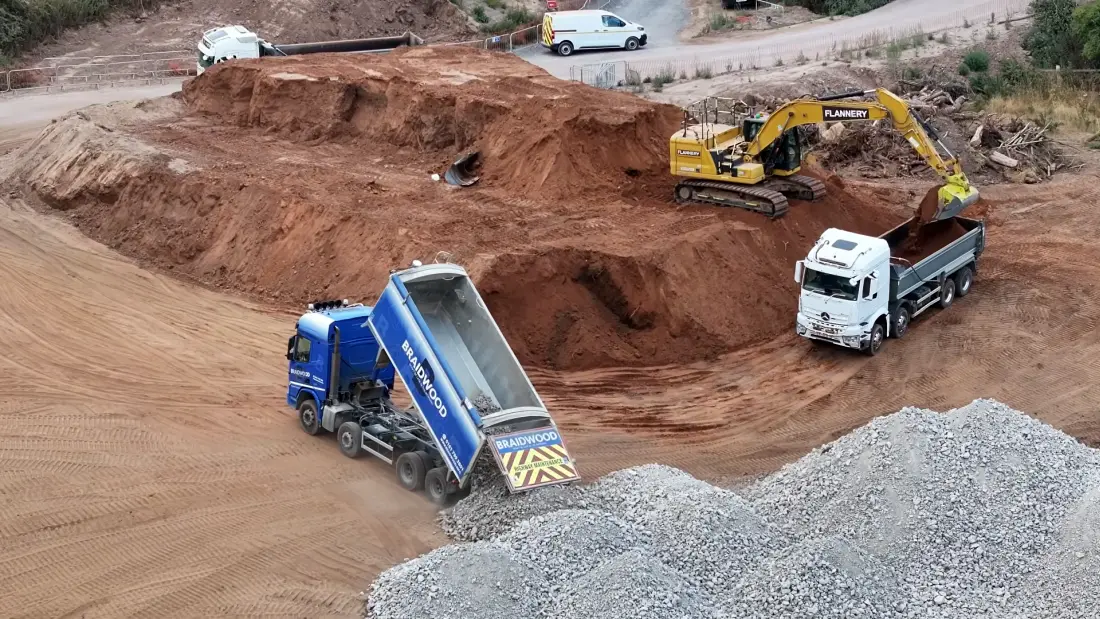
Today at the Llangollen canal works at Whitchurch there were scenes of an 8-wheeled tipper being turned away. This was a delivery vehicle that was not one of the usual to be seen – one of which is depicted in the feature image above. As Canal and River Trust’s (CRT) Project Manager has said, they are looking for a specific composition of 6F5, so this may possibly be what its all about. Its why samples have to be taken to ensure that the aggregate meets the requirements for use in the construction of the new Llangollen canal embankment and its possible some quarries did not have the appropriate 6F5 CRT are looking for.
Today also, besides the numerous lorries this week that have arrived to collect the sandy/clay soil mix CRT are selling to other contractors, the first deliveries of geogrid to be supplied by Tensar were seen on Taylor’s Youtube video. This is a vital part of the canal embankment’s reconstruction which will be used in various layers with the 6F5 forming the main substrate. It will form an internal structure of sorts which should go a long way towards effecting a far stronger and more superior canal embankment. A geogrid, when utilised with a properly graded aggregate (such as 6F5), contains a built up structure that’s superior to any other built from earth or sand.
Geogrids are a type of geosynthetic material that provides a stabilisation and reinforcement function to aggregates and soils. They make use of a two-dimensional pattern of ribs to form a series of apertures or open spaces, which enables geogrid reinforcement to stabilise and reinforce earth materials. This geogrid mesh effectively interlocks with the surrounding materials, enhancing the overall performance.
Geogrids work efficiently because the apertures between ribs allow the aggregate to strike through and interlock with the geogrid reinforcement. Provided the geogrid is stiff enough, the rib profile deep enough, and the junctions strong enough, earth materials are confined within the apertures to prevent the movement of aggregate. This forms a new geogrid/aggregate composite material with improved strength and resistance to deformation. (Tensar – world leader in Geogrid development).
Who are the suppliers for the geogrid material?
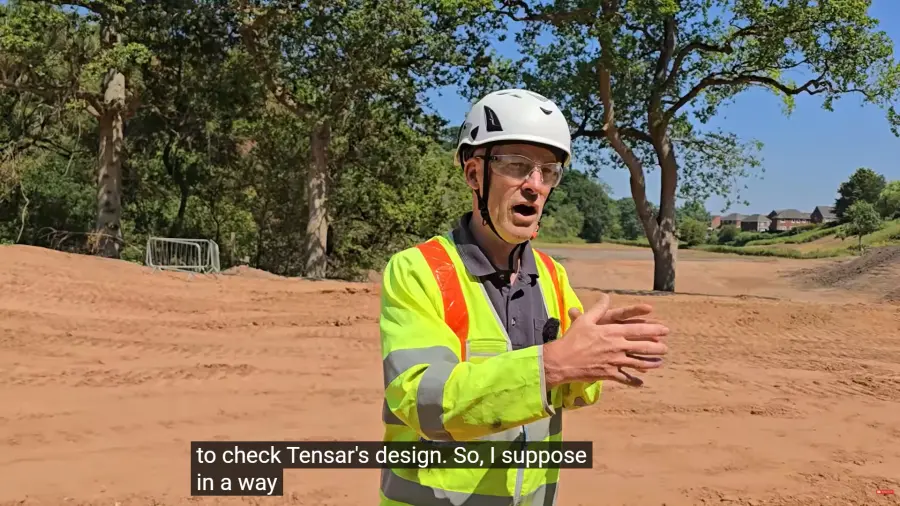
A month ago CRT’s Simon Harding revealed the designers for the new embankment were Tensar. Screencap from Youtube.

Google insists there’s no knowledge re who is supplying the geogrids for the Whitchurch embankment reconstruction!
CRT haven’t cited specific companies in terms of geogrid for the Whitchurch embankment have they? The above screencap from Google’s search page makes that very clear. That is correct as CRT have not made an official announcement in any way or form – as far as I can ascertain. For all anyone knows, the company in question could be Wrekin Products as they’re known to have a collaboration with CRT. But its not Wrekin Products by any stretch!
The truth as it is known is that Kier are the main contractors – something everyone knows because banners declaring Kier and CRT as the organisations involved in the clearance and rebuild works can be seen at several locations around the Whitchurch breach site. In actuality Arcadis are CRT’s consultants for they have a eight year contract with the charity, thus Arcadis designate the appropriate contractors and designers for the project (subject to CRT approval I would assume). As for the designers of the new embankment, Arcadis very clearly chose Tensar – a major company who are also supplying the actual geogrid material! As the screencap above shows, CRT’s Simon Harding quite inadvertently confirmed Tensar’s involvement in the project during an interview a month or so ago. Tensar are doubtless the original innovators of geogrid, a concept that’s now been embraced by numerous other companies.

Steve Court explains how geogrids work. Screencap from Youtube.
The 6F5 aggregate in detail
In terms of the 6F5, its not necessarily a comprehensive quarry material despite what many would think. A look on the Internet will revel that 6F5 is in fact an aggregate compromised of coarse and fine particles sourced from recycled demolition waste (such as brick, ceramics, crushed concrete, gravel) or primarily quarried rock (granite, limestone, gritstone). It is processed at quarries (along with limestone and other bulk) and is usually regarded as an imported material. One aspect of 6F5 not usually discussed is its cheaper than many other aggregates – yet its far more superior and that is no doubt down to it being in part a recycled aggregate. Clearly that’s a benefit for charities involved in substantial construction/infrastructure work whose finances are not exactly great – such as CRT.
6F5 is a bulk fill material used for civil engineering and construction projects. It has excellent load-bearing properties (which is what CRT’s Project Manager Simon Harding has mentioned a number of times during on-site visits – one such interview below comes from Court Above the Cut). 6F5 is often used for sub bases (such as roads) as well as the construction of embankments. Deliveries consist of 20-tonne loads using 8-wheeled tippers.
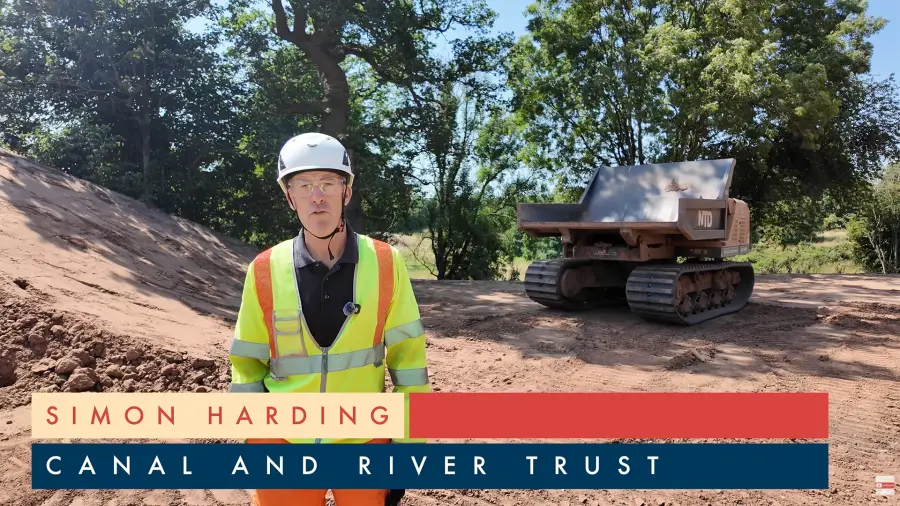
Simon Harding, CRT’s Project Manager, explains why the charity seeks the use of 6F5. Screencap from Youtube.
My name is Simon Harding. I’m the project manager for Canal and River Trust at the Whitchurch breach. Um I’m just going to basically explain some of the the background information on the material that we’re going to use for rebuilding the embankment. So, I think we all know um the original plan was to use the sand um that we dug out of the embankment to rebuild um the reinforced portion of of the embankment. We’ve now sent that sand off to testing for laboratory testing and it’s been found that it’s actually got a very fine um silt in it. So, it’s classified in geotechnical terms as a clay. So, therefore, it’s a cohesive material, not a granular material, which we thought it was as sand. So that means that uh it’s not really uh suitable for our design which is a reinforced earth um embankment. So what we’ve had to do is to look at importing material.
So we’re going to import a material which is a class 6F5 which is a capping stone which is a granular material um and use that. So what we’ve done um in the background is actually use some of the material we had had um on site, the site one material to reinstate uh the field behind so we don’t have to take off so much material. Big problem they’ve got though is it’s heavier than the sort of sandy clay stuff they’ve got. So they can’t they’re looking at options now to make sure that the properties of what they’re actually trying to buy is exactly the same. So what they need to do is make sure that the um 6F5 they’re getting is actually 6F5 and it’s not slightly different.
You can have a wide variety of different materials all under the same name. So they’re working as well with local quarries to see what they can get and that’s the advantage of using this – rather than the type that they used on the track – is this is available quite widely around here but they need to get all the certificates in place to make sure that it’s the correct stuff. So we’re in the process at the moment of talking to quarries and getting the right test certificates so we can use material that has got the right um internal friction and the right density um because the geogrid relies upon uh unit weight for the pull out on the grid section um we’re looking to make sure that although it’s 6F5 it does actually meet that criteria. (Interview at Court Above the Cut).
One other aspect of this whole matter is the exceedingly obtuse weather being experienced everywhere, namely the heat and exceedingly dry conditions that are occurring, there’s every indication that the canal embankment’s reconstruction isn’t exactly problematic at the moment. The contractors are able to work quite well in what must be quite unpresentable conditions, but it must certainly have an effect. For example the site produces huge swathes of dust cloud by way of constant vehicular movement. The entire project is slightly behind but that’s not too important at the moment. In terms of the immediate future, rather than the UK having a considerable element of fairly constant light rain as the country’s wish for an end to this dammed heatwave, what isn’t needed at the moment are torrential rainstorms. These would no doubt cause considerable damage to the entire embankment reconstruction works.
The main feature image is of a 6F5 aggregate delivery – the screencap is from Kieran and Lottie’s You Tube video 14th August 2026.
Leave a Reply