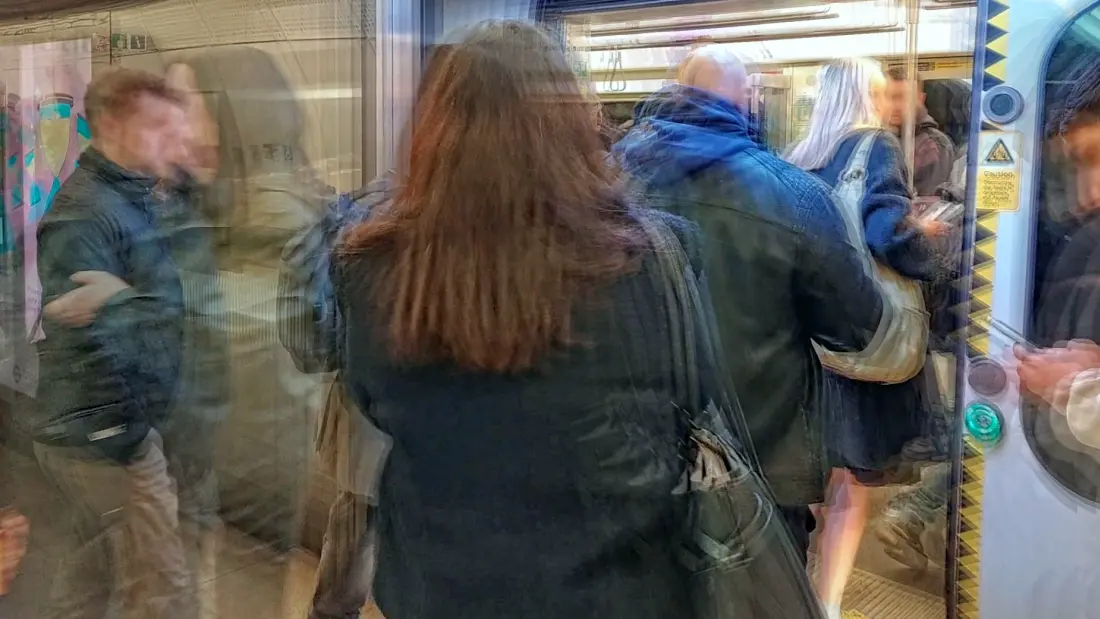
One of the curiosities of city life is the transport systems and the sheer overcrowding that occurs. A particular bugbear is the Elizabeth line, where unlike the tube in which even a degree of certain respectability remains, many people are pushing on to the Elizabeth line trains before everyone has got off. It has become an increasingly intensive phenomenon with no simple end in sight and in many cases its worse than the tube. What few realise is its an activity that’s classed as a criminality. TfL have laws to prohibit this. More on that later.
The worse situations are almost without a doubt at Farringdon (west end nearest the exits), Tottenham Court Road (west end in the eastbound direction and east end in the westbound direction), Liverpool Street (all exits but those on the east side are invariably the worst). Liverpool Street is appalling because even though it has a central corridor with a number of exits off the platforms, vast swathes of people continue to use the station by bunching up at the platform ends.
An exception of sorts to that happens to be at Whitechapel where despite the station only having one exit/entry route at the western end, passengers seem more happy to move along the platform thus less likely to undertake the activities seen at the other Elizabeth line core stations. There are conflicts in boarding/alighting certainly but these are not anywhere near what Liverpool Street or Tottenham Court Road encounter. Aside from Whitechapel, the other central core main stations like Canary Wharf and Paddington barely suffer from such insensibilities because they have multiple exit and entry points.
Further out, Custom House has an arrangement where various stairs and escalators distribute passengers over a wider area, thus the phenomenon is rare here too. There’s been lots of complaints about Woolwich because it has a single entry/exit point and this results in very overcrowded escalators and long queues for these and there’s calls for a second exit to be built. Quite strangely it does not suffer from the said phenomenon because trains start from from Abbey Wood, thus Woolwich passengers rarely have to wait for others to alight first.
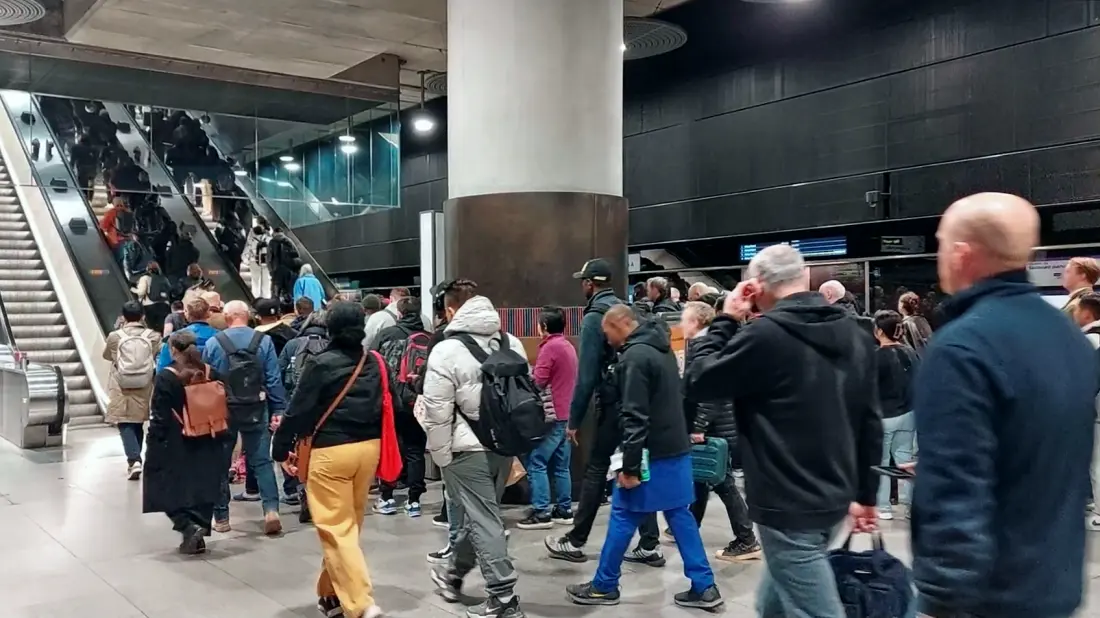
The one exit at Woolwich causes overcrowding when trains arrive at the station in the peaks but almost never causes unwarranted boarding of trains.
There’s one certainty. If the Elizabeth line is extended eastwards, that will change no doubt and its a point at which Woolwich will then become critical. The madness that exists at the Elizabeth line’s other stations will quite likely push Woolwich station over the edge.
The design of the Elizabeth line stations has no doubt produced flows of passengers that results in critical crowding. The most pressing problem seems to be that of people who try to board its trains even before others have got off. This creates a chaotic, inefficient, and uncomfortable situation. Instead of smoothly letting passengers off first the juggling between the two potentially results in additional dwell times as well as a number of safety risks. Its generally a result of extreme haste, a desire to grab available seats and amounts to a simple lack of courtesy.
Elizabeth line platforms on the core section are huge but it makes little difference. There’s oodles of space for people to move about and stand aside as others get off the train. The question is why do people want to get on the train before those others have got off? There’s far less space on the train to move about! Logically its those on the platform who need to move about and make space for those wishing to alight – not the other way round. But no-one seems to understand that. People will crowd about the platform screen doors and as soon as the train arrives everyone is battling to get on the train no matter who wants to get off.
What people do…
The things that people do at the Elizabeth line stations is shocking. They have fights, pee on the platforms and throw up liberally in front of home going commuters. There’s no doubt the constant problem of trying to get off Elizabeth line trains just because others want to crowd on first is very much a bane for most travelling on the line. One guy entered the platform with a pile of plastic boxes and plonked these down right in front of the the passengers trying to alight and then refused to budge.
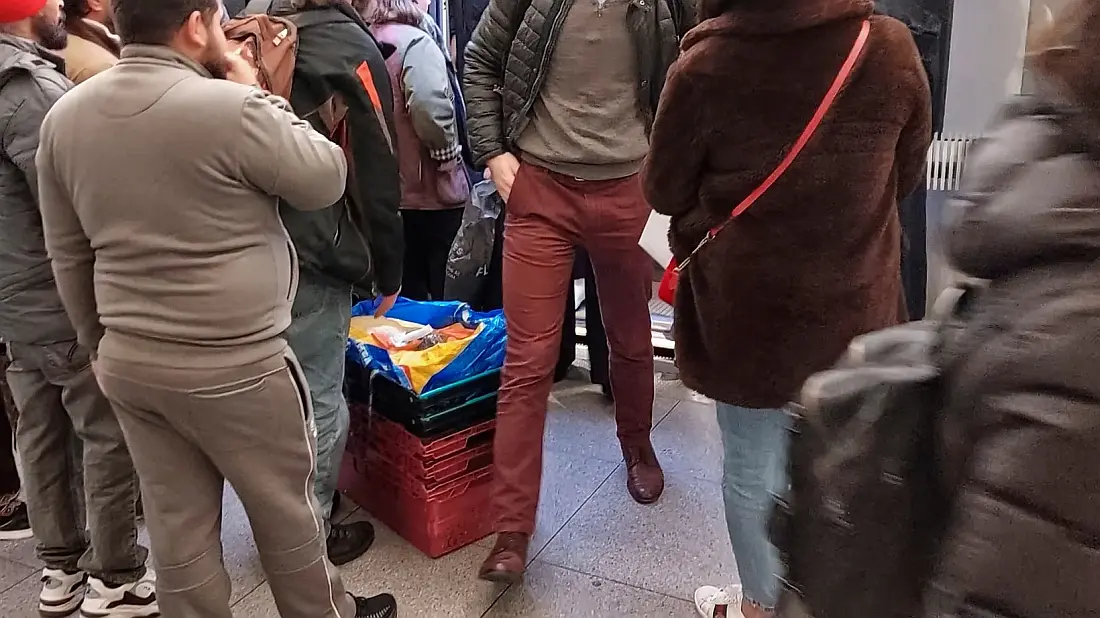
These boxes have a higher priority! In this instance there were sixteen passengers trying to get off the train, never mind the boxes and others crowding around the doors!
Some seem to think the Elizabeth line trains are bigger on the inside than they are on the outside. If people wish to get on a train the simple thing is to let others off first. Contrary to what seems the popular notion, there’s no magic portal through which the trains’ current occupants can disappear in order to not have to disembark!
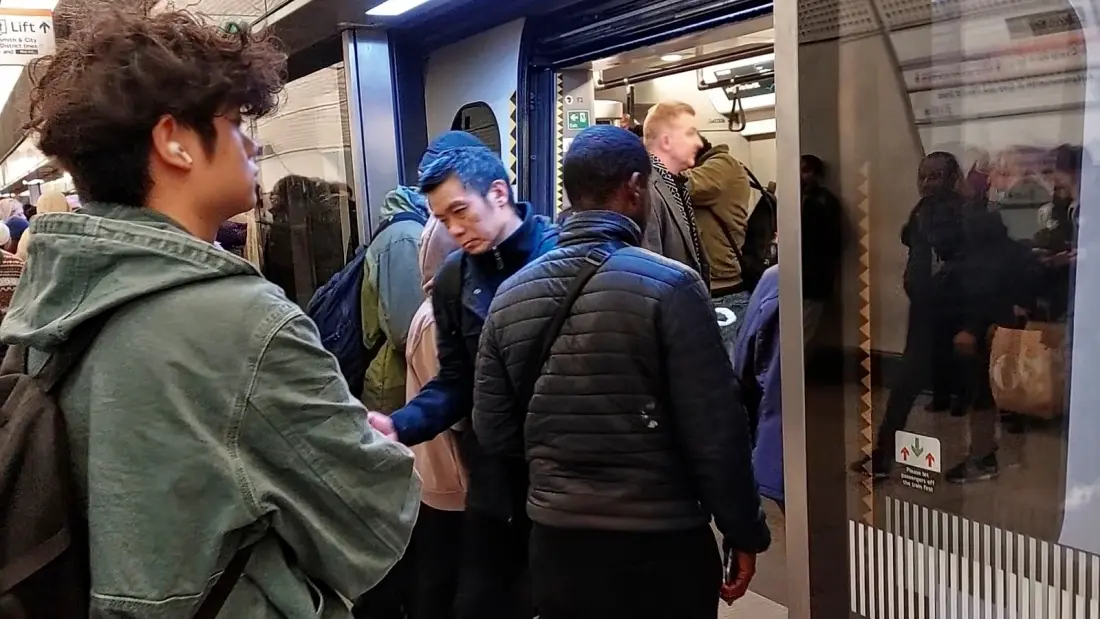
One small example of ‘de-prioritisation’ by EL passengers. The guy in the middle grimaces as he has to push past others about to board the train. At least six passengers boarded before he could even get off. Just three waited. Even so these three still blocked his alighting the train.
People with luggage usually massive, stand right at the interface with the PEDs (Platform Edge Doors), and refuse to budge. They’re going on holiday or have just come back from holiday, or might even be taking books or other paraphernalia to the charity shops, or its their work they taking – say a legal worker with loads of papers that they’re towing along and they refuse to budge and like all the others also barge their way onto trains. One must wonder how many lawyers, barristers, solicitors and even parliamentarians undertake criminal activities daily? I mean they don’t even have to carry anything except a small case or shove their papers in a rucksack and still continue to insist they’re first on the train no matter whomever wishes to get off. That as well as bashing everyone with their rucksack still tethered to their back!
De-prioritisation is illegal
Boarding before others alight is against the law. TfL byelaws state that no-one is to enter a train before others have got off. This byelaw is intended to ensure that orderly boarding and alighting is practised on London Underground, London Overground, DLR and Elizabeth line services.

Transport for London Byelaws stipulate that people do not attempt to board trains before others have got off. (Link to document).
To all purposes and intents the act of boarding a train before others alight is a criminal offence – much like those who force their way past ticket barriers. Somewhat little is done however, and there is no doubt a measure of confidence among fare breakers that they wont be stopped. A case that arose in February 2026 where a prolific offender was let off entirely despite the cost of the tickets (deferred) and the prosecution costs dropped – despite their also having committed further offences on the day of sentencing. It certainly gives the idea that maybe yes, it might be better to avoid paying fares. Even so, the publicity and the shame that befalls can only be viewed as a punishment of sorts too and one that’s not easily avoided.
The problem with boarding offenders is if TfL even tried to apprehend the worst offenders there would be so many it would likely overwhelm the courts as well as TfL’s legal teams. In a sense its why more of a focus is upon fare evasion because that is in any event a deliberate attempt to carry out a criminal act – whereas barging onto a train before others have got off could easily be down to things like idiocy, selfishness and not being aware of the law.
Even if anyone is caught (say for fare evasion) its not a recordable offence (unless perhaps it is a crime of the highest order) so there’s little incentive to honour the laws (and the implicit etiquette that is a subset of these byelaws). One can only deduct the byelaws are totally useless especially this one linked to boarding/alighting trains. Why bother having such a law when no-one takes any action? And when TfL does not publicise that any de-prioritisation of those wishing to alight its trains is illegal and basically subject to a fine of £1000, who cares?

The Elizabeth line’s ROC at Romford certainly has an overview of what happens however the monitoring of individual stations + crowd/boarding activity is more for the control rooms at individual stations. Pic from My London.
On top of that anyone could surely be wondering how TfL can even enforce such a law in terms of boarding/alighting trains. Maybe its impossible? But TfL have cameras and staff watching so they MUST know there’s a considerable amount of law-breaking going on. Not only that TfL are best placed to use their cameras, monitors and vigilant staff to determine possible actions and future measures that could mitigate the situation, especially that on the Elizabeth line where this particular problem is increasingly fractious because everyone thinks they have more of a right to get on a train that those needing to get off.

TfL clearly know how much load their trains have. This is an older example seen in the control room at Palestra. The Elizabeth line has a far more modern version which can detect loadings in individual carriages. Screencap from Youtube.
The situation on the Elizabeth line is bad enough. Part of that is essentially because the Elizabeth line station platforms are fed from the ends thus the worst offences happen to be at the extremities of the platforms where most people come off the escalators. Obviously this considerably poor system of passenger distribution is a design that’s partially to blame. The fact the Class 345s are walk through trains does not really mean a lot if the end pair of carriages are full to the brim – meaning its hard for people to filter through into the lesser crowded parts of the train.
The byelaws in question
In terms of de-prioritisation, its evident no one reads railway byelaws. Not even the conditions of carriage. Yes TfL has those just like the main line railways doo too! The very first words one reads (should anyone even be bothered read it) is:
When you travel on our services, having bought a ticket or when using pay as you go or a free travel concession, you enter into a legal agreement with us.
‘But I haven’t entered any agreement with TfL nor any of its staff!’ Exactly! Its one of those many agreements in life one ought to abide by even though there’s no paper work to be signed. Its much the same as entering a shop, supermarket, theatre or even a park, a library, a council building etc. No agreements need to be signed but at the same time there are laws that one needs to abide by. Evidently in a general way its just that as long as one undertakes their affairs with good common sense, well one should not have to worry. Its the same for the tube, the buses, the coaches, the trains, the trams and even the airlines. Before anyone thinks otherwise, yes taxis and mincabs too! Simply anything that is a public service/facility has rules and regulations.
Transport for London Conditions of Carriage for Bus, Tube, Tram, DLR, London Overground and Elizabeth line Services (link).
Its the same with the Elizabeth line. When one is prioritising their boarding onto an Elizabeth line ahead of numerous others wishing to get off, well that’s the point at which one basically gets to be a criminal. It doesn’t take much but yes, anyone irrelevant of their status or standing in life invariably becomes a criminal once that activity has been undertook. That means many! Essentially there’s few with an unblemished record!
How do people know its illegal to travel without a ticket if they don’t read the byelaws? Well they’re not stupid because they see evidence that its an activity where lawbreaking is strongly frowned upon. One can’t simply enter a station without passing through a barrier or gates – so obviously there is a check in progress. Not only that roaming inspectors and often intensive efforts at stations that involve a combines of Met police, BTP police, local council staff and TfL inspectors. Then there’s the embarrassment which comes to persistent offenders who have their names, place of abode, and their crimes publicised for all to see and read and be broadcast on the media/Television/Youtube etc.
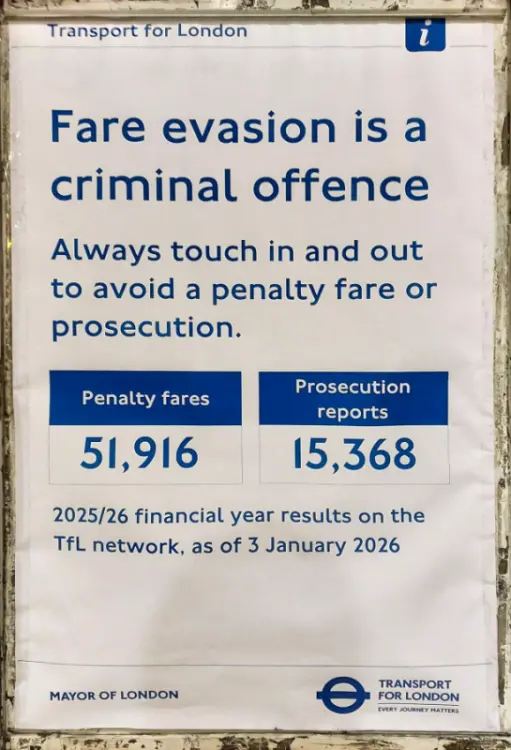
One way passengers will no doubt realise the illegality of using TfL services without authorisation is by these statistics published for such activities.
One does not see these sort of things underway to ensure/check that people don’t aspire to barge their way onto trains before anyone gets off. Its not evident nor is it even advertised as a criminal activity. If anyone becomes aware that anything of the sort might be amiss, its usually a sort of ‘be careful’ message. Platform staff will probably make announcements such as ‘stand clear of the doors, please let others off first.’ But that’s about it. No mention of law-breaking, criminality etc. If that were to happen no-doubt everyone would be accusing everyone else of being a criminal and punch ups could likely occur – and that’s not a scenario which is beneficial to anyone!
Surveys that investigate the problem
Even though TfL no doubt have the means to monitor and mitigate the problems that arise and they can certainly record and evaluate things that have happened by way of their numerous CCTV cameras, the problem is how to address the situation without materially affecting the flows towards the station exits. Studies have in fact been done on the Jubilee line however these are probably a little dated because these were done in 2016, eight years before the Elizabeth line had opened. Those studies involved Green Park and Westminster tube stations because the former has no PEDS whilst the latter has PEDs and this made for a direct comparison between the more traditional, classic style of tube station against one with PEDs.
With that model it was to see if any difference in the distribution of passengers could be observed at both stations. The answer is yes. Passengers were more orderly at Westminster than at Green Park and it could also be seen how the closeness of passengers to the doors affected the flow of passengers alighting especially at Green Park. At Westminster however, the effect was much less because passengers often formed orderly groups to the side of each PED, thus giving those a better means of alighting the train first. The published document for the Jubilee line is Boarding and Alighting Matrix on Behaviour and Interaction at the Platform Train Interface (2016) and was collaborated between UCL and TfL.
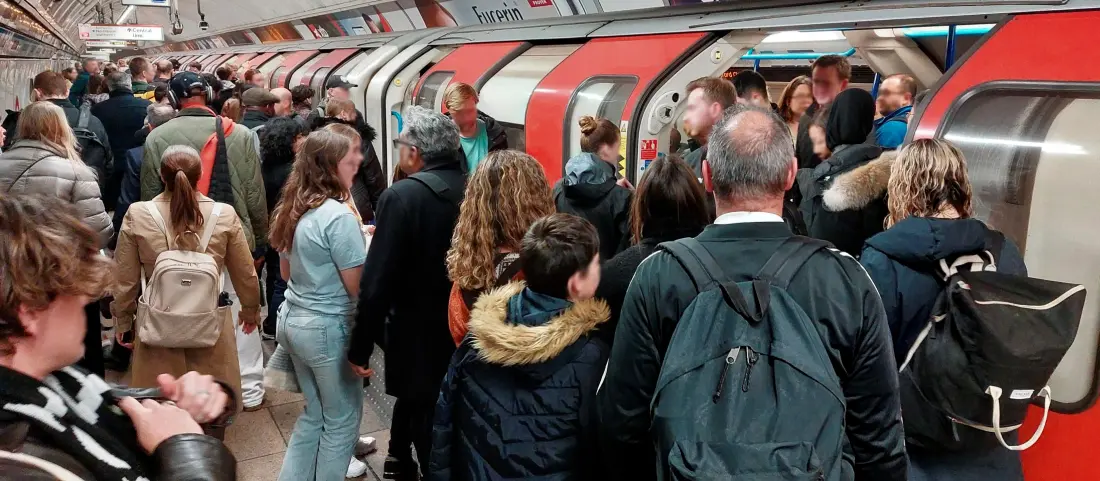
Despite intensive studies no real answer has been found to the problem of those boarding before others have alighted. This recent scene at Oxford Circus (Victoria line) shows a number of people attempting to board the train (and also two actually boarding) despite the fact there’s six passengers still waiting to alight.
The 2016 work was followed up by research done in 2019 that involved life sized mock ups of tube train doors. This work was done by PAMELA (the Pedestrian Accessibility and Movement Environment Laboratory at UCL). This was done for the next generation of tube stock (such as the 2014 stock for the Piccadilly line) however again this work is not relevant to the Elizabeth line. One thing it does show is very often those alighting usually consist of two flows. The first make a very quick exit from the train and then others follow, somewhat more slowly. This creates a gap of sort in flow and in a number of ways this sort of gap in the flow is partially responsible for the frustration of those trying to board a train. There’s no doubt that frustration then builds and those wishing to board soon get quite noble at forcing their way onto the trains before everyone has alighted.
What solutions are available?
It might come as a surprise to know the art of getting on and off a train is probably the most dangerous part of a journey, and where there is a clash between alighting and boarding passengers the increases can rise quite considerably. This has indeed happened at Ealing Broadway (famous for its very unequal Platform Train Interface where a large step up as well as a gap outward has caused a number of falls and injuries. However its the station end of the London bound platform that has suffered the worst because people also rush to board the trains and they collide with people getting off.
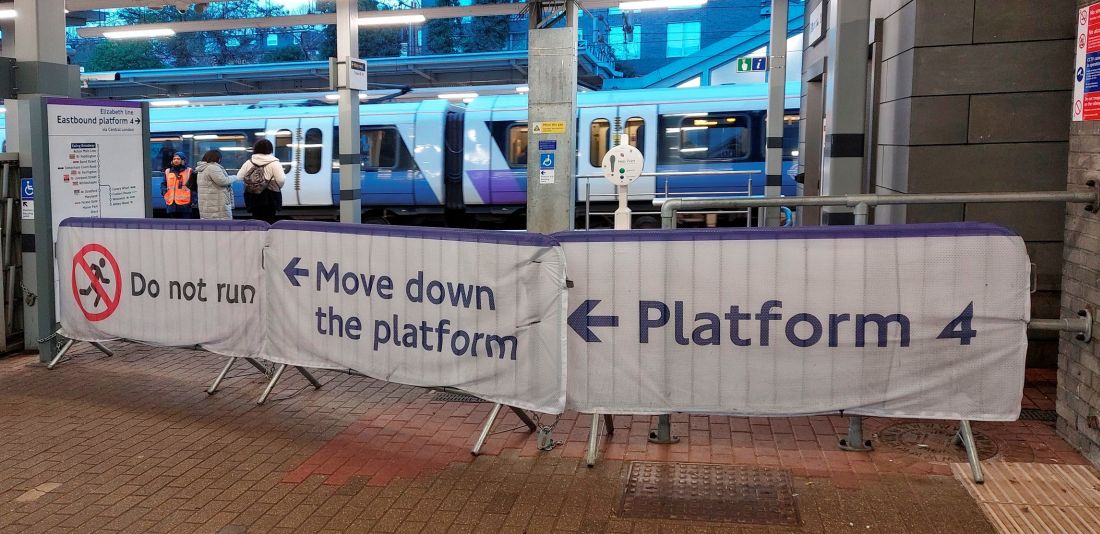
One possible answer to the Elizabeth line’s woes of prioritising boarding and alighting trains can be seen at Ealing Broadway station. These have been in use since April 2025. TfL say this is a temporary measure while longer term solutions are investigated.
Whilst not really being an exact example of the problems the Elizabeth line has, what can be seen at Ealing Broadway is one means of how a system of boarding and alighting the trains can be undertaken at the Elizabeth line’s core stations. The Ealing Broadway arrangement was originally undertaken because many people were running from the stairs to the trains and then attempting to jump on board these, but failing to take proper note of the substantial gaps along the platform and people were injuring themselves. However it does reduce the number of people wishing to get on the trains before others get off by moving people further down the platforms – although the system doesn’t resolve the same sort of problems which occur further down the platforms, it does reduce those at the most critical point nearest the stairs and exits.
There’s no doubt for the foreseeable future passengers/customers alighting from Elizabeth line trains will likely find their exit blocked by those wishing to board, especially at more busy times of the day. Until TfL find a solution to the problem there’s no telling how long it will continue or how worse it will get.

Leave a Reply