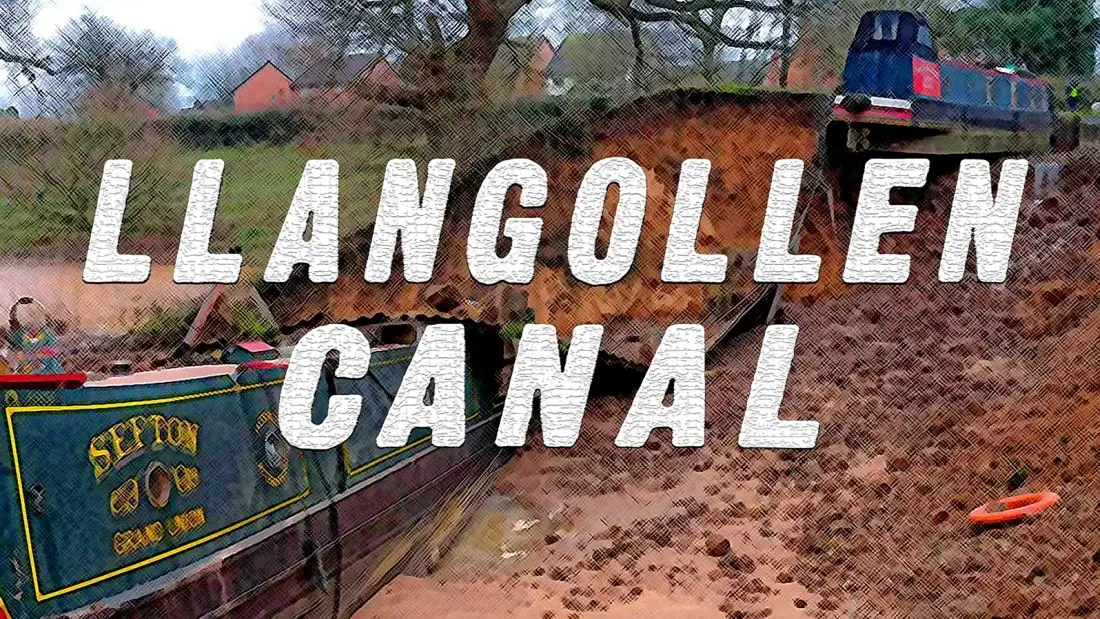
At this time of writing the canal pumps are working and a number of pipes have been laid to convey drinking water (well filthy canal water rather – but it WILL be treated accordingly and purified in order to become drinking water) to Hurleston. No doubt it’ll be thirst quenching tap water for the numerous railway workers at Crewe – one of the rail system’s vast meccas of yards and maintenance depots! The emergency pumping got underway even earlier than I had thought. I decided to do a second post as the first was getting too long and the last two entries from the first post covering the subject of the cofferdams and bypass pumping have been transferred here. Have also decided to try placing the latest item at the top of the page rather than at the bottom of the page!
Its Xmas Day – but the festive period sadly hasn’t been fun for the boaters involved in the Whitchurch/Llangollen canal breach.
A video from River Canal Rescue (RCR) highlights the work to re-float and righten the narrowboats. One issue with any narrowboat is the freeboard is very shallow thus exhausts, drain holes, etc are very low down often just above the level of the water. If a narrowboat tips over its one sure way of sinking because of this design. Its not a fault, its just how the boats can be designed – that taking into consideration besides the boat’s width, the air headroom available (eg low bridges and canal tunnels). Let’s not forget the old working boats had their exhausts finished as chimneys and all washing and cleaning was done by way of bowls, thus these working boats could operate with the freeboard practically level all around.
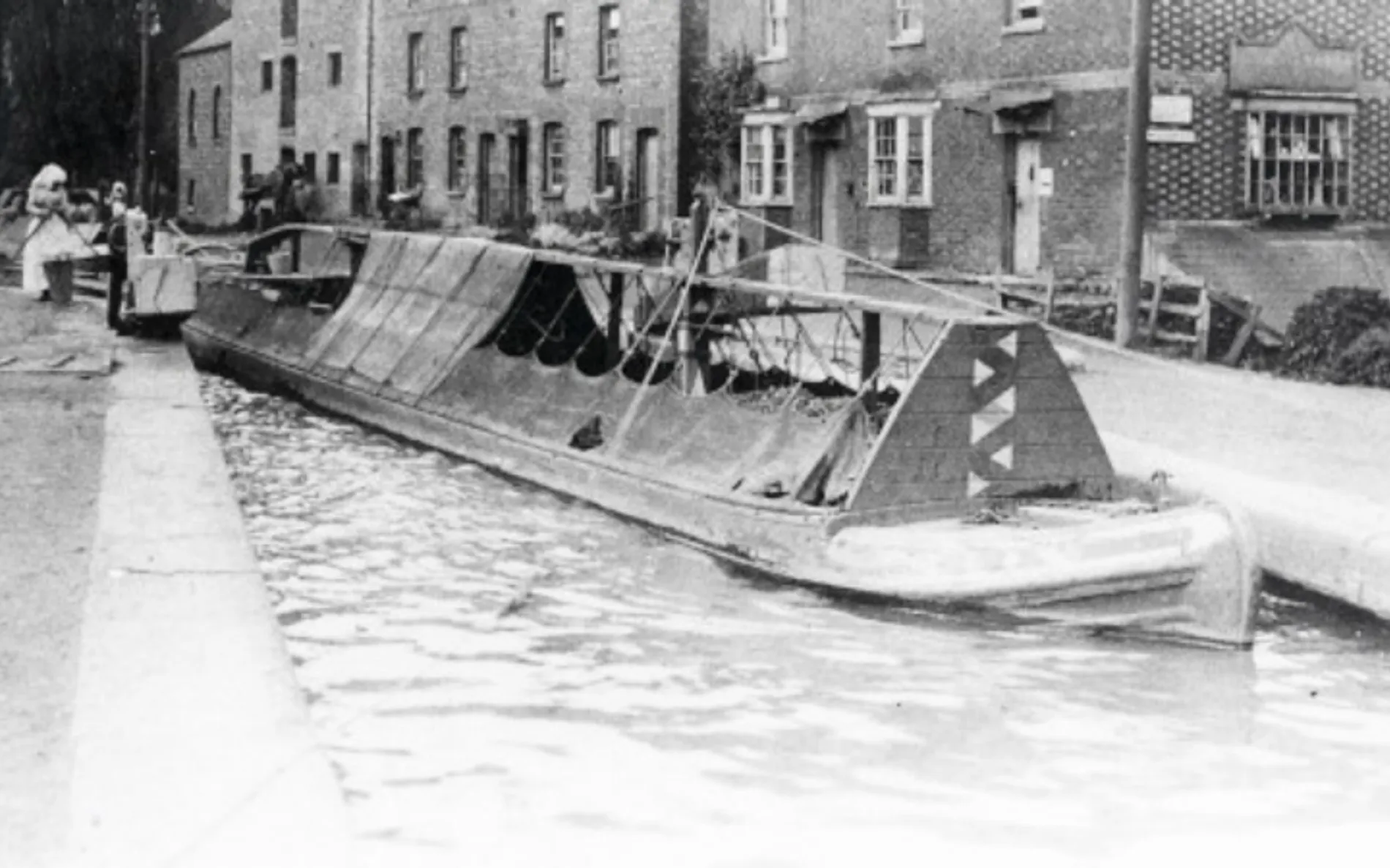
Image from CRT showing how the freeboard of a working narrowboat could sit so low in the water. Its just the style of boat that’s used and when utilised to the full with goods (depending on the weight of the stuff being conveyed) they often sat really low in the water. The picture is of a butty (unmotorised boat) and its no doubt horse drawn (the horse can be seen in the background) but whether it was motorised or unmotorised the principle was the same. The heavier the goods carried the more the boat sat lower in the water. To do this these boats could not afford to have any sort of holes placed below the gunnel.
With modern narrowboats there is a difference (because of the mod cons etc) thus basically these need a much higher freeboard. Even so some anomaly (such as being tipped in a lock or the canal suddenly being emptied of water) can compromise these modern narrowboats. Its why CRT wanted RCR to assist in ensuring the boats affected by the breach could be righted slowly, in order that they didn’t sink upon the canal refilling.
Update 13.25pm 25th December 2025.
Have just realised there is a way to rescue the two boats stricken at the base of the ‘sinkhole’. Empty the flooded field then winch the boats along perhaps a series of railway sleepers laid along the top of this field and up to this road (serving Chemistry/Greenfields) adjacent to the Whitchurch town (Chemistry branch) canal!
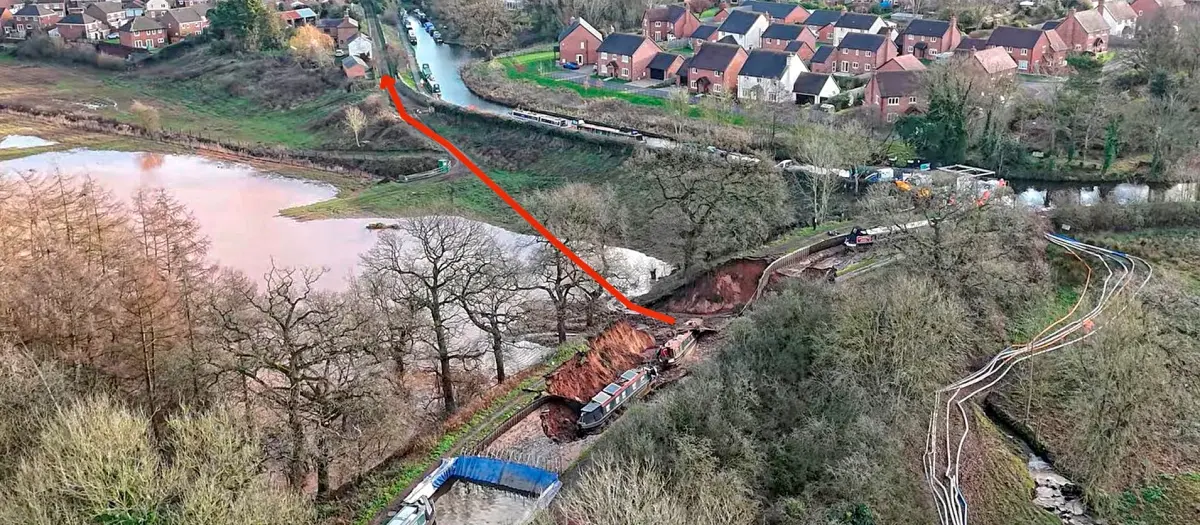
They could winch the boats out of the ‘sinkhole’ and away from the breach site. Then realign and winch the boats up the slope into Whitchurch itself.
The above image was screencapped off Youtube – I added the red line to show a possible means of extracting and winching the boats up into Whitchurch itself.
Update 16.30pm 24th December 2025.
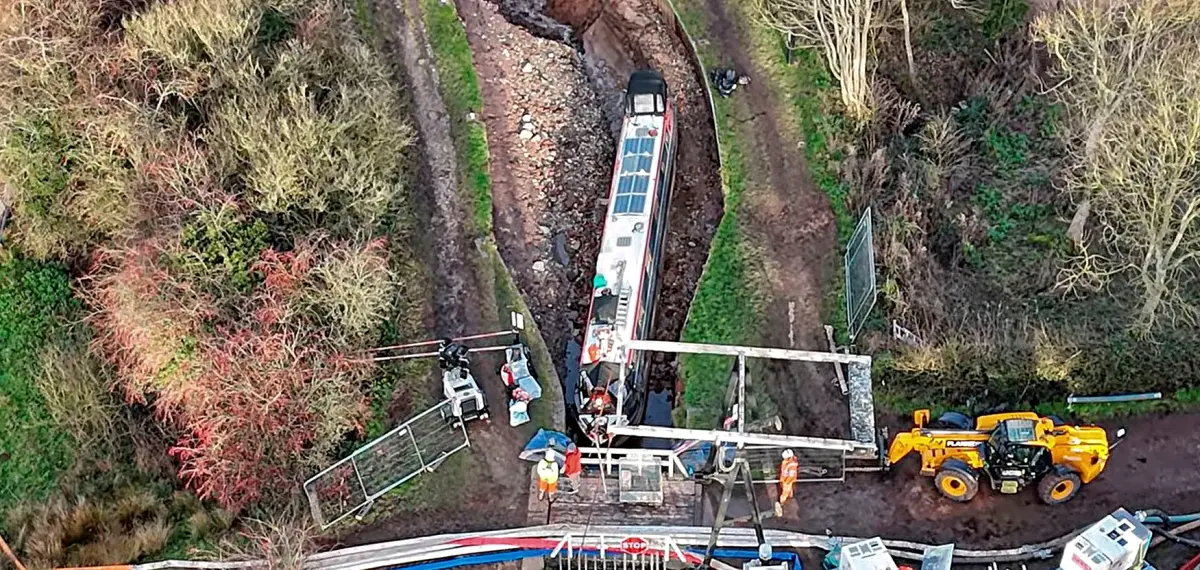
The narrowboat ‘Pacemaker’ has been dragged up to the lift bridge. That’s one boat sorted in terms of rescuing the three. The question however is the means of craning it out. As for the two stricken at the bottom Julie Sharman had implied all three would be rescued, thus innovation is definitely going to have to be employed to rescue those others. Picture: Neil Jones Youtube.
In terms of rescuing the one boat from the breach site CRT said:
The team has also been able to rescue the boat teetering at the edge of the breach hole. This was possible thanks to a specialist winch operation, using a heavy-duty tracked winch measuring approximately 5m by 3m. Once in location, the winch was able to haul the boat along the drained canal away from the breach hole. The boat is now safely located next to the lift bridge. In the new year, a dam will be constructed beyond the boat and it also refloated. CRT Update.
Observers (eg on Canalworld Forum) are expressing some surprise that CRT’s Julie Sharman had said the canal will be opened between six to nine month’s time. I had more or less said the same as CRT too that it would be autumn or possibly winter 2026 and I also said it could ironically be done before the Bridgewater’s own breach repair is finished.
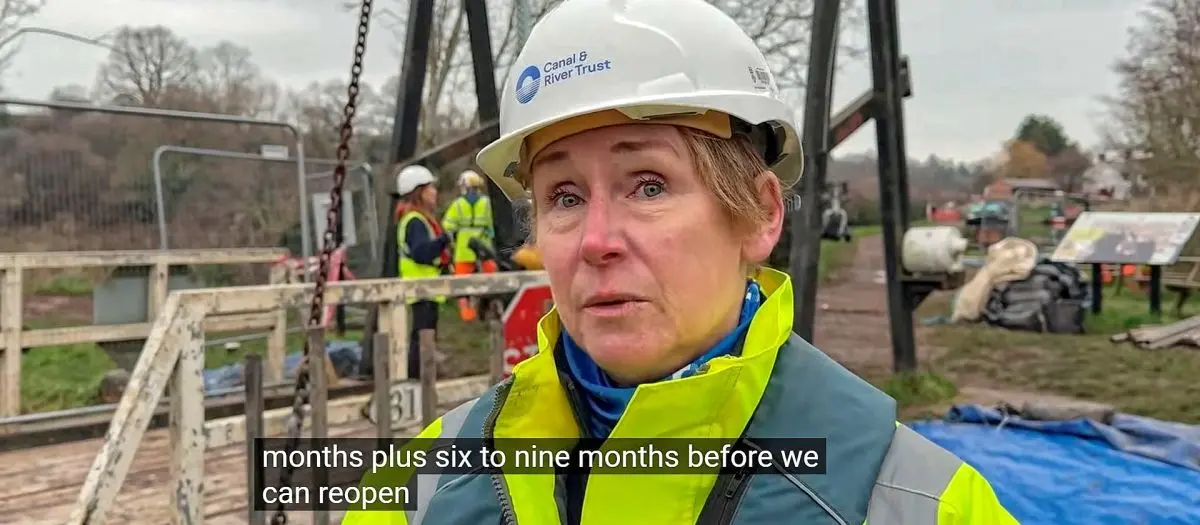
CRT’s Chief Operating Officer Julie Sharman on when the canal could reopen. Full interview starts here on Youtube.
One must remember there is a business/commercial requirement by a public utility that the canal supplies them with a certain amount of water each year. The reason the Llangollen canal never closed compared to many other UK canals is because it has this unusual role of bringing vital water from the Welsh mountains to the north West of England (yet another reason it didn’t close was because it supplies water to a major part of the North West canal network too – including the Bridgewater!) There’s also a vast tourism and hire boating trade dependent on this particular canal.
Thus it is in CRT’s (as it was for British Waterways) interests to keep this vital water supply route operating in one way or another. Of all the UK canals, the Llangollen is specifically one which will get repairs done faster than is usual – and this is because all the stops have to be pulled out.
Update 15.45pm 24th December 2025.
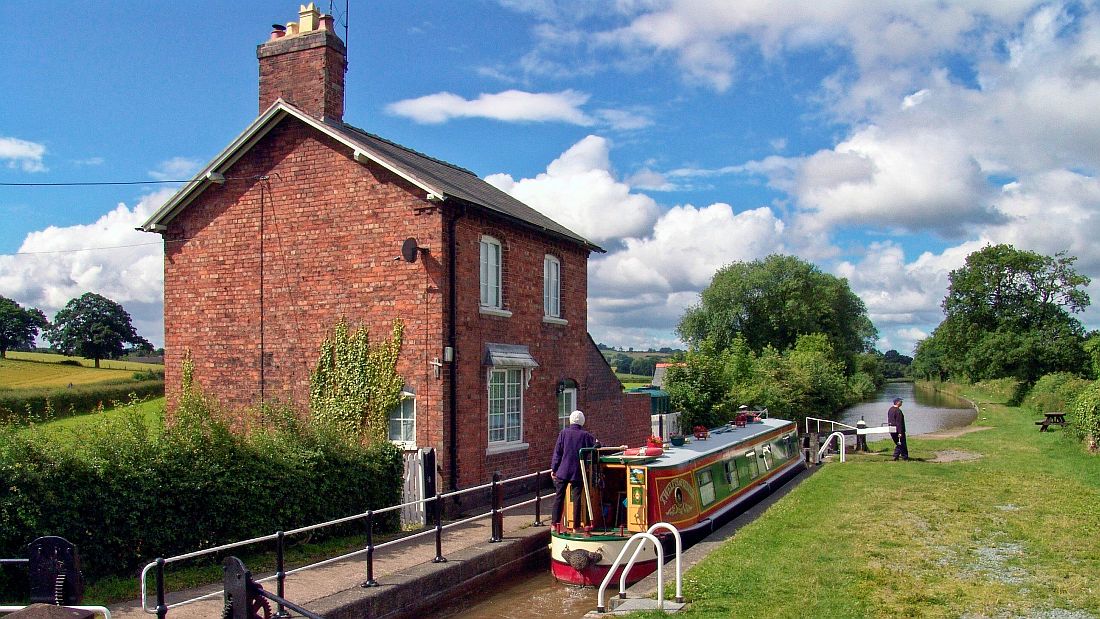
Having mentioned the locks below Grindley Brook, this is Marbury lock, the first of the four above Wrenbury. Pic from one of my more recent Llangollen trips.
Updated 09.15am 24th December 2025.
Good film released an hour or so ago showing a lot of scenes at ground level rather than by way of drones. It shows the emergency pumping outlet in use. Includes a chat with CRT’ staff’s Julie Sharman – who was also a prominent feature in interviews at the time of the Toddbrook reservoir dam failure. Julie says ‘six to nine months before we can reopen the canal.’ Seems quite confident the boats stranded at the bottom will be rescued. Sharman confirms TWO culverts underneath the embankment – thus the lesser known example is the one that’s failed rather than the main one. Narrowboat Life Unlocked Youtube.
Updated 09.15am 24th December 2025.
Two aerial views of the latest on the Whitchurch bypass pumping. These are from Neil Jones Youtube.
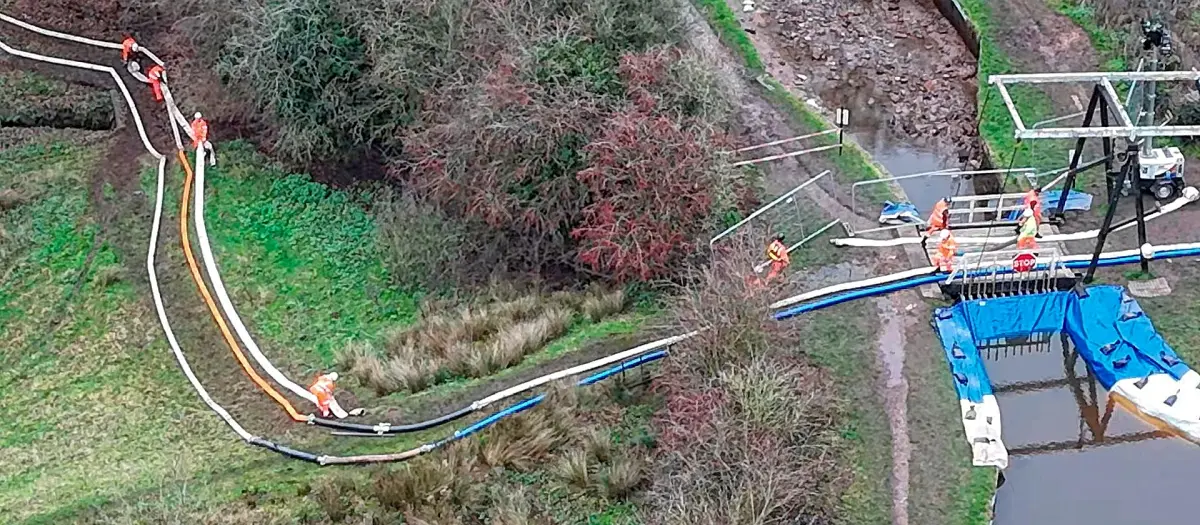
The pipework at New Mills lift bridge can very clearly be seen. Two large pumps now installed and looks like its going to be a fair set of pipes (three, four, maybe five pipes whatever). The piping can be seen going over the top of the Staggs Brook culvert. Source: Youtube.
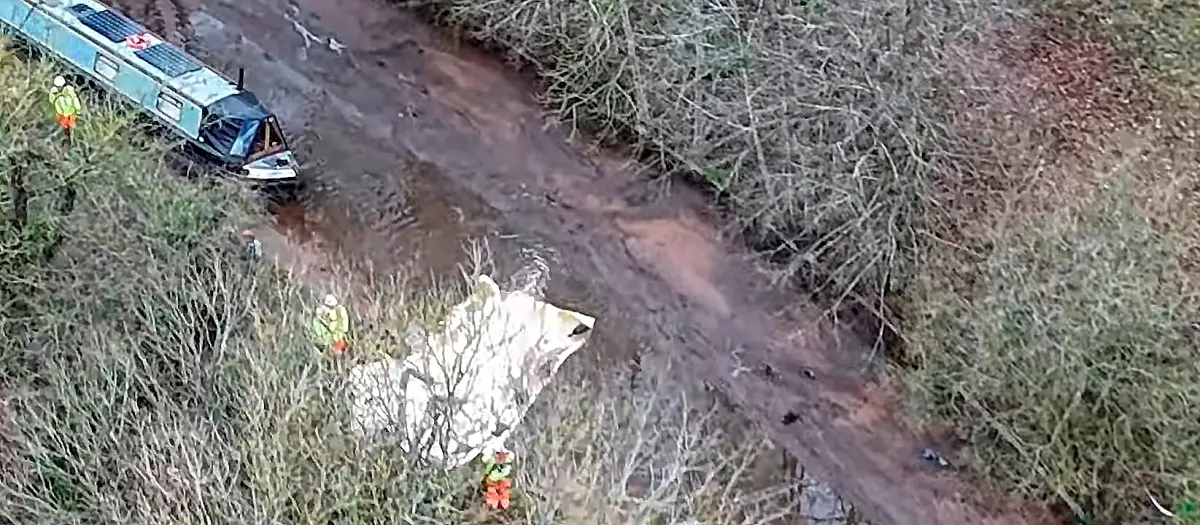
The pumping was clearly in operation during the afternoon of the 23rd December and the canal was just about to see its water levels rise slightly. This bit of canal wont take long to fill because its abut 1.5km to the top of Grindley Brook staircase locks that needs filling. Source: Youtube.
The white tarpaulin sheeting is doing what I had suggested it would do. Exactly when I couldn’t tell as so far I’ve not seen any information to say when this commenced – nor any chronology to detail the day’s progress. Hence its a matter of guesswork.
In terms of filling the canal too needs water below Grindley Brook because the entire flight is totally empty. Its full below the Grindley Brook flight however navigation is not allowed beyond Povey’s lock some 1.5km (a mile or so) further back – although the uppermost turning point for boats would be at Wrenbury meaning any boats in that section will have a long trip of about eight kilometres or five miles reversing back through Quoisley, Willeymoor and Marbury locks! Evidently if they wait a week, maybe two , maybe more, they’ll be able to turn at Grindley Brook.
Last night I decided on a well earned rest and decided to watch Oppenheimer on BBC IPlayer. Despite being a pacifist and against all forms of militarism, it was in fact a great film – better than I had imagined it would be e.g. it wasn’t exactly the celebration of war I had imagined it to be – and it did explain why the atomic bomb was necessary – largely because the Nazis were developing one too.
This Llangollen stuff is why the whole writing blogging stuff (not just this one but several other posts that too are getting shoved further and further behind). Had thought these would be done by Xmas but as I said yesterday Xmas is going to be all work and no play – or pay either. Rather its just my sheer dedication of putting out stuff for others to read. My decision to spend the best part of the evening watching a three hour film is why I did not see the above mentioned video that was released last night around 9pm giving the latest aerial views on the Llangollen canal bypass pumping progress.
Updated 08.30am 24th December 2025.
Two views showing the emergency pumping system that’s being installed to enable the water supply to Hurleston to continue.
I had thought they would use an elevated structure slung above the towpath section but no, they’ve sought permission from the landowners of the fields below and are instead taking the emergency flow pipe through the top part of that and also the northern end bit. Much of the route involves laying the pipe along the bottom of the canal embankment which suggests this bit could be CRT’s own property. The following pictures show the emergency pipe route. I have highlighted the course of the pipe in the second image because that was the end of the video I had sourced these images from. It seems CP Overview must have left before the work had been completed. I assume the emergency pumping system was put into operation late this afternoon, possibly as nightfall arrived. The full drone images from this afternoon can be seen on CP Overview’s Youtube.
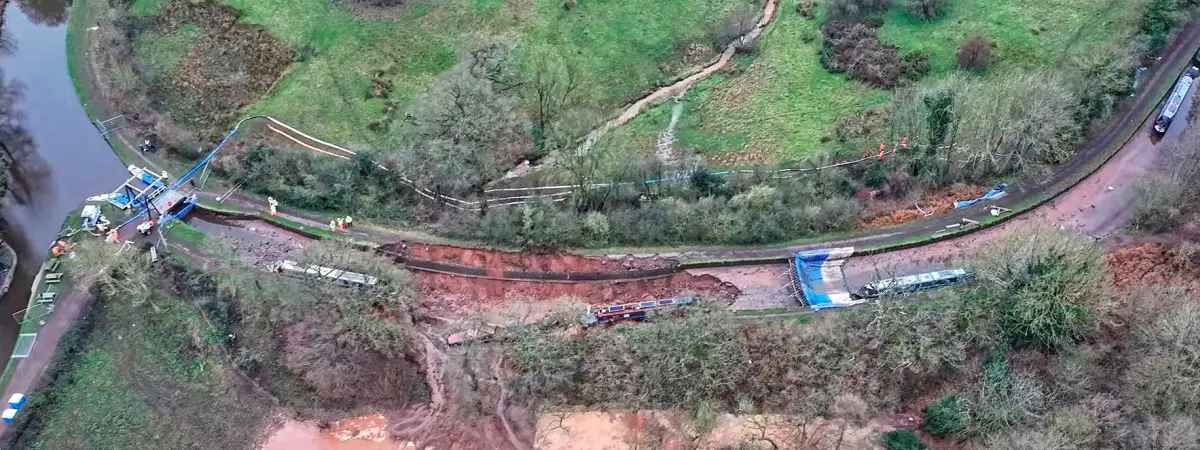
The substantially completed emergency pipe can be seen threading its way across the field below the canal embankment. It crosses over the top of the main culvert. The pump is by the lift bridge at left.
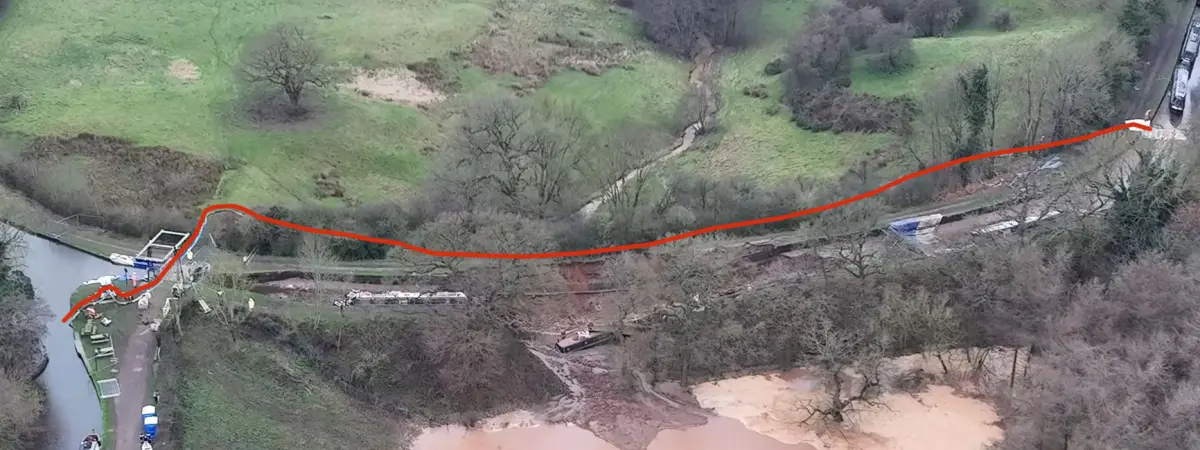
This aerial view has been marked to show the full course of the emergency pipe across the field and to where it will re-enter the canal. The spot at which is does that is where the contractors have laid a large sheet of while plastic tarpaulin. This can be seen at extreme left. The pipework had not been completed at this stage however the white tarpaulin is definitely where the outflow from the pipe will be. Normally this would not be done but in view of the amount of water that will need to be pumped it will no doubt generate a strong outfall thus the tarpaulin is there to prevent the force of the water affecting the integrity of the canal at that point.
Quite possibly tomorrow someone will film the completed works with their drone!
One other thing. It looks as if the cofferdam (which can be seen in both photos to the right of the breach) is temporary. It seems possible seeing there is another unused cofferdam assembly on the towpath waiting to be put into use (at a spot just before the location where the outfall will be) which indicates they might be placing this additional cofferdam further back once the stricken boat at centre has been floated away. Evidently they’d rather there was no water on any part of the remaining embankment, thus its likely the current arrangement will be a very short term measure simply for the purposes of removing that boat.
As for the other three boats (two down in the ‘sinkhole’) and one hanging half over the ‘sinkhole’, its been said these three will have to be scrapped on site. In other words these narrowboats will have to be cut up and removed. Unless someone has a well thought out plan on how to retrieve these boats intact because so far the site’s location provides no opportunity for a crane to get near enough to these boats to crane them away intact.
Updated 2020pm 23rd December 2025.
Cofferdams are being put in, one by the lift bridge and another immediately to the front of the most stable boat closest to the breach. Some of the guys doing the work are those also working on the Bridgewater! Their apparent early departure last week for an extended Xmas break seems to have gone awry… details on cofferdam and canal staff from Taylors Youtube video.
Some might think I have overlooked one of the issues with this breach, which is the water supply to Hurleston reservoir. I mentioned it very briefly further up the page and also commented on that on a Youtube video. The speed with which they are undertaking this work is because the Llangollen canal is a vital water supply channel conveying waters from the River Dee in Wales for distribution (via Hurleston treatment works) throughout Cheshire. The absolute priority is to get the water flowing again and its evident the stanked off section of canal will be just that 70 metres or so between the lift bridge and the most stable part of the embankment. Pumps will no doubt be installed – before Xmas day hopefully – which will pipe the water around the breach section – possibly along an elevated structure sited above the towpath so as to avoid any possibility of being compromised by any further possible slippages in the failed section.
The speed of the work is no doubt down to both Canal and River Trust and United Utilities (who mange the water supplies throughout the North West of England) wishing to see this vital water channel restored to use as quickly as possible. Canal and River Trust do of course gain a considerable revenue for the supply of the water.
The actual removal and rebuilding of the embankment will no doubt be a much longer job. It’ll be either autumn or next winter eg late 2026 at the earliest I would think. They way things are going we might even possibly see a curious situation where the Whitchurch embankment gets completed before the Bridgewater’s Bolin embankment!
Updated 15.25pm 23rd December 2025.
Leave a Reply