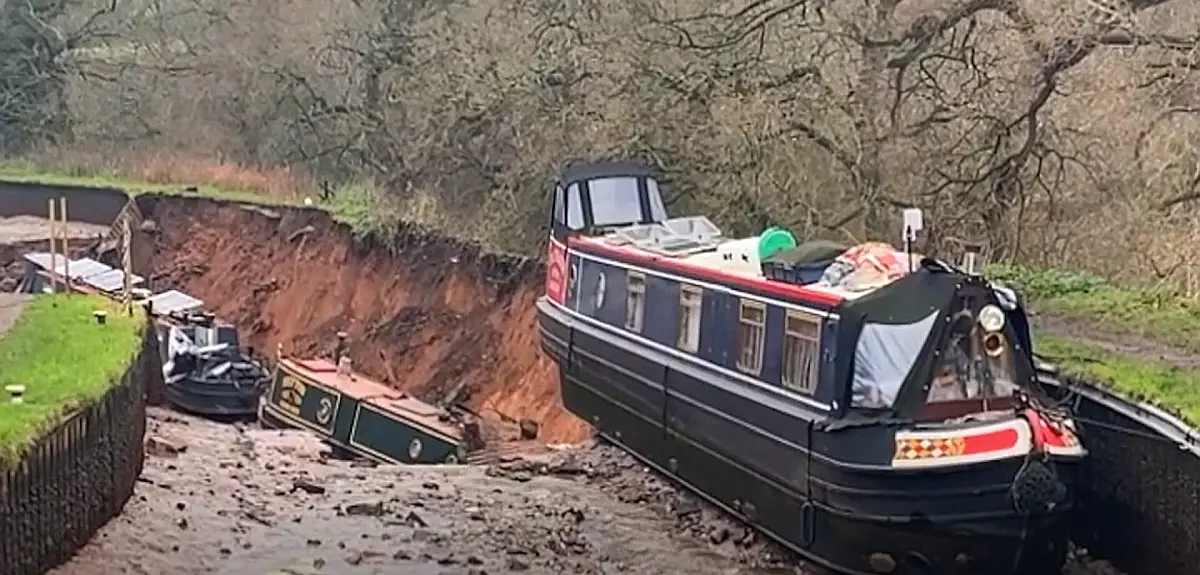
The Llangollen canal had a massive breach at Whitchurch this morning. The incident site is just to the west of the town near its large Aldi store, and this is where the Sandstone Trail crosses the canal by way of a lift bridge. A huge sinkhole appeared and canal boats were seen sitting perhaps twenty feet below the bottom of the original canal bed. At least one boater caught in the Bridgewater canal incident is now stuck further up on the Llangollen canal at Trevor – and their cruising potential is once again severely limited due to this breach almost exactly one year on from that on the Bridgewater!
The breach occurred about 4.20 am and around an hour later a major incident had been declared. Ten people were rescued from the narrowboats that had dropped into the sinkhole. No injuries were reported.
BBC News: Major incident declared over canal ‘sinkhole.’
Dramatic video showing the breach as it was underway during the night. Water can be seen flooding down in huge volumes past the boat (at approx 3.20mins) which was trapped at the bottom, and indeed a few short moments later part of the canal bed collapses into the breach area. From 4.00 onwards a narrow boat can be seen progressively sliding back and then it drops down into the large sink hole that had formed.
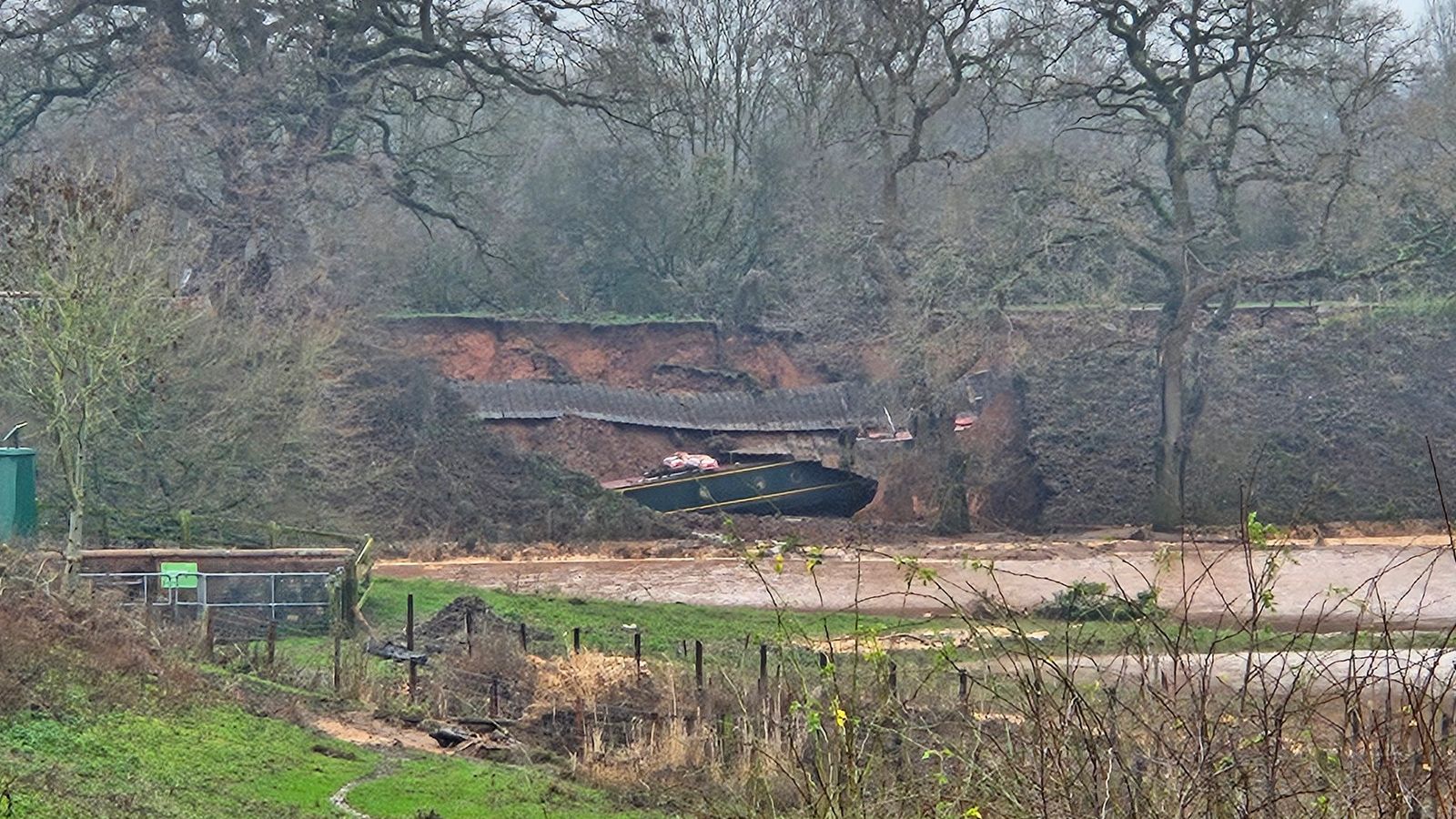
Image from Sky News (via Canalworld forum). This boat evidently dropped down into this sinkhole and the towpath’s steel edging then dropped down on top of that boat!
Google Street view of the same stretch in June 2025. The depth and nature of the breach is unimaginable.
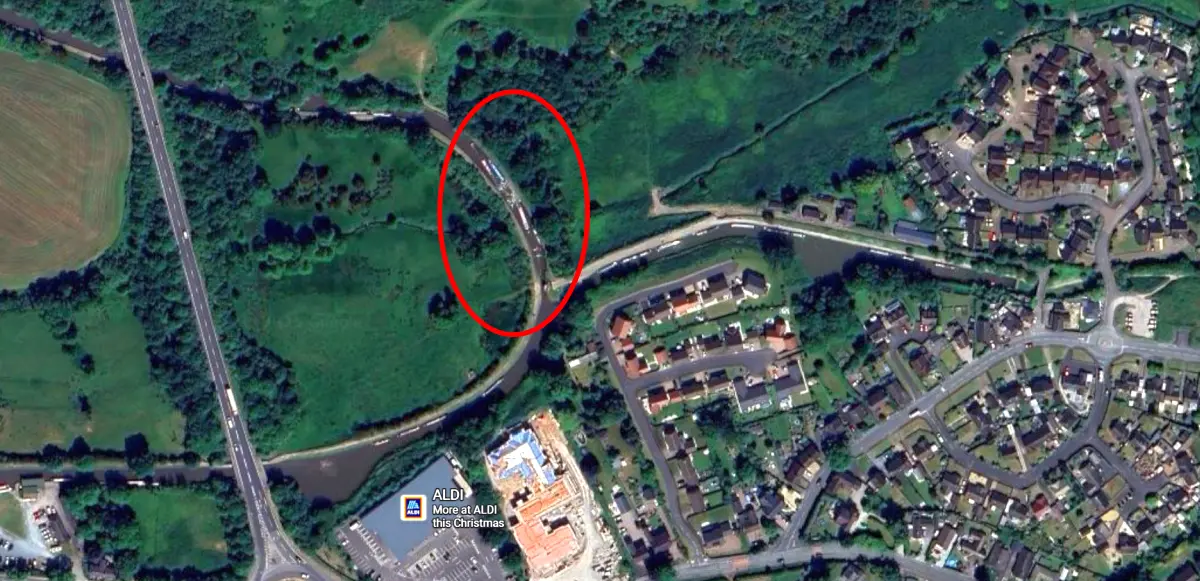
The exact site of the breach at Whitchurch, Shropshire. The canal crosses a valley at this point. It seems the breach is due to a culvert failure beneath the canal embankment. Google Streets.
There’s no doubt this breach will compromise the water supply for Cheshire. Much of that is provided by a flow of water from the far end of the canal at Llantysilio to Hurleston reservoirs where it is then prepared for distribution.
Canal River Trust update issued at 11.55am on 22nd December:
Please see below a statement regarding the breach at Whitchurch on the Llangollen Canal.
— Canal & River Trust (@CanalRiverTrust) December 22, 2025
We will provide further updates as soon as they are available via the notice on our website here 👉 https://t.co/9vjr1y29Fi pic.twitter.com/Ik3U8bkU9E
I’ll try and do some updates on this latest incident – and that besides the Bridgewater canal which I was also planning an update on the cessation on the recent works on that route. That on top of several other articles that are being done because of deadlines too! Xmas is a time of work!
Updated 12.15pm on 22nd December 2025.
Updated 13.05pm on 22nd December 2025.
Youtube video released a few minutes ago using a drone right over the sinkhole. Very dramatic shots. Two others who can be seen (they’re not the drone pilot) are not supposed to be at the site itself – seeing the towpath is both tied and fenced off. But very much like the Bridgewater canal breach a year ago people will find a way however…. The drone pilot was actually by the lift bridge thus they were outside the prohibited area.
Below – a couple of screenshots from the SWNS video.
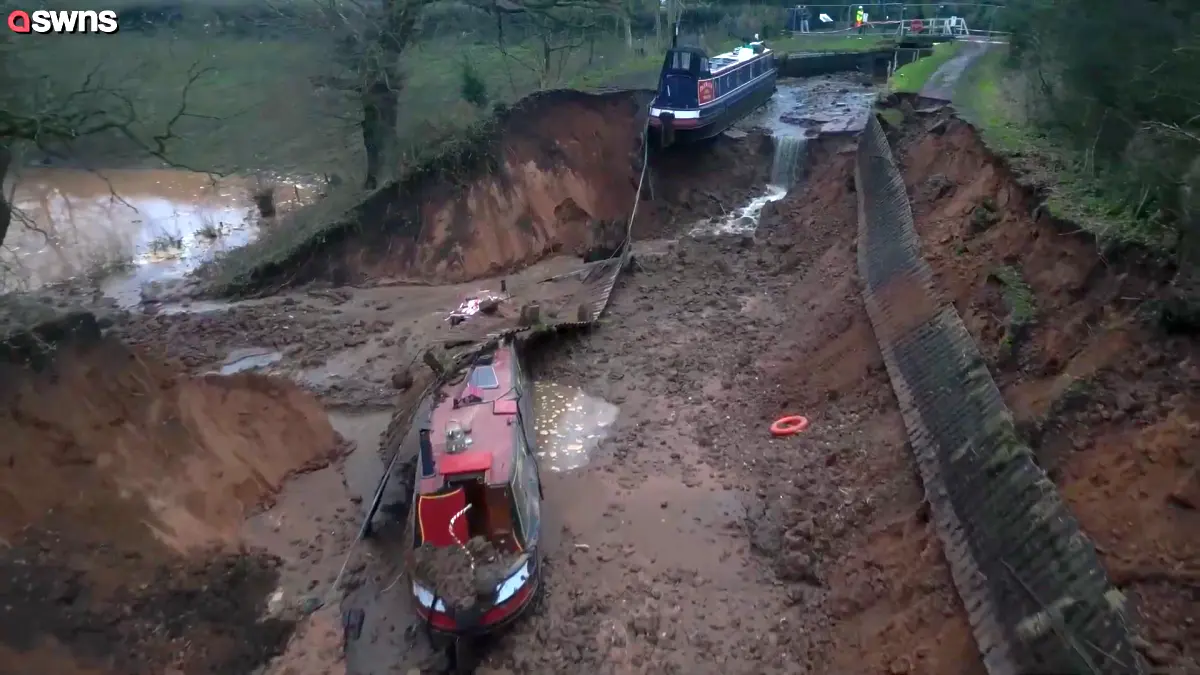
Close up of the ‘sinkhole’ or breach as it is properly called.
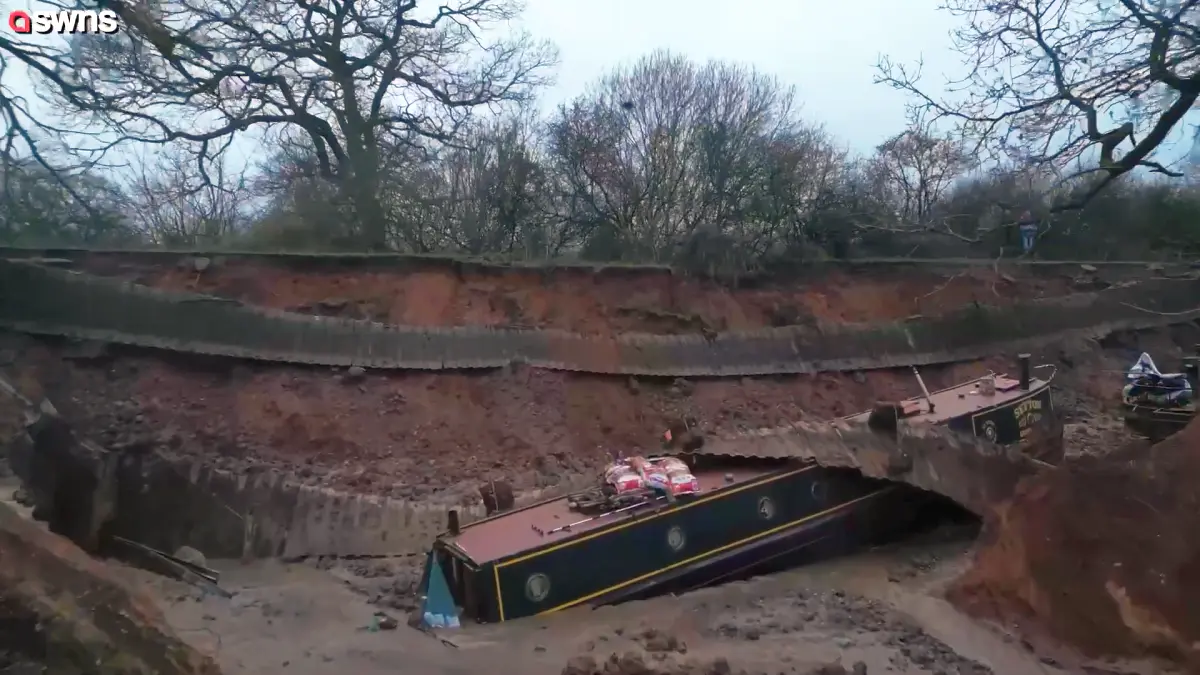
The narrowboat right at the bottom is partially embedded in mud.
One curious aspect of this particular breach is the way its occurred and totally opposite to how these usually are caused. Breaches usually tend to ‘congregate’ in the direction of the flow of water (which is downhill) however this one occurred on the uphill side. The towpath side (which is on the downhill side) has largely survived intact. Its a strange sort of situation… There’s also something about this and the Bridgewater breach but I’m not too sure about it yet. It must be said that the one main commonality between the two appears to be culvert failure. Curiously the Whitchurch culvert is working (as the video below shows) thus its possible that over the preceding months or years the water tables had rearranged themselves and the natural channels/conduits for the water had also changed.
The culvert is seen here working fine. The breach might not be a culvert failure even seeing it occurred on the uphill side of the valley.
NOTE (added 23rd December):
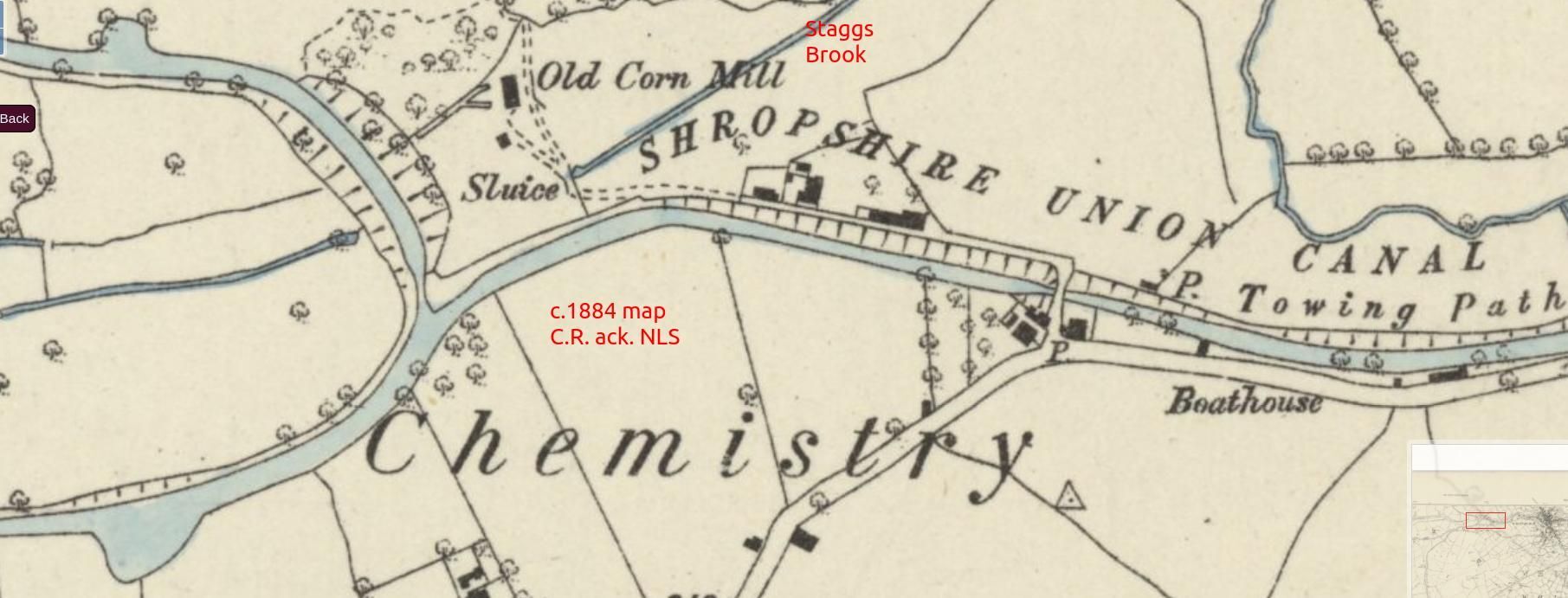
The culvert that was filmed appears to be separate from the embankment system. EG Staggs Brook. Possibly there was a smaller culvert to the north (as appears to be indicated on the map) and its that which got blocked. Pic from Canalworld.
Updated 16.20pm 22nd December 2025.
One clear thing about this embankment, having viewed more videos including new and impressive close-ups of the actual breach, is this is another that’s built largely with sand! The Bridgewater canal’s embankment was also largely built with sand. Evidently in both cases its the amount of sand used in the embankment’s original construction that has contributed to the calamity.
The Shropshire Union’s Ellesmere branch (or Ellesmere canal) as the waterway was originally known, was engineered by William Jessop. Evidently he took a leaf out of Brindley’s book (pardon the pun with Grindley Brook!) in building this part of the canal (not discounting that other parts of it too were no doubt built in a similar style). If this is the case is it possible the huge embankment at Pontcysyllte is also built in a similar way? If that went, it would be massive given the embankment’s vast height. Fortunately the sides of the embankment are well covered in trees so its possible it is very stable. This one at Whitchurch, no doubt because of its height, would have been the reverse. Its lower height and less substantial embankment probably saw to it that any trees that grew in its side weakened rather than strengthened the embankment. The embankment’s sand composition no doubt made it worse – and this is similar to what appears to have happened on the Bridgewater canal.
The canal breach has now made it into cartoon lore as shown below! Some say its in poor taste.
My latest cartoon for tomorrow's @Telegraph
— Matt Cartoons (@MattCartoonist) December 22, 2025
Buy a print of my cartoons at https://t.co/ILFJjPmckx
Original artwork from https://t.co/bVPAkgE34y pic.twitter.com/Ubx9uPMLvY
Updated 20.30pm 22nd December 2025.
It may come as a surprise to know this particular embankment is the only one on the entire original part of the Llangollen canal built to cross a valley. Some might point out the long low slung embankment at Whixall – however that was built to convey the canal across swathes of low lying peat bog so its a different mode. With that work a specialist gang of workers were employed for more than a hundred and fifty years keeping the embankments there at a level. If these dropped in any sense they were built back up in order to keep the canal’s freeboard consistently level. The BBC has an article on this work entitled ‘The Whixall Moss Gang.’
There are some other minor embankments on the canal such as near Hurleston and at Bettislfield, but none so large as the Whitchurch one. The later embankments on the canal (including the Chester and Ellesmere canal’s two stupendous aqueducts) were engineered by Thomas Telford with William Jessop as the supervisor. However there’s debate on who did what. Its thought Jessop did most of the work with Telford looking in from time to time – although Telford certainly disputes that notion in his autobiography.
Similarly Jessop disputed the amount of work Telford did and its known both Telford and Jessop had disagreements. Jessop didn’t see Telford in a good light although later the two pretty much hedged their differences to one side. There’s lots of debate on whether it was Jessop or Telford who actually designed and built Pontcysyllte aqueduct. Whilst living in the locality many years ago, I wrote a history of that – some of this was used in a publication entitled ‘The canal between Chirk and Trevor’ – as well as articles in the major waterway journals. The hybrid aqueduct at Chirk may have been a result of employing the different construction preferences both engineers had.
The embankment at Whitchurch wasn’t on the original plans, but rather it was an alteration of the canal route, whose main line had originally intended to avoid Whitchurch. Whitchurch would however be served by a long branch off the main route. In due course Whitchurch was included by deviating the route to form the present alignment from Hurleston via Swanley, Wrenbury, Marbury and Grindley Brook. This was in part achieved by a Deviation Act of 1796 which authorised the route to be altered. The rest of the route down to Hurleston was achieved by various other alterations too, with work on parts of that not beginning until 1803 in fact and those were down to later alterations to the 1796 Deviation Act. As history shows much of the canal was built piecemeal – that arose because the original intention had been for a route from Shrewsbury to Chester but with parts of that already having been built, a shortage of support and money basically left the company with bits of canal that had to be linked together somehow. Thus there’s every clear indication the canal was built in a haphazard manner and contractors and navvies no doubt came and went as the various sections were built and different techniques were no doubt employed in construction.
One wonders whether Telford would have approved of the construction methods used on the earlier part of the Llangollen canal since these were essentially Brindley style. It seems it was more Jessops’ supervision than Telford’s. TBH it wasn’t actually a problem this methodology for Brindley was thorough in his quality of work given the materials of the time. The issue could well have been the different contractors who no doubt employed short cuts where possible. Nothing new under the sun of course. Jessop would have no doubt had to take the contractors’ word they were doing everything according to the book, because with the different sections of canal being constructed at different times, it was likely difficult to keep track of what was going on. And if the contractors were using shortcuts including what can only be the use of sand, well as long as that held up what was there to argue about?
The embankment involved the use of a small culvert (no doubt it was built in situ prior to the embankment’s construction) and like many others across the UK canal system, these culverts were perhaps a foot or two in diameter and very much the same as those on the Bridgewater canal.
Brindley certainly knew of the issues of having small diameter conduits because these could easily get blocked. At Wet Earth Brindley in fact devised his supendous siphon so that it could work nominally with large volumes of water ‘going uphill’ but also that it could operate in the reverse direction, a sort of pressure wash perhaps once a month or so, to clease the tunnels of any potential debris.
These canal culverts, numerous as they are, were built essentially without a single thought as to how they could be unblocked. Maybe it wasn’t even that which was of any concern and the canal maintenance workers had their methods of unblocking these. The canals were built with what can only be a different mindset on how the world looked and operated including the industrial products that were manufactured and which involved non-petroleum based derivatives. That because in those days oil wasn’t even a thing, it hadn’t been extracted and plastics and the other derivatives had not yet been discovered.
The differences these days could well be the materials that block these culverts. That includes plastics, such as bottles, sheeting, even carrier bags. Its why canal boats regularly get plastic bags, wiring or polypropylene rope wrapped round their propellors. Just imagine the amount of plastics floating in the world’s water! (Imagine the chaos if it were all to be dumped back on land and that would certainly be something – this was indeed illustrated last week in the BBC’s five part serial ‘The War Between the Land and The Sea.’) That’s modernity and its no doubt also a result of the sheer arrogance humanity sadly holds in regards to nature and everything else. On top of that the more voluminous amounts of water (due to global warming as well as concretisation, tarmac roads, vast housing estates etc) must certainly also contribute. Certainly a faulty (blocked) culvert and an embankment built largely from sand can only constitute what is a potential recipe for disaster.
Updated 09.20am 23rd December 2025.
Leave a Reply