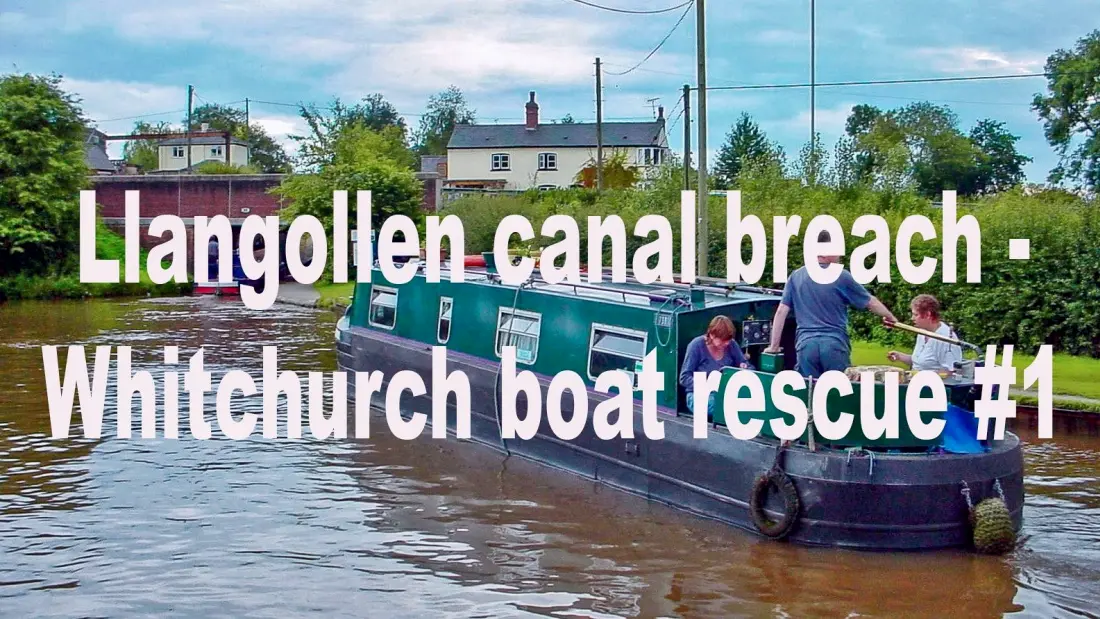
Narrowboat Pacemaker was removed from the New Mills breach site at Whitchurch, Shropshire, today! It is now entirely safe. A series of pulleys was used for this operation due to the very tight site constraints. No doubt pulleys (as I said yesterday) will be a feature during these boat rescue operations. I didn’t expect it to be used in the case of Pacemaker though!
As this short Youtube video shows, Pacemaker was also being refloated today.
The Shropshire Star has this article which shows a video of the operation and also the new cofferdam that was quickly built behind in order to permit Pacemaker to be refloated.
The very tight constraints meant they had to winch Pacemaker part-way through the bridge hole and then re-jig the ropes and pulleys and add an extra length of strapping which went round the boat’s stern. When I say stern it was thereabouts but not the stern itself. This strapping went round where the boat’s propellor housing is its like an extra stern below the main stern and this is how a narrowboat is designed.
Youtube video showing the operation.
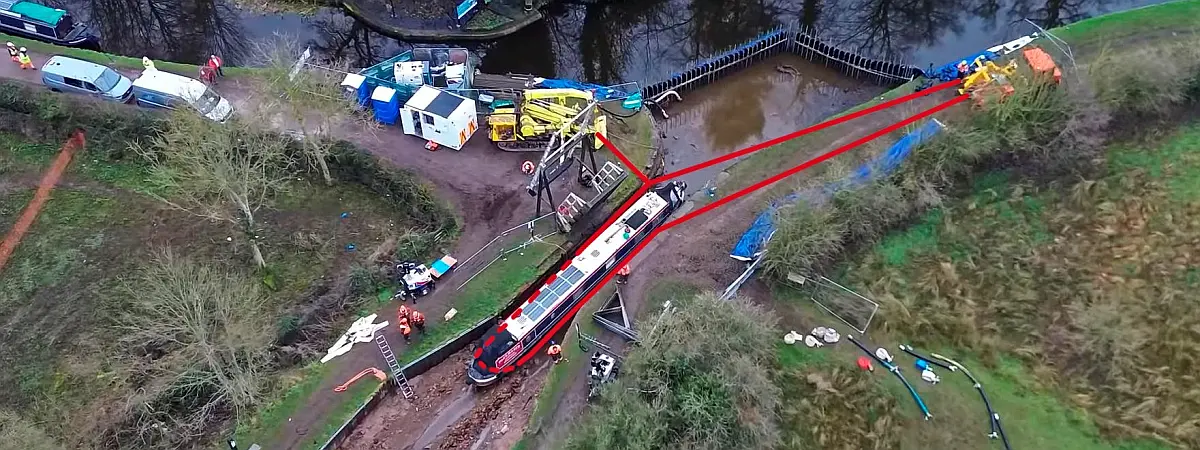
Screenshot from the Youtube video with the winch tethering arrangement illustrated.
Of the three Youtube vloggers whose drones could be seen flying about the site – Neil Jones was one of the lower of the four drones – his video has some great shots of the rescue operation including the winching arrangement. The latter part of his video also shows the refloating operation.
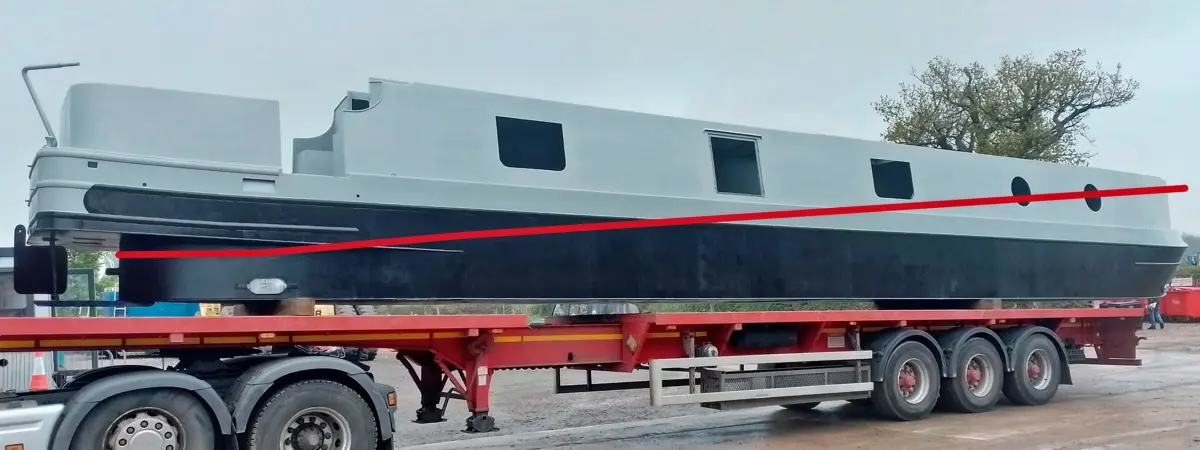
Had to find a suitable image quick! This image from Knight Narrowboats – who build bespoke craft – shows the hull arrangement of one of their leisure style narrowboats. Its not a traditional style like Pacemaker however what’s below the waterline is of interest and this picture I have highlighted with red to show the arrangement for winching Pacemaker through the bridge hole. As illustrated the rearward end of the winching ropes are tethered around the stern where the propellor is. No doubt a large strap was used with Pacemaker to keep the wire from slipping and potentially gouging the hull. These hefty straps were also used along the sides to prevent any damage to the boat’s superstructure.
Neil Jones’ video clearly shows the work to place the huge orange straps around the stern of Pacemaker in readiness for the second stage of the winching operation conducted today.
Knights Narrowboats are appropriate because they are based at Church Minshull, on the outskirts of Crewe! Yes! Crewe has canals as well as railways! The railway town is in fact surrounded by canals on three sides – these being the Shropshire Union (aka the Shroppie), the Trent and Mersey and the Shroppie’s Middlewich branch. Church Minshull on the Middlewich branch is not far from the Shroppie’s main line at Barbridge – from where its a short run to Hurleston Junction and the Llangollen canal.
N/B Pacemaker was towed to Whitchurch marina and lifted out this afternoon. Inspection work will be conducted to ensure the hull’s integrity before the boat can be put back in. Alternatively the owner, Paul hopes to have the opportunity to move away from the Llangollen canal completely (as are a number of other boats – around eight) because they don’t want to be stuck on the canal until the breach is repaired and navigation throughout becomes possible once again.
In the meantime work was also underway at the north side of the site where they hope to winch the two boats out of the breach site (the sinkhole as some describe it). The digger there was clearing a path down to the canal side for vehicles to access the site. Whether they will dig through the canal sides to effect a ramp or build up a ramp over the top of the towpath is not certain at this point.
I would think perhaps they’ll dig down and through the offside canal bank (and secondary towpath) and then continue the slope down through the embankment structure itself to the level of the stranded boats. I say that because they’ll no doubt have to rebuild the entire embankment and more than that as I have suggested previously – this being the canal round to the by-pass bridge. Thus removing any part of the canal or the embankment isn’t going to do any damage because its got to be replaced anyway!
It looks like the two stranded boats Sefton and Ganymede will be winched out later in the week. The ramps have to be constructed first and then the various other things such as a wooden surface to the ramp (made from old sleepers or something of the sort) so it will probably be Thursday before the two stranded boats are winched out.
Updated 1915pm on 13th January 2026.
Four videos on Youtube this afternoon showing the initial work to build a means of rescuing the two stricken narrowboats at Whitchurch. The videos (and drone filming) were by Neil Jones, CP Overview, Taylors and Kieran/Lottie. The latter of those videos is embedded below.
Kieran and Lottie video showing the works to build (or excavate) a ramp to the stricken boats. Welding work also continuing with stuff being done to Sefton’s stern – no doubt its extra strengthening anchor points as I detailed the other day – essential for the intensive winching and pulley system that’s necessary. It might look a minor job but in no way is it even a mere job. The boats could have easily been written off but clearly they’re going the full mile to retrieve the boats. No doubt its also good publicity for the companies involved because it will show they have a excellent range of equipment and innovative insight that can deal with tasks which appear to verge on the impossible.
I have to say this breach is the most I’ve seen in terms of media coverage. The last any received huge national and international coverage was the Coventry canal in the late 1970s – that because it happened right in the centre of the city. It was the first breach I ever encountered and one I was also involved with. The two big breaches on the Llangollen in the 1980s (one of which I was involved with) didn’t even get this amount of exposure. The recent Bridgewater one got a good amount of publicity but never before has there been anything on this scale of media coverage as at Whitchurch.
Updated: 18.05 on 14th January 2025.
Court on the Cut finally visited the breach site and he gave a lot of thought on the subject. He did mention there were two culverts not one. Thank goodness! But what impressed me more was his assertion the embankments were not up to scratch.
They weren’t. As I illustrated in my Bridgewater posts a dodgy method of employing sand had been used in that canal’s embankments and it was recorded for posterity. There’s no doubt a similar thing happened for the Shropshire Union’s Ellesmere canal and yesterday I even detailed where the sand for the New Mills (Whitchurch) embankment could have come from.
Court on the Cut also discussed how the embankments were improved later. That is true. Look at later canal constructions (not just the railways) and one can see the embankments are far more stupendously built. The Birmingham and Liverpool Junction Canal was built 1829-1835 and it was built more like a railway – except it carries water!
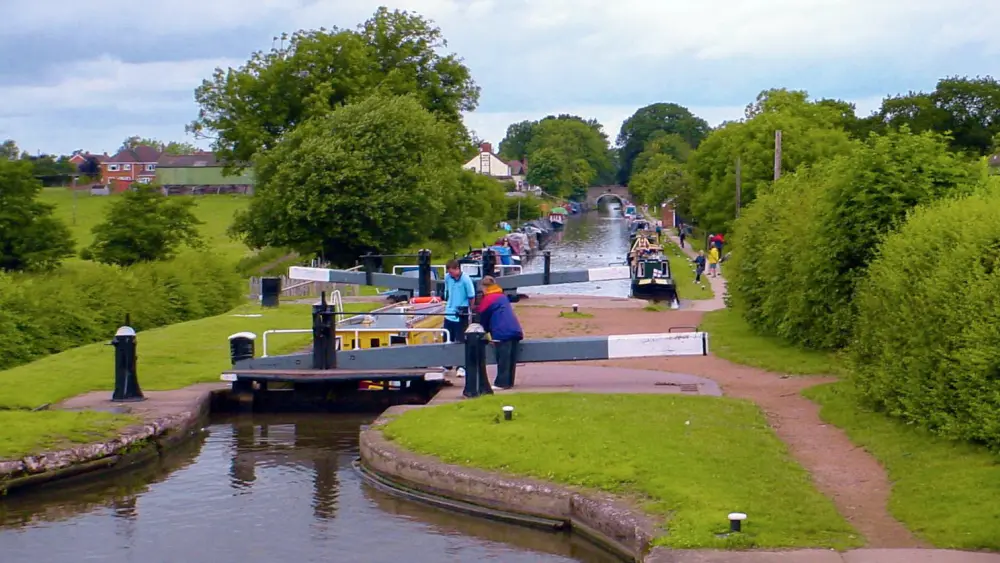
Wheaton Aston lock. Pic taken the last time I ventured up the Shropshire Union canal.
The B&LJC (now the Shropshire Union canal’s main line) linked Wolverhampton with the older Chester canal – thus providing a through route from the Black Country and Birmingham area to the River Mersey. The canal used later engineering techniques thus a large part of the route is built upon embankment (plus very deep cuttings) in order to keep the route level and its why from Autherley to Tyrley lock its practically on one level (around 25 miles – save for the one lock at Wheaton Aston and a stop lock at Autherley) and it has some noted embankments such as those at Shebdon and Shelmore. Below is a view of the latter and its clear these are superior in comparison to the earlier canal embankments.

Shelmore embankment is around a mile long. Railway & Canal Historical Society Online Media Archive.
Here’s a transcript of what Court on the Cut said re the early canal embankments.
You can also see everywhere there’s Canal River Trust and there’s a big group have just come down and uh they were the ones that were behind me at the beginning of the video and they’ve dug out a load of bags of stuff like just small amounts in a bag and they’ve all gone off. So, I think what they’re doing now is soil samples so they can see what the embankments made of because the problem is with these embankments. And I always get a little stick for this. They weren’t built very well when they were built. You’re talking 200-250 year old embankments.
And before the 1800s, they didn’t really know what they were doing. It was all quite experimental. So, they were building these embankments and they were putting them onto anything. The Bridgewater is known where the bridge was before is known to have quicksand underneath. This could have anything under. So they need to know what they’re dealing with when they come back to repair it. The other thing that they used to do was they used to build them at a 2 to1 ratio. So they were very steep sided.
After 1800 and in the railway era, they built them at 3:1. So a much bigger, larger base to take that weight. So there’s a lot of work that’s going to have to be done here just to figure out what they’re dealing with so they know how much engineering needs to go into it to rebuild. You can’t just plunk a load of earth there and put some water in it cuz it’ll leak and it’ll breach again.
Update: 00.12 on 15th January 2026.
The feature image is of boats waiting to ascend the locks at Grindley Brook. I have very few pictures of the canal at Whitchurch (these entail the lift bridge ad boats moored up) yet none seem interesting enough for this substantial canal series being done! Its why a focus of sorts on Grindley Brook is being done as I have loads of photos from there and besides, the locks are just a short distance from the breach site. Most of my LLangollen photographs stretching back more than forty years invariably focus on the more interesting part of the canal from Ellesmere to Llangollen – including the previous breaches that occurred.
Leave a Reply