The world’s first railway to be authorised by an Act of Parliament was the Surrey Iron Railway. This was a certainty despite the long held assertion the line had been the world’s first public railway. In the first part of this feature, the Surrey Iron Railway had numerous other achievements that were too a first, thus its difficult to find any other railways that had such an impressive range of achievements.
The iron railway opens – and after
The first of any opening related to the the Surrey Iron Railway happens to be the canal that fed the northern end of the line. Without that canal there was little opportunity for any connection to the River Thames as it was tidal and the dictates of the iron railway was that transhipment ought to be consistent and reliable. if it was to be successful. It might be viewed somewhat ironically that canals had to be a part of the iron railway, but the company had no other choice than to build one.
The difference (as explained in the first part of this feature) was unlike other ‘public railways’ whose route relied on the existence of a canal and a formation that was owned substantially by the canal or colliery proprietors, the Surrey Iron Railway had to pursue an Act of Parliament in order to build its railway – and the act also permitted the construction of this canal – which was the ‘add-on’ rather than being the other way round as the Lake Lock railway was.
Thus in early 1802 the short canal that led off the Thames into Ram Field where the Surrey Iron Railway started its journey south, and the Ram brewery was located.

Contemporary illustration of the Surrey Iron Railway and Wandsworth basin on a Churchman’s cigarettes card. Flickr.
The canal initially had served just the railway but was later extended to afford direct access to the brewery. By way of that, the canal reached almost as far as Wandsworth High Street. It ended at a wharf about where the former Ram brewery’s tall chimney can still be seen. The location of the wharf at the southern end of the canal was about here.
The Wandsworth canal (or McMurrays canal as it was later known) was opened on 7th January 1802. Contemporary accounts also suggest the iron railway itself had been considerably built all the way to Croydon and this report (below) from January 1802 had suggested the railway was to be opened that year in time for the King’s birthday.
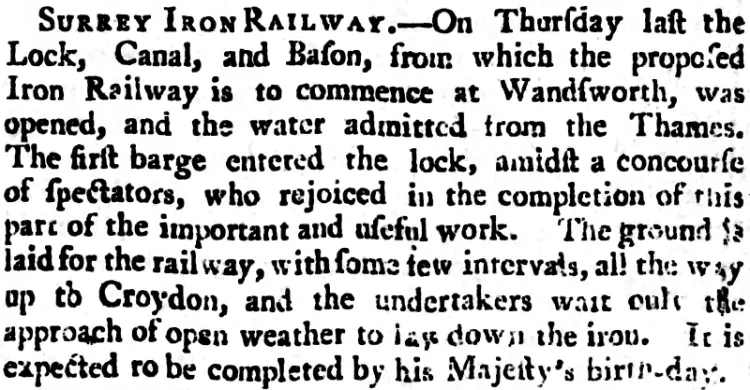
January 1802 sees the opening of the Surrey Iron Railway’s canal at Wandsworth. English Chronicle and Universal Evening Post 12th January 1802.
The canal ended use in the early 20th Century, perhaps before 1920 or thereabouts – although some suggest it was 1932. Hence the canal was the last bit of the Surrey Iron Railway to see use – this being seventy years or so after the railway itself had closed!
An advertisement in the The Star (and other similar papers during that period) for 17th September 1801 indicated the company had sought tendering for the purpose of constructing fences along the entire line:
SURREY IRON RAILWAY
Any Person or Persons inclined to undertake the Fencing of the Iron Railway, from Wandsworth to Coydon and Carshalton, in the County of Surrey, with Oak Posts and Rails, may see a specification of the Work to be done by applying to Mr. Luttly, at Wandsworth, to whom Porposals Sealed up, are to be delivered, on or before the 23rd day of September instant. By Order of the Committee.
WM. BEDCOTT LUTTLY, Clerk.
Wandsworth, September 10th. 1801.
The iron railway itself opened in stages with the first of those being at Wandsworth on the 3rd June 1802. This was followed by a section to Garratt and later Mitcham. Dates for those sections vary depending on which newspaper or historian is read. McGow says the route to Garratt opened in September 1802 whilst Bayliss says it was October 1802. The entire route opened in 1803.
Not a lot is known about the construction of the Surrey Iron Railway, however its rumoured Sir Edward Banks, 1 as a young man had worked on the line during its construction. That however was not as a labourer as this Google Books publication 2 like so many other sources, have implied. Bank’s work included canals, docks, and bridges, and his most famous were the old Waterloo and London Bridges. 3 Banks had likely been a contractor of some sort on the Surrey Iron Railway, and because of that he became the major contractor for the Croydon, Merstham and Godstone Iron Railway. No doubt William Jessop had been impressed with Banks’ work.
The iron railway from Wandsworth to Croydon wasn’t exactly a free-for-all. Users of the line had to have their company or proprietor name clearly shown on the sides of the wagons. Each wagon had to be registered. Those who could meet the various requirements for using the line were no doubt able to use it upon the payment of certain tolls. They were also required to log their journeys with company clerks at major locations, hence there would be a detailed log of every trip made upon the railway. It is also likely any gate keepers employed along the line also had to tally any wagons that passed those very crossing points. Such places would have been found at Summerstown, Colliers Wood and Mitcham, thus there would have been sufficient overview of the line in order to ensure that businesses were not operating unregulated stock on the line or avoiding its tolls etc.

Crossing at Colliers Wood. Tolls and checks likely undertaken here also. View looking in direction of Croydon. Image from Twitter/X.
The economic impact of the Surrey Iron Railway, while not dramatic as the later steam railways, was nonetheless significant, at least in the line’s early days. For example, farmers in the Croydon area could easily transport their produce to the markets of London although this largely required onward transit by either road or barge. Where the advantages of that lay, compared to undertaking a similar journey wholly by road or even canal is not certain. The reliance on horse power meant the line’s speed and carrying capacity had limits.
In a sense one wonders whether a canal would have been better – for that had been the original proposition. On the advice of William Jessop, the promoters were directed towards the notion of using a railway instead to serve the industries the River Wandle passed. The numerous businesses sited alongside the Wandle made it one of Europe’s most industrialised rivers. These days its practically impossible to see how this worked or what sort of benefit the railway had given, but there’s no doubt many locations along the iron railway in fact were near to or served directly mills on the river itself, and that even included the line’s terminus at Pitlake, which too had once consisted of mills stood alongside the nearby river itself, an area where various watercourses and mill ponds could be found.
A map in a long out of circulation book, Croydon Old and New (pub 1975) shows the numerous waterways and ponds that once existed in the area. One of those, almost adjacent to the Croydon Merstham and Godstone Iron Railway had been Scarbrook Ponds. 4 In terms of mills, that nearest to the iron railway terminus was Harris’s mill. 5 Its possible a short line from the terminus served these, especially the bleaching mill 6 sited near the parish church/minster and old palace. It must be said other short branches off the Surrey Iron Railway had also existed. There were two such instances at Wandsworth, so another at Croydon wouldn’t have been out of place. The old Ordnance Survey series of maps (1800s to 1860s) comprehensively details the route of both the Surrey and Merstham Iron Railways but when it comes to branches (including that at Croydon and another at Beddington) its not quite clear whether these are indeed branches or not. In terms of the area’s other mills and industry, a little further away was Page’s Malthouses 7 which didn’t need a branch for it would have been served directly by the Iron Railway to Merstham.
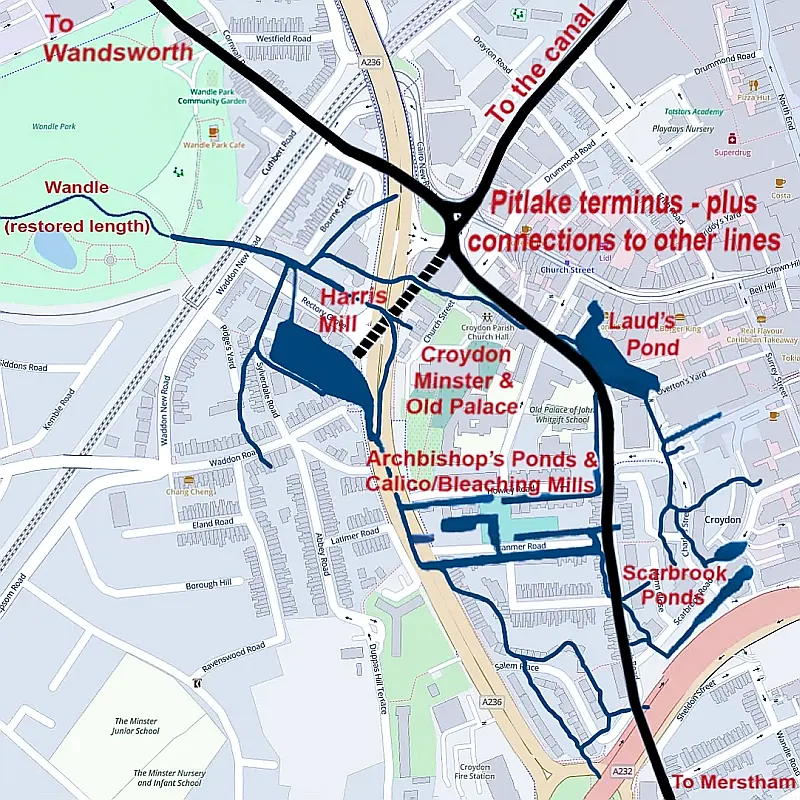
How the Wandle and interconnected waterways/ponds at Croydon looked in the first half of the 19th Century – showing also where the iron railway ran. Map by the author based on one at LB Croydon 8 plus that in Croydon Old and New (pub 1975).
One of the reminders of this previously substantial water borne area has to be Croydon’s Surrey Street Pumping Station. 9 Opened in 1851, the Grade II listed building was built in order to replace the Wandle which many residents and businesses had used – but whose waters were contaminated from the use of privies and cesspools. Certainly the pumping station accelerated the Wandle’s demise, for its said much of the river began to be culverted and its numerous streams and ponds filled in. Wandle Park, just to the north of Pitlake, soon became the first instance any trace of the Wandle could be seen as it flowed north to Wandsworth.
The other important link in terms of waterways was of course the line from Pitlake to the Croydon canal basin – and sited where West Croydon station is. This iron road, which was opened in January 1812 was built and owned by Edward Grantham, a landowner. Ownership was later transferred to the Croydon Canal Company.
Junction of the Croydon Canal with the Croydon and Merstham Railway. E. Grantham begs leave to inform the Public, especially those persons concerned in the carriage of heavy goods, that he has by means of his wharf, situated in Church-street, Croydon, effected a complete Junction between the Croydon Canal and the Croydon and Merstham Railway: and that the same is now open for the passage of goods to and from the river Thames. (The Times 29th January 1812 and The Courier 30th January 1812).
Although there’s assertion there was a delta junction at Pitlake between the three lines, Edward Grantham’s report suggests the line linked only with the Croydon, Merstham and Godstone Iron Railway. The interests which the canal held would have almost certainly ensured the Surrey Iron Railway did not benefit directly by means of the Croydon canal. Perhaps that was amended at some later time. As to the means of propulsion on the iron railway branch to the Croydon canal, it may have been a rope worked line. There is some thought (eg Paul Sowan who wrote a whole article on this) it may have been hauled by horses with a rope incline on the steeper section nearer to the canal basin.
In terms of such iron railway oriented branches, that from Mitcham to Hackbridge is well known – this was built to serve the western branch of the Wandle river. It too featured a privately owned line. That fully served the mills sited around the lower end of Hackbridge, almost into Carlshalton itself. Another is that which was constructed at Earlsfield to serve Garret Mills on the Wandle and Trewint Street is where the line once ran. The mills at Mitcham had no direct rail connection however the iron railway is known to have had sidings in the locality thus there had been some means of facilitating Mitcham’s mills.
There’s no doubt at the start the Surrey Iron Railway had been a success because it was doing the job intended which was to serve the area’s numerous mills and factories. Its long term financial status was very poor however because soon after its early formative years, the Croydon canal had been opened. This offered better opportunities than the iron railway did because the canal direct linked to the heart of London’s vast docks system. The Surrey Iron Railway suffered very badly because of this huge advantage the Croydon canal held.
As for haulage, well the Surrey Iron Railway was quicker, but the canal could carry more with great ease. The competition forced the iron railway to look at ways of facilitating greater transit as well as loading and unloading, and at some point special waggons were built in order to try and demonstrate that quicker unloading could be done compared to the canal. Not only that, the biggest waggons the line could carry were also experimented with.

The Little Eaton line, Derbyshire. A somewhat close relation to the Surrey Iron Railway. Chasewaterstuff Railway & Canal Blog.
In terms of ‘rolling stock’ there’s very little detail on these specialist waggons used on the line. In terms of news reports, there is one thing that is certain. The line saw speciaist waggons that were simply huge. One such particular wagon was known as the ‘Portsmouth’. It was a huge wagon that weighed between 8 and 10 tons and needed eight horses to pull along. Its said the wagon “did not appear to make the slightest impression upon” the plate track. 10 This suggests the iron railway may have been somewhat overengineered, but that would have been the done thing anyway for there was no knowing just how heavy these waggons could get, especially when fully laden with coal from Wandsworth or quarry aggregate from Merstham.
To be continued…
References
- Wikipedia – Edward Banks: https://en.wikipedia.org/wiki/Edward_Banks_(builder) ↩︎
- Google Books – Wonderful Inventions From the Mariner’s Compass to the Electric Telegraph Cable: https://www.google.co.uk/books/edition/Wonderful_Inventions_From_the_Mariner_s/LoUDAAAAQAAJ?hl=en&gbpv=1&pg=PA299&printsec=frontcover ↩︎
- Kent Archaeological Society – Sir Edward Banks the man who constructed Rennies London bridges: https://www.kentarchaeology.org.uk/books/sir-edward-banks-1770-1835-the-man-who-constructed-rennies-london-bridges ↩︎
- Industrial History Online – Scarbrook Ponds: https://www.industrialhistoryonline.co.uk/yiho/site.php?site=GTL02939 ↩︎
- Industrial History Online – Harris’ Mill: https://www.industrialhistoryonline.co.uk/yiho/site.php?site=GTL02581 ↩︎
- Industrial History Online – Croydon Palace Bleaching Works: https://www.industrialhistoryonline.co.uk/yiho/site.php?site=GTL02219 ↩︎
- Industrial History Online – Page and Overton’s Malthouses: https://www.industrialhistoryonline.co.uk/yiho/site.php?site=GTL02731 ↩︎
- London Borough of Croydon – Croydon Minister Conservation Area Appraisal: https://www.croydon.gov.uk/sites/default/files/Planning/Conservation%20areas/Croydon%20Minster%20CAAMP.pdf ↩︎
- Wikipedia – Surrey Street Pumping Station, Croydon: https://en.wikipedia.org/wiki/Surrey_Street_Pumping_Station,_Croydon ↩︎
- Google Books – Knight’s American Mechanical Dictionary: https://www.google.co.uk/books/edition/Knight_s_American_Mechanical_Dictionary/HEYOAAAAYAAJ?hl=en&gbpv=1&pg=PA1860&printsec=frontcover ↩︎
Leave a Reply