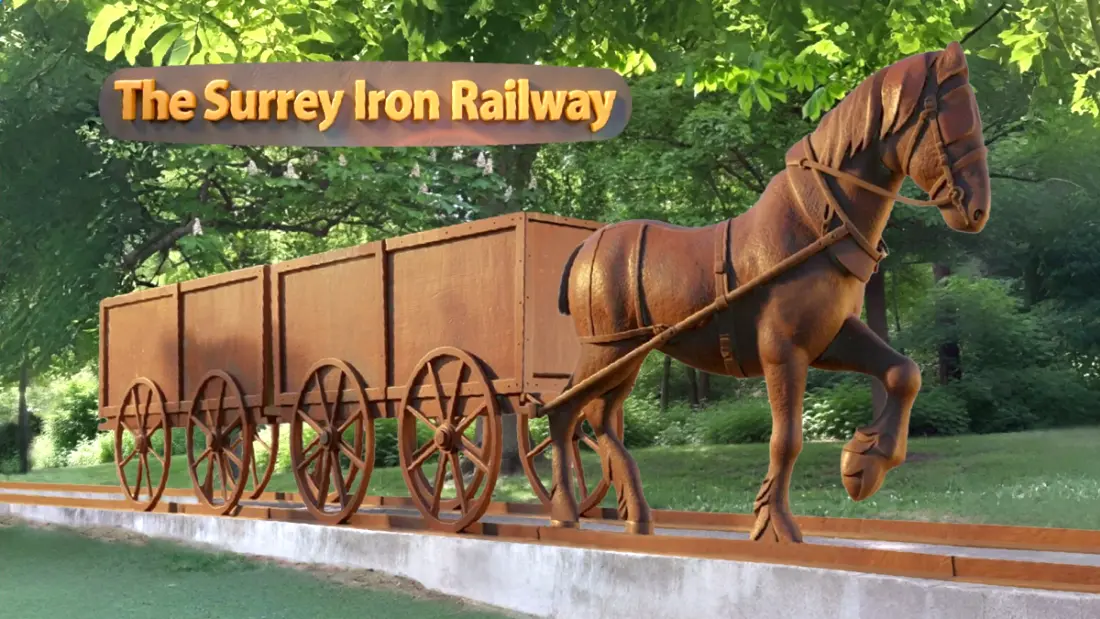
Plateways, characterized by their flat-topped rails or “plates” often laid on stone blocks, were designed to be pulled by horses. These early railways were primarily for private transport of goods – usually for canals, mines or factories. The Surrey Iron Railway was in essence a public railway, being accessible to any individual or company willing to pay tolls. Its engineer was William Jessop, who had designed earlier plateways for a number of canal systems. The passing of an Act of Parliament in 1801 granted permission for the construction of the Surrey Iron Railway, often claimed to be inadvertently labelled as the ‘world’s first public railway.’ As shall be seen in a moment, the world’s first public railway was indeed the Surrey Iron and not any others as has so often been asserted.
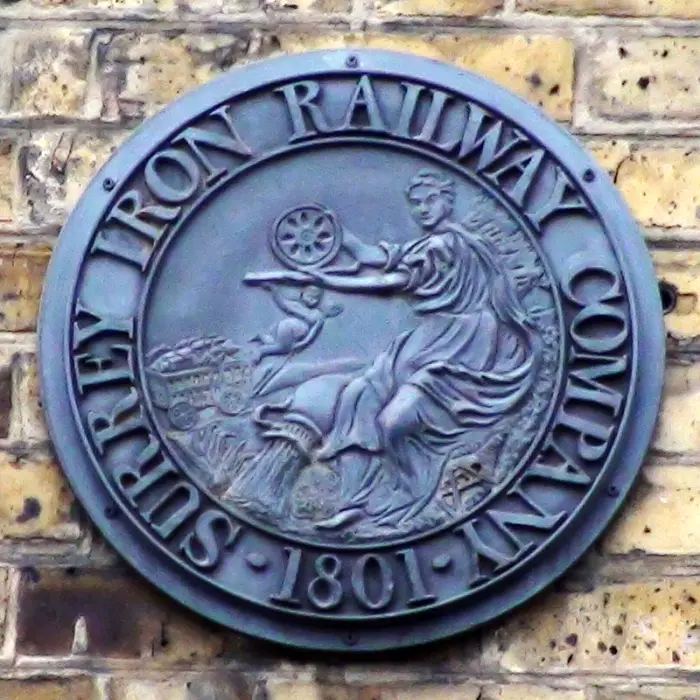
The Surrey Iron Railway Coat of Arms. Facebook.
Transport firsts?
Transport firsts are difficult to evaluate, but there is one thing that’s certain. We British seem to think we have many firsts in terms of transport. But for example, when the ‘first’ of the canals were being built in this country (starting with the Bridgewater Canal of 1769) its sobering that artificial waterways had been built centuries before such as the Fossdyke, the New River (including aqueducts, lengthy tunnels) and the Wey Navigation. Even self-propelled road vehicles were already a reality at the time the Bridgewater canal was opened thus technology was already in a sense ahead of the desire for artificial waterways. Nicolas-Joseph Cugnot’s Fardier à vapeur showed its first ever paces in 1769.
In the 18th century, additional instances even followed railways, which had initially emerged in the UK perhaps a century earlier. Richard Trevithick created a steam-powered road vehicle in 1801 and a railroad-based vehicle in 1804. Even in 1803, he operated a passenger-carrying vehicle known as the London Steam Carriage with success. The issue at hand was undoubtedly one of convenience, and it’s possible that the Surrey Iron Railway and others prevailed because they offered a convenient alternative to a canal for moving heavy loads.
Most of these were hampered by limitations, including pulling power and the tonnage that could be carried. Thus the only practical and true means of large scale conveyance in 1803 was transport by barge or horse drawn plateway. For millennia water had been the most reliable way to move large objects. The Surrey Iron Railway made an effort to defy this trend. First, it didn’t quite rely on a canal because the majority of its cargo went to the Thames, but it also had a railway that was far longer than anything built before. That presented another issue: land. Before the company could construct its track, land had to be obtained.
The Surrey Iron Railway – was it the first of its type?
Many often bill the Surrey Iron as being the first public railway in the world. It has been agreed there were other lines worthy of this title, thus the Surrey Iron Railway has been re-evaluated as not exactly being the world’s first public railway. However the Surrey Iron Railway was the first of its kind even though others claim the Lake Lock Rail Road has that honour. The difference is the Lake Lock, also a public railway, was a feeder to the Aire and Calder Navigation (essentially a canalised river). The Surrey Iron Railway was not a feeder to any canal or canalised river. It did have a short canal at its northern end however the purpose of this canal was to permit traffic off the Thames into a safe haven where barges could be unloaded. Hence the Surrey Iron Railway stood independent of the country’s many artificial waterways.
Lake Lock was pretty much the same as many other iron rail roads or waggonways – the Little Eaton tramway, the Consall Forge and the Cauldon Low tramways, or the quarry and limestone lines such as at Pentrefelin or Llanymynech that fed into the Ellesmere and Montgomery canals in Shropshire and Wales. The Ashby, Ticknall and Cloud Hill tramway was a horse plateway which opened one year before the Surrey Iron Railway and like a number of others, it closed in the first part of the 20th Century.
These were all constructed to serve a man-made river, and perhaps more significantly, the land which they used belonged to the owners. William Jessop and Thomas Telford adhered to a theory that waggonways, plateways, or tramways best served as feeders with canals the primary means of transportation. When steam traction was used for the first time on the Penydarren tramroad, it attracted notice. This in 1804 was Trevithick’s famous locomotive which some view as the real precursor of the modern railway rather than the Stockton and Darlington. As soon as the Surrey Iron Railway had begun business, its future did not looks so promising.
What is important in terms of the Surrey Iron Railway being at the top of the list, it was almost certainly the world’s first public railway without dependence upon a canal. It had no land to speak of and thus had to legally acquire land for its route. The act authorising the line was what one observer called a ‘pure railway bill’ (Google Books):
Perhaps the first railway to work free from a canal, for any length right out, was the Surrey Iron Railway, for which an Act of Parliament was passed in 1801, and another in 1803; so that the whole length was 21 miles, reaching from the quarries at Merstham, Reigate and Godstone, to Croydon and the Thames at Wandsworth. (Google Books).
There is one other caveat in all this however. In terms of ‘leasing’ out a railway for the use of others, one wonders whether the Whickham Grand Lease Way (1621 to around 1723) as well as the Stella Grand Lease Way (circa 1630 to around 1700) 1 had been the world’s first public railways. These were commercial wooden railways, however as per usage it was the beneficiaries of various mines that were able to use it. In a sense these were not a railway where the various mine proprietors paid a fee to use the tracks. Rather it was a landowner the railway and associated mines belonged to, and these were leased out. In a way these early wooden waggonways were a kind of public railway – but not in the sense of being one where individual tolls were paid. Despite the extremely early age at which these lines operated, they’re not what the Surrey Iron Railway would have been – which is the establishment of a railway by an Act of Parliament.
The Surrey Iron Railway’s Act of Parliament makes it the first
The Surrey Iron Railway’s claim to being the first ever was by diligence of its having to obtain an Act of Parliament. Thus it was the first to be obtained for a railway. 2 The Lake Lock and others were built mainly on land belonging to the owners thus they did not need legislation. At the absolute minimum, it was the Act of Parliament and the need to compulsorily acquire the necessary land for its route that the Surrey Iron Railway can be viewed as the first of what would be numerous examples of railways across the UK (and indeed elsewhere) to be established by this very process.
Unlike the canals and their railways, the Surrey Iron Railway required private enterprise to run its trains. That in a sense prevented it from operating efficiently. For governments that have attempted to privatise railway systems, it serves as a kind of early warning. For safety there is a significant amount of regulation, thus its difficult to incorporate private enterprise. On a canal, a private operator could easily carry enormous amounts of tonnage on a single vessel plus regulations were less severe which also helped. Even though the Surrey Iron Railway’s goal was to promote waggons that could be used on the roads or on the railway itself, in reality the standardising of the waggons became rather a crucial factor compared to barges on a canal, and that resulted in far less flexibility.
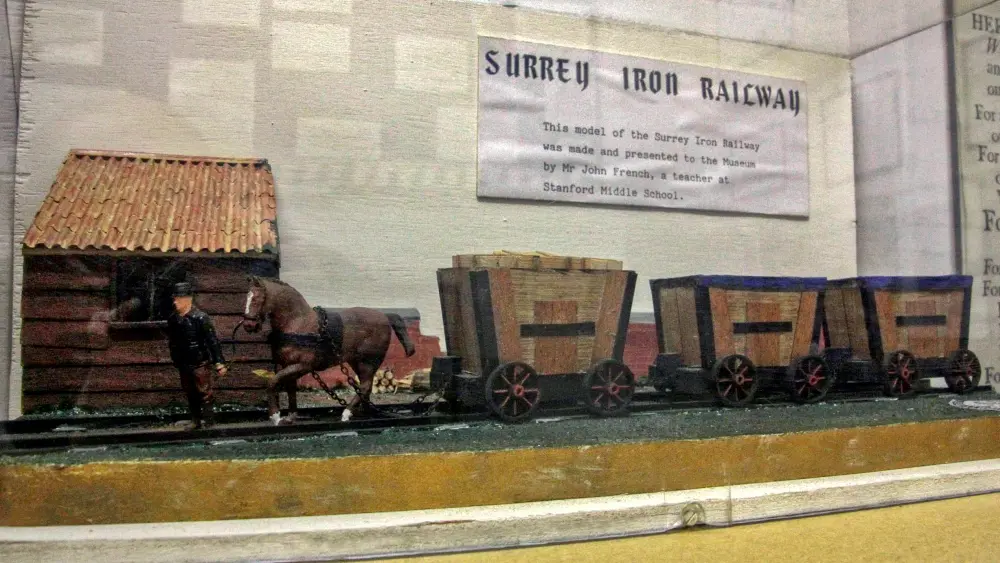
Model of how the iron railway may have looked. This can be seen in the Wandle Industrial Museum at Mitcham.
As a result the Surrey Iron Railway was not even “superior in every respect to the old and sluggish canal.” (Frederick Williams 1852). The iron railway was indeed touted as being faster but in overall terms including transfers and regular plateway breakages, it proved sort of contrived and was not exactly superior to a canal nor even by this time a burgeoning roads network – much improved with the use of macadam and tar. Thus the Surrey Iron Railway was a concept that wasn’t to be.
There’s no doubt the Surrey Iron Railway used cranes to speed up work, and its waggons had side doors to facilitate unloading. It seems even some waggons had an experimental design that allowed them to be tipped and unloaded faster. Even so, the Surrey Iron Railway was, in a modern sense, what Beeching would deemed an old fashioned type of intensive manpower operation of the type he despised.
A short haul waggon way connected to a canal worked considerably well – and its why several such systems lasted into the early 20th Century. As a stand alone system the Surrey Iron Railway failed, having struggled to make money even. Those with an eye for business saw little reason in owning a waggon on the Iron Railway compared to having one on the roads. The former required tolls to be paid whilst the latter was toll free – something the railway had no answer for. If the company had permitted a free-for all on its line, how would a vastly increased maintenance routine – as well as continual breakage of the iron rails – be paid for?
Other considerations in terms of being first
A slightly different way of evaluating which railway had been the most important in terms of history, is the Surrey Iron Railway had substantially been the first railway ever to capture the world’s attention – and that because it was sited in the metropolitan area which constituted London and its outlying areas. The line’s call to fame was that it was not just one of a kind (like other plateways) but that it was a public railway – meaning anyone could use it. Farmers, proprietors and merchant men with a suitable wheeled wagon of the correct gauge and a sturdy horse, could upon acquiring a permit, be allowed to use the Surrey Iron Railway.
As for canals, there’s no doubt the Surrey Iron Railway built its own canal (just 625 metres or 2050 feet in length) at Wandsworth. The difference here was the iron railway was the master and the canal the servant. The Lake Lock railway is extolled as the very first to have conceived of a public line, however it was merely a 3 mile long feeder to the 34 mile long Aire and Calder Navigation. In comparison the Surrey Iron Railway was of substantial length at eight miles. Its extension to Merstham increased this to around seventeen miles. There was the hope a longer railway would substantially increase revenue and keep shareholders happy but that did not happen.
The Surrey Iron Railway is credited with the first railway junction in history. This was at Mitcham where the 1.5 mile (2km) branch to Hackbridge and the main route to Croydon split. This is down to interpretation because it wasn’t a junction in the technical sense with a signal box and signals guarding the differing routes. Regardless of this, the Railway Gazette maintains Mitcham had the world’s first ever rail junction.
Evidently any number of railway firsts depend on what is being implied and what the actual schematics happen to be. Some argue the Stockton and Darlington isn’t the first in the world because it actually started out as a horse drawn railway and it had entertained the idea of steam traction hauling passengers very late in the day. In fact its passenger service on 27th September 1825 was a special one-off. Its regular passenger trains were horse-drawn until 1833, thus no passenger steam hauled services were seen in those eight years apart from that one off special that had appeared on 27/09/1825! In a way its a bit of a cheat to claim the Stockton and Darlington’s 1825 had date marked the 200th anniversary of the UK’s railways. Maybe 1833 would have been a more truer milestone?
In terms of passenger operations, the Stockton and Darlington’s one off run on 27th September 1825 is little different from Trevithick’s 1804 attempt which had both goods and passengers (seventy men in all) conveyed by steam locomotive for nine miles from Penydarren to the Glamorganshire canal at Abercynon. Which truly had been the first passenger conveyance of those two lines? Was it 1804 or 1825? There’s no doubt the most magical rabbit to be pulled out of the hat wins the day.
One other milestone is the Surrey Iron Railway had been the first in the UK to shut completely – and that five years before another alleged ‘first’ – the Newmarket and Chesterford whose nine mile line from Six Mile Bottom to Great Chesterford closed in 1851. But that constituted a partial closure! The first really ought to be the Croydon, Merstham and Godstone Iron Railway, by decree of being an extension of the Surrey Iron Railway! Nevertheless it can be decreed both the Surrey and Merstham lines in fact had constituted what was Britain’s first ever large scale railway system closure!
The Surrey Iron Railway – a historical round-up
The Surrey Iron Railway ran for eight and half miles between Wandsworth and Croydon with a general ruling gradient of 1 in 120 (one inch per ten feet or 28.33 minutes of angle) up towards Croydon. It was a 4 ft 2 in (1,270 mm) railway line with flanges set on the rails instead of the wheels, so the line is more accurately known as a plateway. A footpath was provided alongside the entire length of the railway. The whole undertaking was designed by William Jessop with George Leather as resident engineer and the firm of Jessop and Outram as contractors.
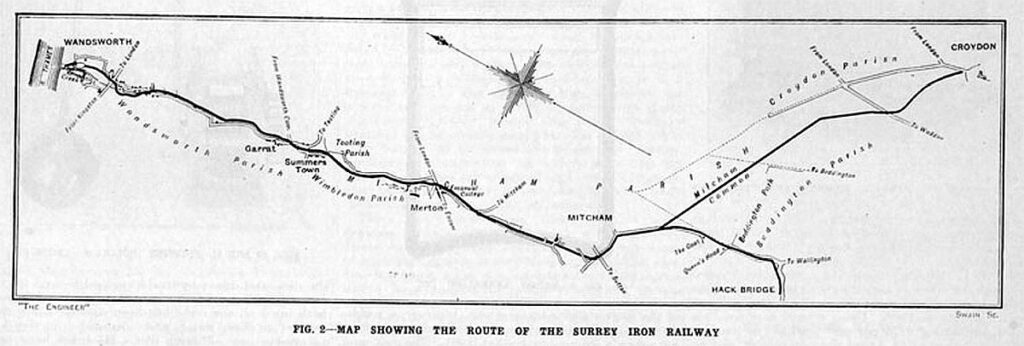
The course of the railway between Wandsworth and Croydon. Facebook.
The Hereford Journal of 3 June 1801 reports: “The Surrey iron railway promises to be one of the most useful public works that have of late been undertaken for the improvement of the country. The iron roads are excellent substitutes for the canals and in some instances superior to them. This iron railway commencing at Wandsworth will in all probability be extended to Portsmouth…”
For its new route, the Surrey Iron Railway reportedly purchased a total of about 61,000 stone blocks. While the iron rails came from the local Butterley Ironworks, the stone came from quarries at Cromford. Doubtless the newly constructed canal system was the means by which these materials arrived at Wandsworth. The opening of the Cromford Canal in 1794 (see London Rail’s feature) would have made it possible for the stones and rails to be transported immediately down to the Trent via the Erewash Canal, and then along the river to Shardlow, with onward transit via the Trent and Mersey, Coventry, and Oxford Canals.
Whether the transit used the recently opened Grand Junction or the Oxford Canal is open to debate. There was continuous transit all the way to Wandsworth via the Oxford Canal/Thames. The other would have relied on the transhipment of the rails and stones via Jessop’s Blisworth Hill Railway, built to ensure transit while the problematic canal tunnel at Blisworth was being built. This is covered on London Rail.
Perhaps the transits involved both routes, say the stones via Oxford and the iron rails via Blisworth, that is on account of the ease of transhipment of these. One curiosity in all this is the possibility that the Surrey Iron Railway (and its extension to Merstham) could have conceivably been transported upon another iron railway en route to Wandsworth! The Blisworth Hill Railway closed in March 1805 – but its track was not resold for other iron railways. This is because the ex Blisworth Hill trackage was largely reused for a temporary line from Gayton to Northampton until its relevant canal (the Northampton Arm of May 1815) could be completed.
In terms of the Surrey Iron Railway then being under construction, another was soon proposed. This was the Croydon, Merstham and Godstone Iron Railway. The Salisbury and Winchester Journal for 12th September 1803 reported a committee of the Croydon, Merstham and Godstone Iron Railway at the Bear Inn, Havant, on Friday 26th August 1803 convened “for the purpose of extending the said Railway to Portsmouth and London”. This was no doubt an intention to extend the line from Merstham to Portsmouth and from Wandsworth to London. Both the Surrey Iron Railway and the Croydon, Merstham and Godstone Iron Railway would be incorporated into a new company called the London and Portsmouth Iron Railway.
The Merstham extension involved a great amount of engineering including bridges, embankments and cuttings – and perhaps the earliest examples of such works in the south of England. There are examples of large scale engineering works in the north of England on earlier lines such as the Ashby, Ticknall and Cloud Hill or the Butterley Gangroad, but the Merstham extension was no doubt the first in southern England.
Continued in part two.
Source material used
This feature was originally penned in 2013 for the 210th anniversary of one of the earliest public railways. The Surrey Iron Railway of 1803 formerly ran between Wandsworth and Croydon. The original 2013 series were no doubt the first in-depth Internet guide covering the route of the former railway. Peter McGow’s intensive research on both Surrey Iron Railway and Croydon canal proved an excellent means of working out where these former transport routes had gone. McGow’s work is specialist & can only be seen at the Croydon archives or the Wandle Museum. Its not an actual hands on route guide, which is what this London Rail series is.
Derek Bayliss’ Retracing the First Public Railway (Surrey Iron Railway) and Retracing Canals to Croydon and Camberwell (Croydon and Grand Surrey canals), published in the 1980s, were intended as a more accessible guide covering both routes. Both Bayliss and McGow’s work proved an invaluable source. His Surrey Iron Railway work can be seen at the Wandle Museum, whilst that on the Croydon Canal is available only through the Croydon Local Studies Library and Archives. A comprehensive online guide to the Croydon Canal can be seen at London Canals.
Two other sources also were invaluable in this considerable updating of the 2013 work. These are F. G. Bing’s The Grand Surrey Iron Railway and Charles Lee’s The World’s First Public Railway – both published in 1931. These give a detail of the iron railway that isn’t possible these days, including information, observations and pictures.
The feature image is based on the Rotary Field sculpture sited in Purley. Good old hard work by the author with some help from AI created this fantastic image.
Leave a Reply