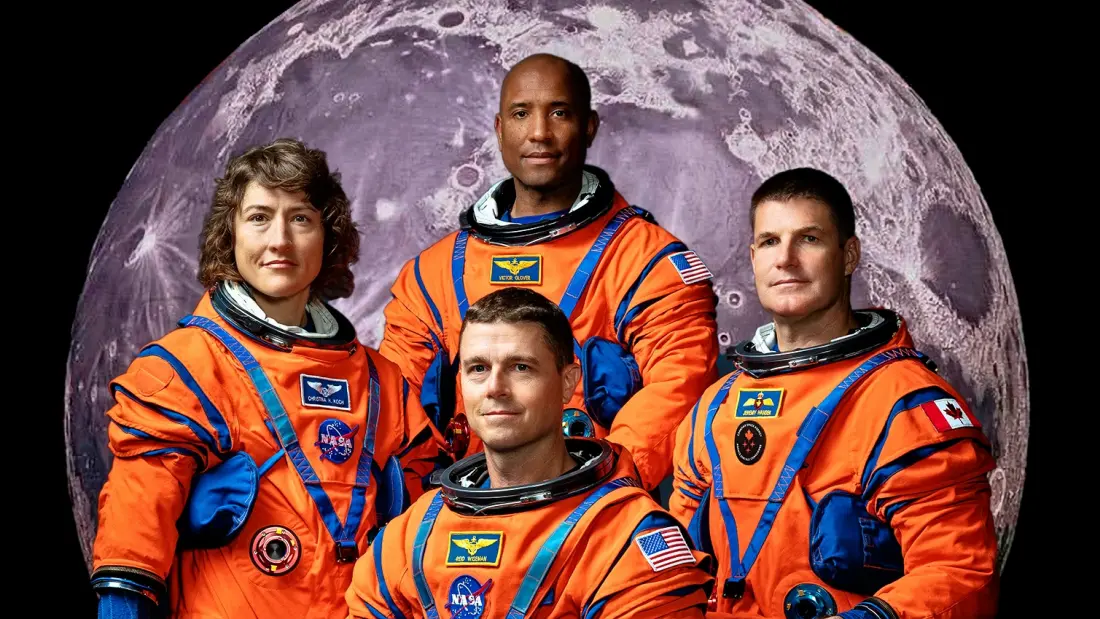
Even though this is currently day four of the Artemis mission, it was decided to start with Day 5 for the most recent reports instead of continuing with Day 4. In a way it was a means of keeping my sanity as sleep hasn’t been good, which is why a number of times I’ve woken up and screencapped the going ons with Artemis. Thus this post begins at 07.00 am on the 5th April 2026.
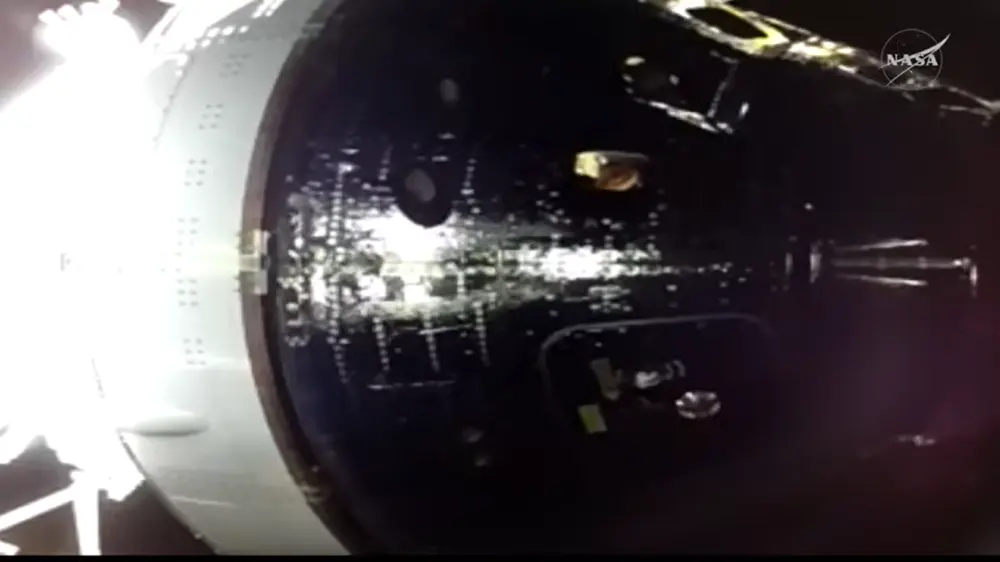
After another TV session with NBC and CNN, the solar panels (and cameras) were re-arranged for some shots involving the crew looking out of the craft’s windows. This was around 2 or 3am, I forget which. I think this is Christina at the window (just slightly above the centre of the picture). Quite a number of attempts were made to depict photographs showing the crew in this manner. However it seemed somewhat difficult given the lighting conditions. Evidently MCC would have secured hi-res photographs so maybe it did work. It just didn’t render very well on the live streams.
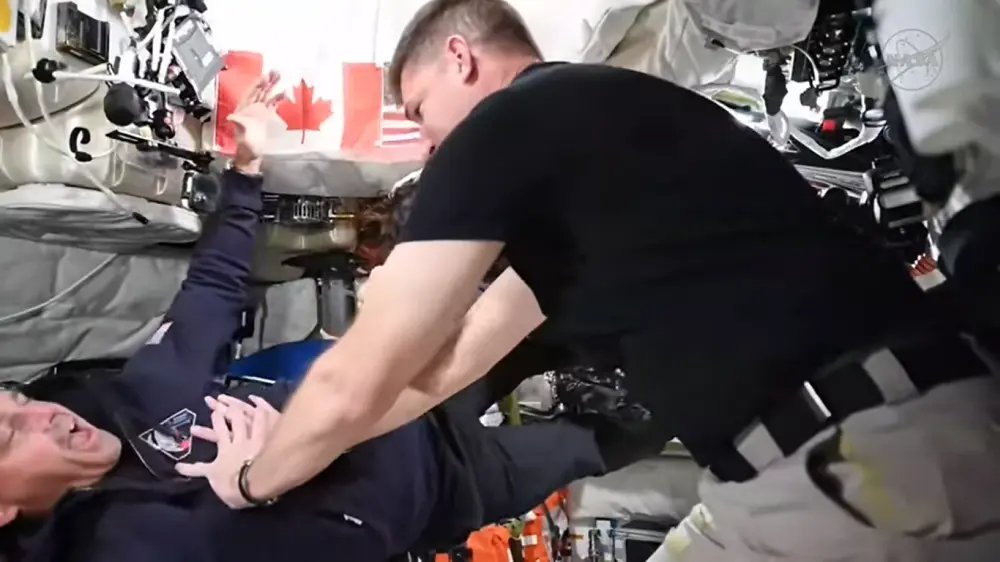
The crew were seen doing some jovial CPR – this was a demonstration to show how they could do CPR in the Orion capsule, not a serious practical CPR session as they had undertook before. I think this was in answer to a question where they could undertake CPR if it was ever needed.
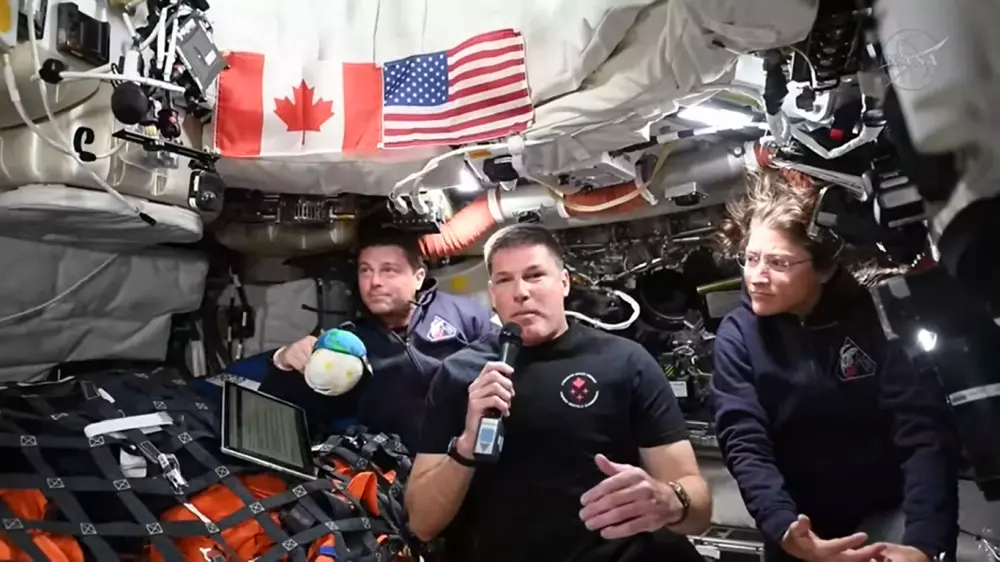
The crew look somewhat bemused as Jeremy speaks French. One of the interviewers for the 45 minute session with Jeremy spoke in French and Jeremy replied in French also. Clearly the crew understood little of what Jeremy was saying!
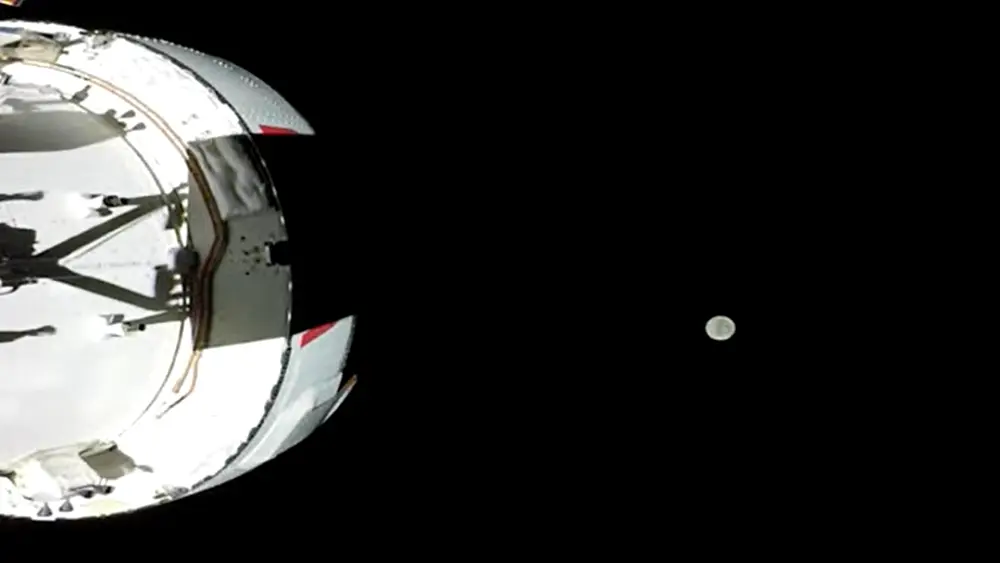
Like the other photographs so far in this post, this was taken at a moment I was awake. The screen was the usual blue fayre, however for about 25 seconds or so this shot could be seen. No doubt the craft is closer to the moon, but not greatly so. Its 84,123 miles yet. Progress seems very slow because the craft is currently doing 1,914mph. As I said yesterday, the rate will have to increase somewhat during Day 5 (Easter Sunday), possibly as the evening approaches. There’s no doubt the velocity of the craft would actually be greater than the speed, so we’re only getting half the picture really in terms of that. The velocity would no doubt increase as the craft approaches the moon.
This perhaps is the final rendering of the original 2019 artwork intended for the missing blog posts. As discussed yesterday the eagle was included. However the problematic NASA logo which causes some imbalance in this newer format – this being the large upper stroke – got moved to the left and the Apollo eagle symbol substituted in its place. Both the year 1969 and 2019 have also been included, just to stress the fact this is a 2019 blog post (so far unpublished) and not exactly a 2026 one – even though it has been somewhat updated.
MCC (12.55pm UK time approx) just announced its been three days, 13 hours and 17 minutes since Artemis 2 was launched. Their message was as follows (it was somewhat garbled in regards to the hours for the lunar flyby so may be incorrect):
The Integrity spacecraft is currently 207,000 miles counting away from earth, and 73,000 miles away from the moon. This means of course we are getting closer and closer to our lunar flyby, which happens on flight day six. We actually have a countdown on in here because on flight day six, the crew also passes the Apollo distance record. So that’s coming up in one day, six hours, four minutes and counting down from there. The lunar flyby is in one day, 5 hours, nine minutes and counting.
I checked over some stuff and it seems ‘the lunar flyby of one day, 11 hours, nine minutes’ (as it appeared to have come out as) ought to read ‘the lunar flyby is in one day, 5 hours, nine minutes’ etc. So have corrected that bit. Its all fiddly stuff and none is exact anyway. There doesn’t seem to be one website that gives any exact UK times and forums and Redditors even have their heads scratched because its not certain whether NASA is using UCT or EDT.
NOTE: In one of the broadcasts Leah Cheshier Mustachio (NASA Communications) at MCC Johnson Space Centre said they use Central Time. So evidently there’s a difference. What it means if something is specified in terms of time its on Central Time thus UK time would be six hours ahead.
NASA’s website has details (Eastern time as specified) however I think these are slightly out seeing Artemis One took off some ten minutes later. Have added UK times and dates:
6th April 2026 (6th and 7th April in UK times).
12:41 a.m.: Orion enters lunar sphere of influence. (05.41am on 6th April UK time).
2:20 a.m.: Crew sleep begins. (07.20am on 6th April UK time).
10:50 a.m.: Flight Day 6 begins, Crew wake up. (15.50pm on 6th April UK time).
1 p.m.: NASA+ coverage of lunar flyby begins. (18.00pm on 6th April UK time).
1:56 p.m.: The crew will surpass the record for human’s farthest distance from Earth previously set by Apollo 13, at 248,655 miles from Earth. (18.56pm on 6th April UK time).
2:15 p.m.: Crew configures Orion’s cabin for flyby operations. (19.15pm on 6th April UK time).
2:45 p.m.: Lunar observation period begins. (19.45pm on 6th April UK time).
6:47 p.m.: Predicted loss of communications as crew heads behind the Moon (estimated 40-min.) (23.47pm on 6th April UK time).
(At 7.00pm/19.00EDT the UK’s date changes to 7th April 2026.)
7:02 p.m. Orion closest approach to the Moon. (00.02am on 7th April UK time).
7:05 p.m.: Orion reaches maximum distance from Earth. (00.05am on 7th April UK time).
8:35 p.m.: Orion enters period with Moon eclipsing the Sun. (01.35am on 7th April UK time).
9:20 p.m.: Lunar observation period (flyby) concludes. (02.20am on 7th April UK time).
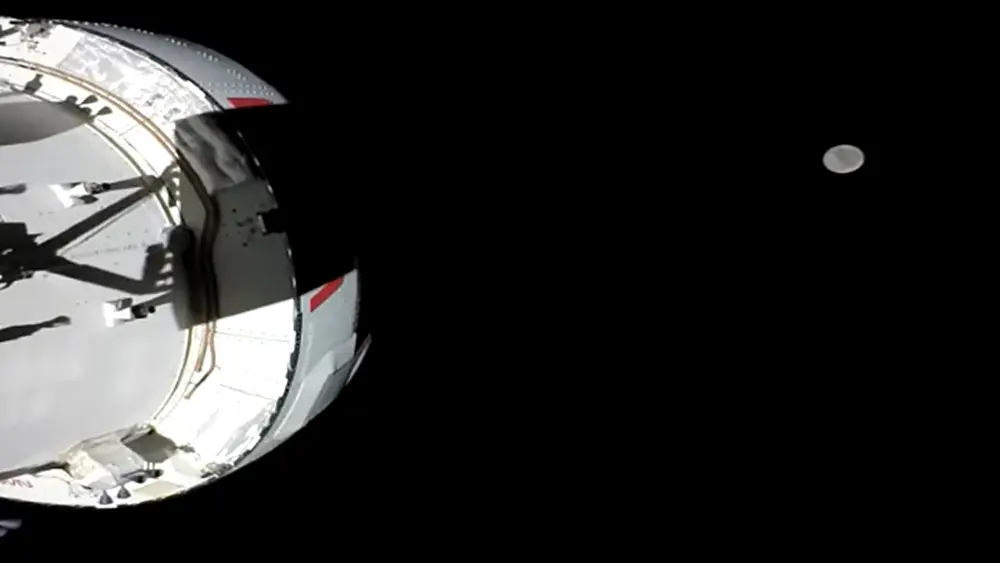
Current view of the moon from Orion. The lunar disc is slightly bigger now. 13.55pm UK time.
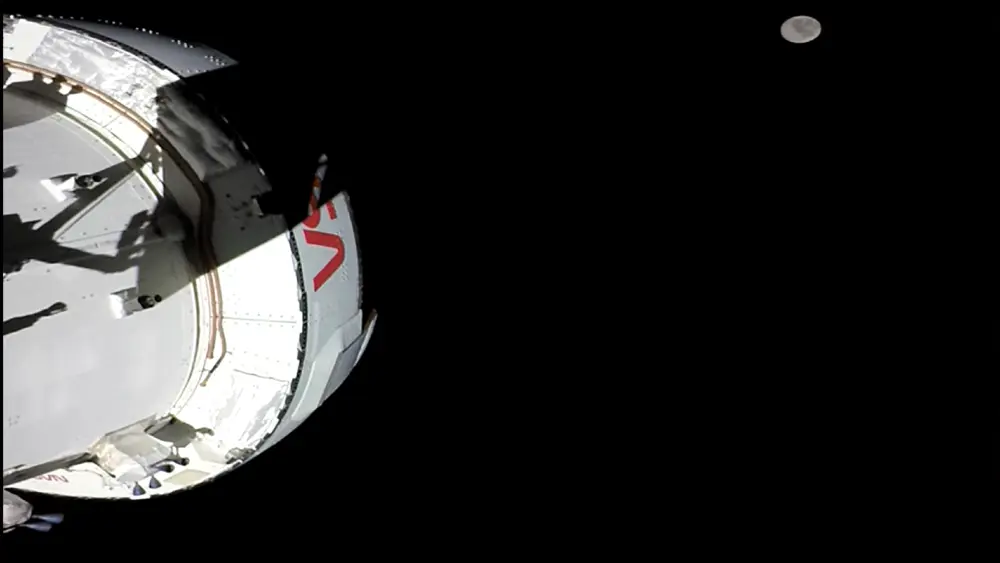
Just a tiny difference in size and detail an hour later as Orion approaches its lunar encounter. 15.05pm UK time.
BBC News has just published this interesting article re Artemis and the photographs being taken. It carries a sprinkling of scepticism however. Basically it asks “But is there unique scientific value in these images, or are these simply the equivalent of holiday photos?” It seeks out the opinion of Chris Lintott, Professor of Astrophysics at the University of Oxford, who says:
The value of the images coming back from Artemis and its crew is artistic, not scientific. Unless something very unusual happens, there will be nothing for the [Artemis] astronauts to discover. There’s a possibility they might see an impact flash if a meteor hits the dark side but it would have to be a pretty big one. For science they would need to do a systematic count [of it], best done with a video camera, not looking out the window. The [images] we already have back are beautiful, stunning and iconic – taking by astronauts not by robots. This is a voyage of exploration, not lunar science and that’s fine!”
NASA, as the article says, is pushing a scientific narrative for Artemis 2. But that is not what it is according to the BBC. In a sense they are right. Far greater images can be obtained with satellites, including NASA’s Deep Space Climate Observatory, which takes far better pictures. Space probes do much better too including those recent ones from China and India.
I would think Artemis 2 is more about adding a human touch to science. Robots taking photos probably don’t register so well with the general populace (except maybe die hard cosmologists), thus this could be an opportunity to both win over and educate those who have little knowledge of how the cosmos works as well as the importance of the relationship between Earth and its one and only neighbour. I would agree that scientifically, Artemis 2 is not such a great deal in terms of progress compared to the Apollo program. On the other hand if space exploration is to continue and thrive, well someone’s got to start somewhere. The space billionaires have their eyes on other means and objectives of reaching space. But even so, one big question remains – which is the hugely wasteful means of getting into space. If a base was established on the moon it would no doubt aid further exploration and also enable the launch of craft in an almost negligible gravity environment.
The main question for me at least, is the continuing expense and slow progress that is made. Rockets might be exciting but they’re not the answer, no matter how much of the hardware is made returnable. The fact we haven’t really progressed that much in terms of the moon in more than fifty years does show there is a criticality in how space is viewed and what sort of benefits it can accrue. The Space Shuttle was one step towards a different means of travel but after that things seem to have gone stale. The space billionaires are no doubt pushing the envelope and that is admirable especially when we now have returnable boosters and rockets. But it still a similar technology to that developed in the 1950s and 1960s. The question is, what would true space progress be and how would it look? If we can’t think beyond multi stage rockets and the rest of it, well its basically a pointless exercise.
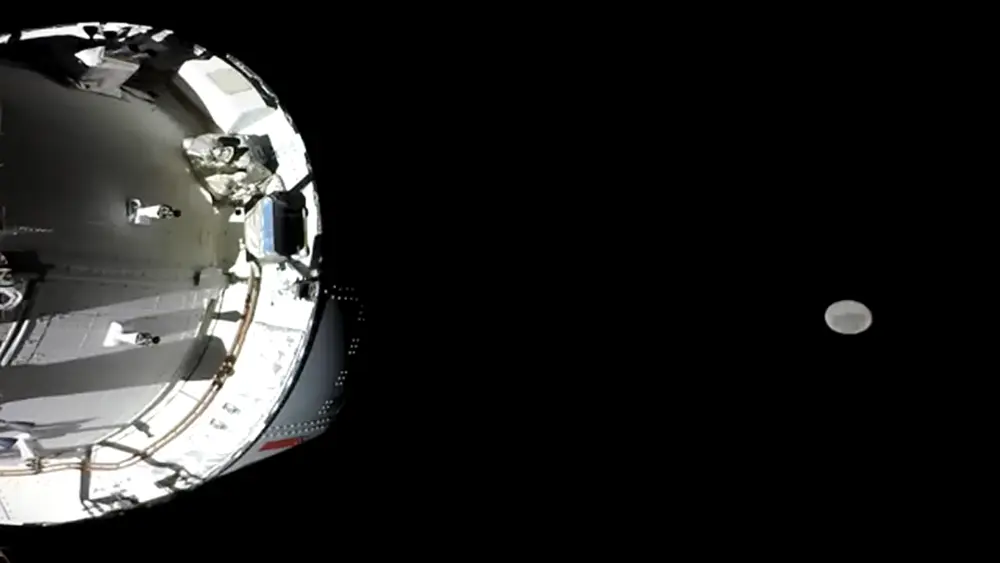
Definitely getting bigger. Still another twelve hours or so before Orion feels the lunar pull. Distance 63,130 miles. Screenshot 18.00pm UK time.
Leave a Reply