Even though this is currently day four of the Artemis mission, it was decided to start with Day 5 for the most recent reports instead of continuing with Day 4. In a way it was a means of keeping my sanity as sleep hasn’t been good, which is why a number of times I’ve woken up and screencapped the going ons with Artemis. Thus this post begins at 07.00 am on the 5th April 2026.
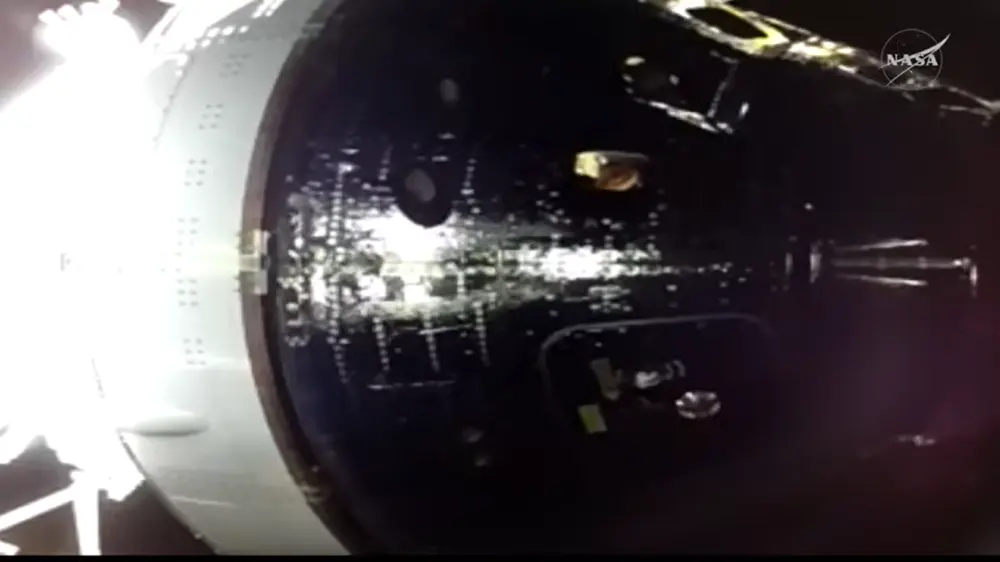
After another TV session with NBC and CNN, the solar panels (and cameras) were re-arranged for some shots involving the crew looking out of the craft’s windows. This was around 2 or 3am, I forget which. I think this is Christina at the window (just slightly above the centre of the picture). Quite a number of attempts were made to depict photographs showing the crew in this manner. However it seemed somewhat difficult given the lighting conditions. Evidently MCC would have secured hi-res photographs so maybe it did work. It just didn’t render very well on the live streams.
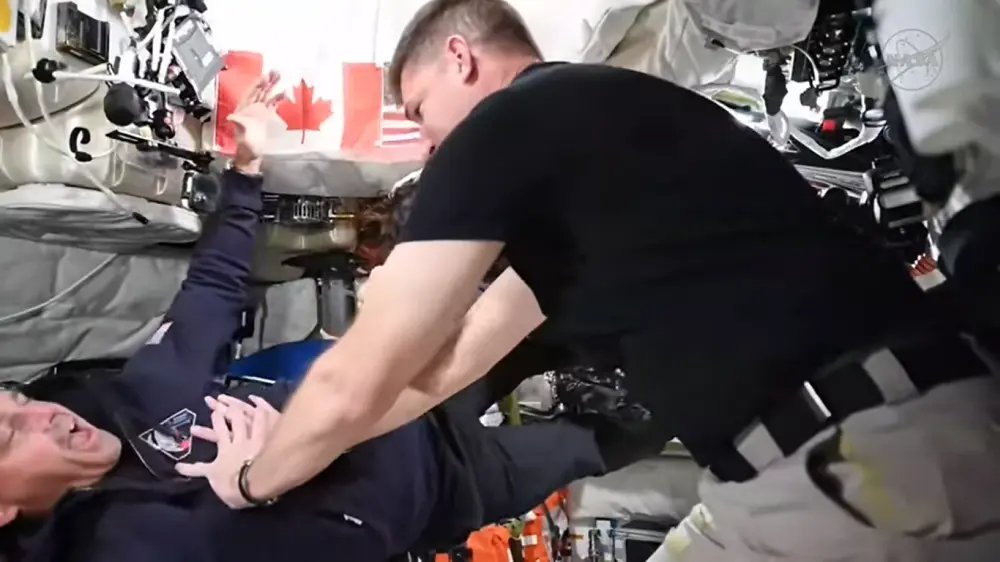
The crew were seen doing some jovial CPR – this was a demonstration to show how they could do CPR in the Orion capsule, not a serious practical CPR session as they had undertook before. I think this was in answer to a question where they could undertake CPR if it was ever needed.
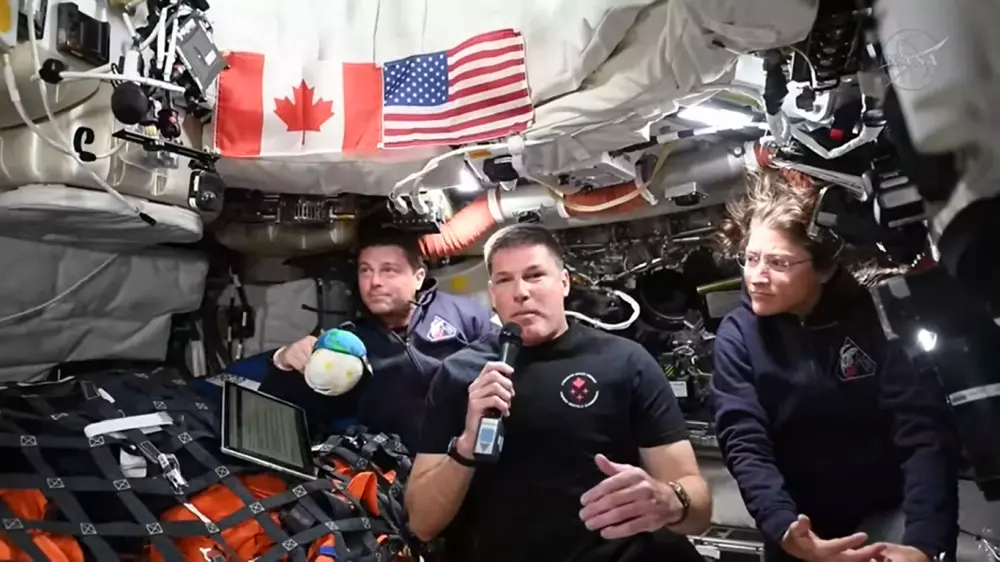
The crew look somewhat bemused as Jeremy speaks French. One of the interviewers for the 45 minute session with Jeremy spoke in French and Jeremy replied in French also. Clearly the crew understood little of what Jeremy was saying!
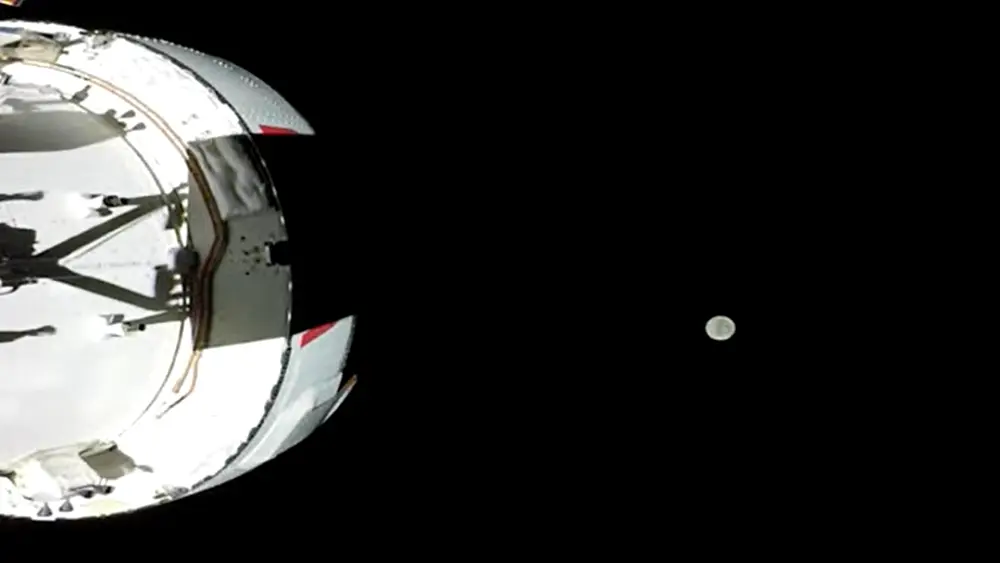
Like the other photographs so far in this post, this was taken at a moment I was awake. The screen was the usual blue fayre, however for about 25 seconds or so this shot could be seen. No doubt the craft is closer to the moon, but not greatly so. Its 84,123 miles yet. Progress seems very slow because the craft is currently doing 1,914mph. As I said yesterday, the rate will have to increase somewhat during Day 5 (Easter Sunday), possibly as the evening approaches. There’s no doubt the velocity of the craft would actually be greater than the speed, so we’re only getting half the picture really in terms of that. The velocity would no doubt increase as the craft approaches the moon.
This perhaps is the final rendering of the original 2019 artwork intended for the missing blog posts. As discussed yesterday the eagle was included. However the problematic NASA logo which causes some imbalance in this newer format – this being the large upper stroke – got moved to the left and the Apollo eagle symbol substituted in its place. Both the year 1969 and 2019 have also been included, just to stress the fact this is a 2019 blog post (so far unpublished) and not exactly a 2026 one – even though it has been somewhat updated.
MCC (12.55pm UK time approx) just announced its been three days, 13 hours and 17 minutes since Artemis 2 was launched. Their message was as follows (it was somewhat garbled in regards to the hours for the lunar flyby so may be incorrect):
The Integrity spacecraft is currently 207,000 miles counting away from earth, and 73,000 miles away from the moon. This means of course we are getting closer and closer to our lunar flyby, which happens on flight day six. We actually have a countdown on in here because on flight day six, the crew also passes the Apollo distance record. So that’s coming up in one day, six hours, four minutes and counting down from there. The lunar flyby is in one day, 5 hours, nine minutes and counting.
I checked over some stuff and it seems ‘the lunar flyby of one day, 11 hours, nine minutes’ (as it appeared to have come out as) ought to read‘the lunar flyby is in one day, 5 hours, nine minutes’ etc. So have corrected that bit. Its all fiddly stuff and none is exact anyway. There doesn’t seem to be one website that gives any exact UK times and forums and Redditors even have their heads scratched because its not certain whether NASA is using CST or EDT.
UPDATE: In one of the broadcasts (well approx 17.00pm UK time) Leah Cheshier Mustachio (NASA Communications) at MCC Johnson Space Centre indicated they use Central Time. Evidently there’s a difference. What it means if something is specified in terms of time its on Central Time thus UK time would be six hours ahead. All the times below (which are given on EDT) should have an extra hour added for the UK. Have screencapped where she says central time is used.
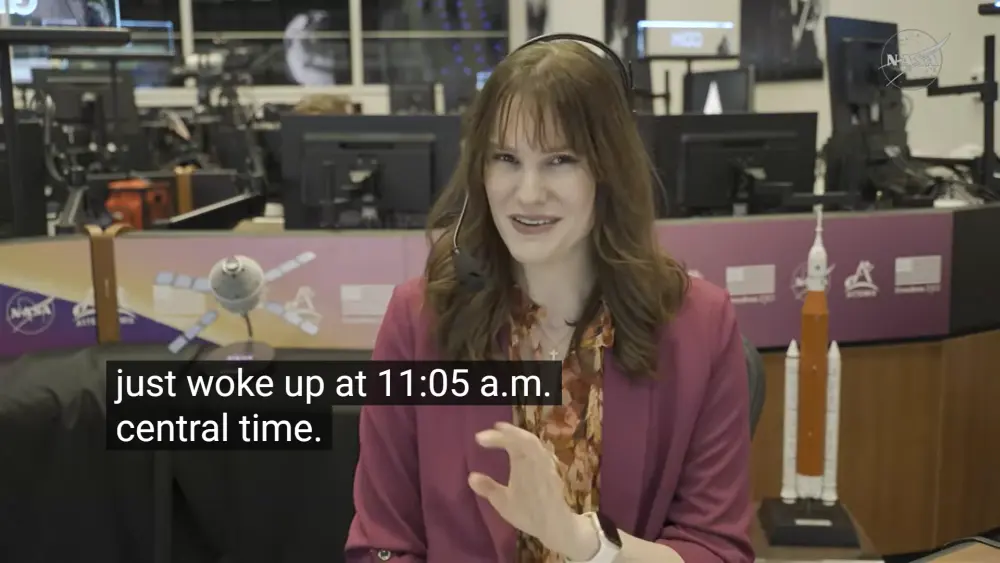
Its central time (CST) says Leah Cheshier Mustachio (NASA Communications) at MCC.
NASA’s website has details (Eastern time as specified) however I think these are slightly out seeing Artemis One took off some ten minutes later. Have added UK times and dates:
6th April 2026 (6th and 7th April in UK times).
12:41 a.m.: Orion enters lunar sphere of influence. (05.41am on 6th April UK time).
2:20 a.m.: Crew sleep begins. (07.20am on 6th April UK time).
10:50 a.m.: Flight Day 6 begins, Crew wake up. (15.50pm on 6th April UK time).
1 p.m.: NASA+ coverage of lunar flyby begins. (18.00pm on 6th April UK time).
1:56 p.m.: The crew will surpass the record for human’s farthest distance from Earth previously set by Apollo 13, at 248,655 miles from Earth. (18.56pm on 6th April UK time).
2:15 p.m.: Crew configures Orion’s cabin for flyby operations. (19.15pm on 6th April UK time).
2:45 p.m.: Lunar observation period begins. (19.45pm on 6th April UK time).
6:47 p.m.: Predicted loss of communications as crew heads behind the Moon (estimated 40-min.) (23.47pm on 6th April UK time).
(At 7.00pm/19.00EDT the UK’s date changes to 7th April 2026.)
7:02 p.m. Orion closest approach to the Moon. (00.02am on 7th April UK time).
7:05 p.m.: Orion reaches maximum distance from Earth. (00.05am on 7th April UK time).
8:35 p.m.: Orion enters period with Moon eclipsing the Sun. (01.35am on 7th April UK time).
9:20 p.m.: Lunar observation period (flyby) concludes. (02.20am on 7th April UK time).
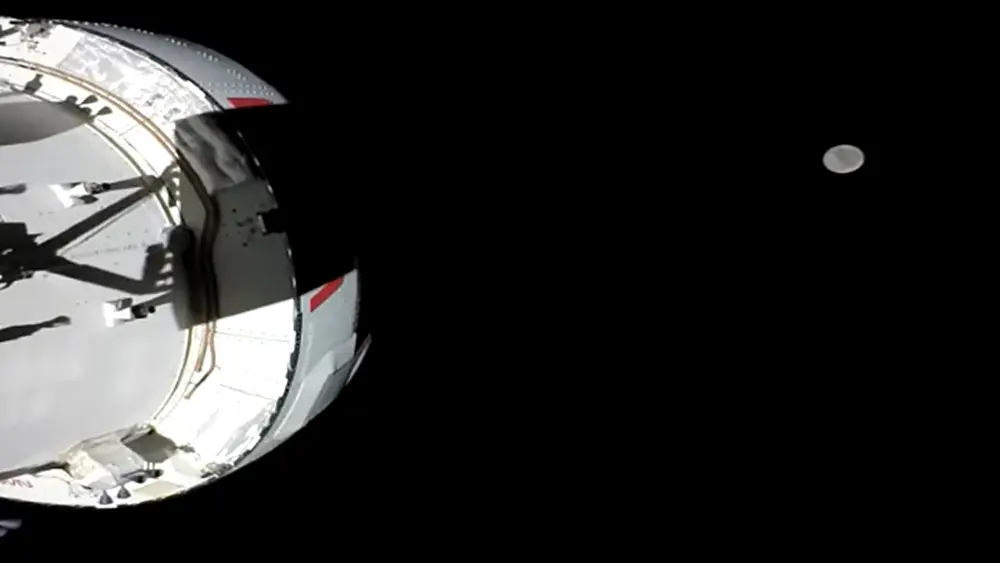
Current view of the moon from Orion. The lunar disc is slightly bigger now. 13.55pm UK time.
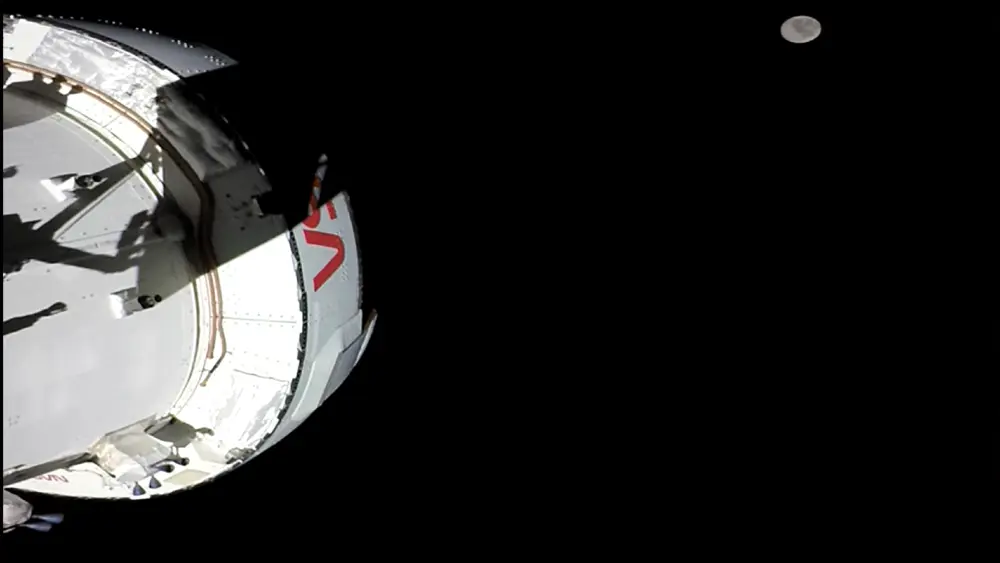
Just a tiny difference in size and detail an hour later as Orion approaches its lunar encounter. 15.05pm UK time.
BBC News has just published this interesting article re Artemis and the photographs being taken. It carries a sprinkling of scepticism however. Basically it asks “But is there unique scientific value in these images, or are these simply the equivalent of holiday photos?” It seeks out the opinion of Chris Lintott, Professor of Astrophysics at the University of Oxford, who says:
The value of the images coming back from Artemis and its crew is artistic, not scientific. Unless something very unusual happens, there will be nothing for the [Artemis] astronauts to discover. There’s a possibility they might see an impact flash if a meteor hits the dark side but it would have to be a pretty big one. For science they would need to do a systematic count [of it], best done with a video camera, not looking out the window. The [images] we already have back are beautiful, stunning and iconic – taking by astronauts not by robots. This is a voyage of exploration, not lunar science and that’s fine!”
NASA, as the article says, is pushing a scientific narrative for Artemis 2. But that is not what it is according to the BBC. In a sense they are right. Far greater images can be obtained with satellites, including NASA’s Deep Space Climate Observatory, which takes far better pictures. Space probes do much better too including those recent ones from China and India.
I would think Artemis 2 is more about adding a human touch to science. Robots taking photos probably don’t register so well with the general populace (except maybe die hard cosmologists), thus this could be an opportunity to both win over and educate those who have little knowledge of how the cosmos works as well as the importance of the relationship between Earth and its one and only neighbour. I would agree that scientifically, Artemis 2 is not such a great deal in terms of progress compared to the Apollo program. On the other hand if space exploration is to continue and thrive, well someone’s got to start somewhere. The space billionaires have their eyes on other means and objectives of reaching space. But even so, one big question remains – which is the hugely wasteful means of getting into space. If a base was established on the moon it would no doubt aid further exploration and also enable the launch of craft in an almost negligible gravity environment.
The main question for me at least, is the continuing expense and slow progress that is made. Rockets might be exciting but they’re not the answer, no matter how much of the hardware is made returnable. The fact we haven’t really progressed that much in terms of the moon in more than fifty years does show there is a criticality in how space is viewed and what sort of benefits it can accrue. The Space Shuttle was one step towards a different means of travel but after that things seem to have gone stale. The space billionaires are no doubt pushing the envelope and that is admirable especially when we now have returnable boosters and rockets. But it still a similar technology to that developed in the 1950s and 1960s. The question is, what would true space progress be and how would it look? If we can’t think beyond multi stage rockets and the rest of it, well its basically a pointless exercise.
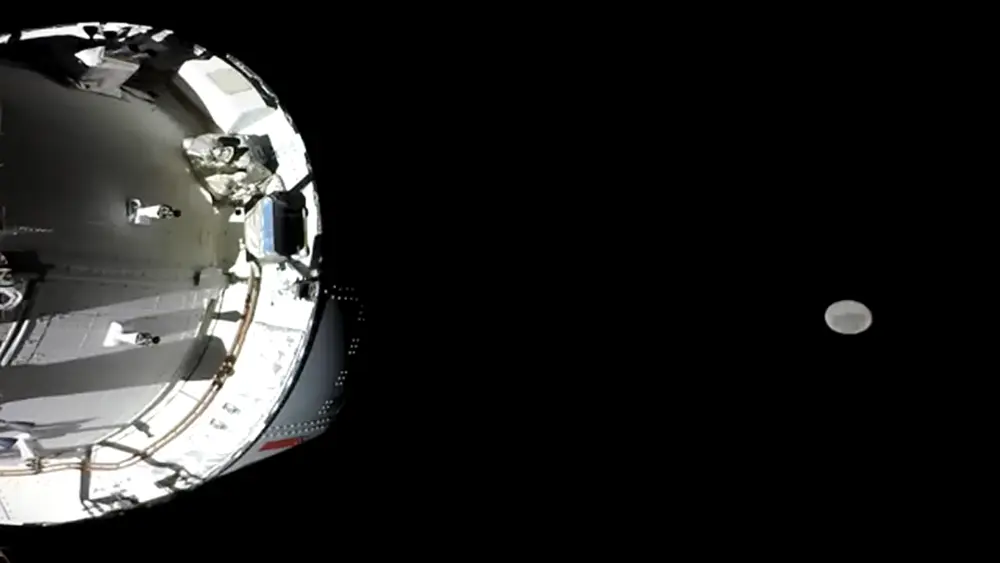
Definitely getting bigger. Still another twelve hours or so before Orion feels the lunar pull. Distance 63,130 miles. Screenshot 18.00pm UK time.
We all saw the camera shots from the inside but not the outside!
Reid Wiseman was the one who wanted a private convo with MCC/CapCom yesterday. According to sub Reddits he’s since had a number of goes at MCC, including stuff about emails, delays in family conferences, and has refused to do exercises. Says the crew are super exhausted.
Reid Wiseman gets testy with Jacki about his exercise schedule.
Anybody awake to hear Commander Reid get snippy with ground control last night?
Reid talking about the family conference being late/emails being locked + talking about the crew being super exhausted.
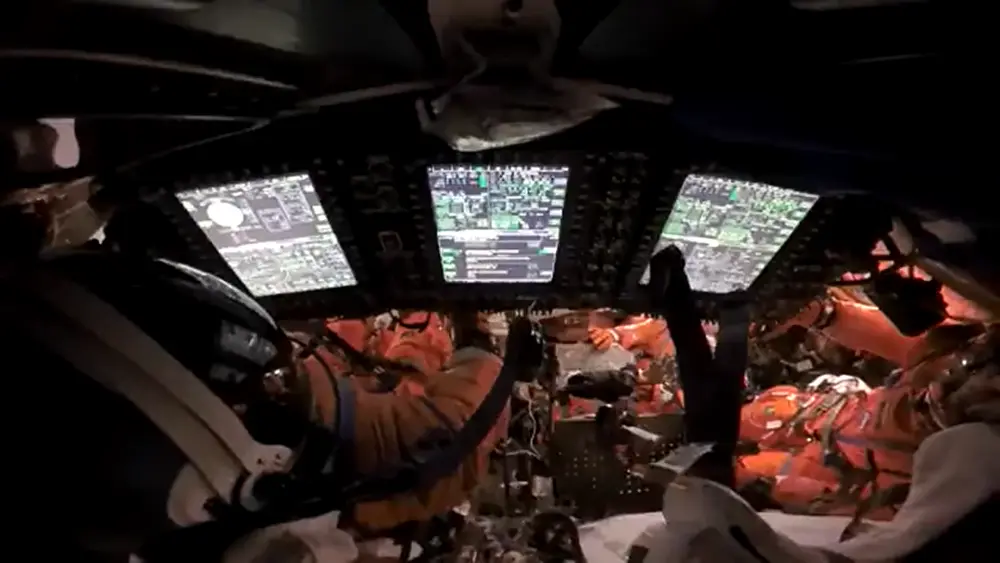
The crew are undergoing exercises which involves putting their suits on and enacting an exercise which should help with future missions. It also involves testing the cabin pressure and suit pressures for emergencies.
It seems the crew were somewhat slow at the pre-prep, and MSS would like to see a quicker response. With the help of MSS they had to log and photograph the various things needed to enact the emergency set up. MSS admitted at the conference following this that they too needed to get up to speed with procedures such as this. Despite all that the crew donned their spacesuits in good time and in line with expectations. Kelsey Young, Artemis 2 lunar science lead was saying they needed to get used to directing the crew on such matters and also on things like lunar observations and the rest of it. She said it was important because when it comes to actual lunar landings, the ability with which both sides will be able to guide and prompt and oversee procedures would need to be more refined.
The crew will no doubt need to do all this prior to re-entry so it was an opportunity to get familiarised with the procedures anyway.
Evidently the slowness and somewhat difficult interaction between ground and space crew is a result of not having had lunar missions led by humans for more than fifty years, so there’s a steep learning curve.
At the latest NASA update seminar Doctor Lori Glade (Exploration Systems Development Mission Directorate) said of the lunar mission – ‘having humans on board really compliments the robotic exploration that goes on from NASA.’ She also added that the lunar flyby is an opportunity for both ground scientists and the crew to give feedback and observations on what can be seen. His would be important for future missions, especially on how lunar crews would operate on the moon’s surface.
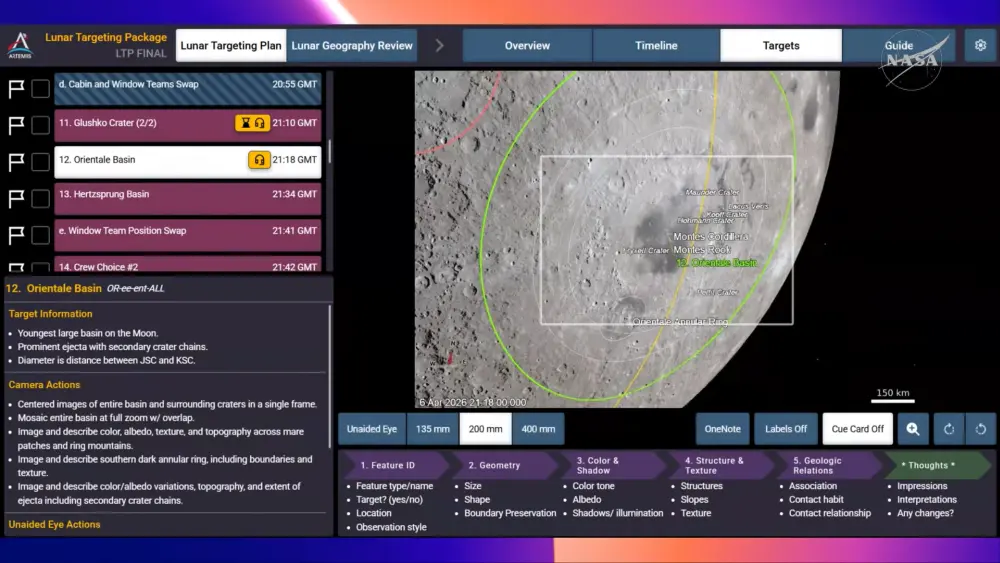
Kelsey Young showed a picture of the Lunar Targeting Plan – its the planning software the Artemis 2 crew will use when they are on the lunar flyby. She explained the work that would be needed to use this software:
This is what will guide the crew’s observations during the flyby. It is just a guide. They are the field scientist and they are encouraged to, you know, go off book if what they’re seeing in front of them really compels them. We’ve even built in targets specifically for crew choice, where they can really imagine what pops out to them. And so what you see here is what the crew will be looking at for the entirety of the flyby tomorrow. You see on the left side a list of sort of targets that are listed vertically in the top left of the screen. Those are the targets in the timeline to order. We’re asking them to image them in and they’re in a specific order because ultimately these targets trace back to our lunar science objectives. We have ten lunar science objectives for this mission. All of them are covered in the targets in tomorrow’s targeting plan, and they’re in that order down the left side that you can see. The bottom left has the words that explain the significance of the target, as well as the prompt of what we’re asking the crew to image and describe.
So we have distinct prompts for the person that will be using the camera that’s outfitted with an 80 to 400 millimetre zoom lens. And then we also have prompts for the person that’s going to be looking at the moon at the time with the unaided eye, just using their eyes to describe what they see. Along the bottom is a cue card as a reminder of what should go into their science descriptions. I would expect they’re not going to need to reference the cue card that much because they’ve had many, many months to practice giving good descriptions. And then of course, the middle, the moon, the picture of the moon, this is to help guide them into the specific target that they’re going to be describing and imaging at the same time. You see specific labels called out to help them provide geographic references for their descriptions. And you also see the previous target and the next target highlighted in different colors. So this is the piece of software that the crew will be looking at. And if you go to the next picture, one of the activities the crew did yesterday was to review that plan…
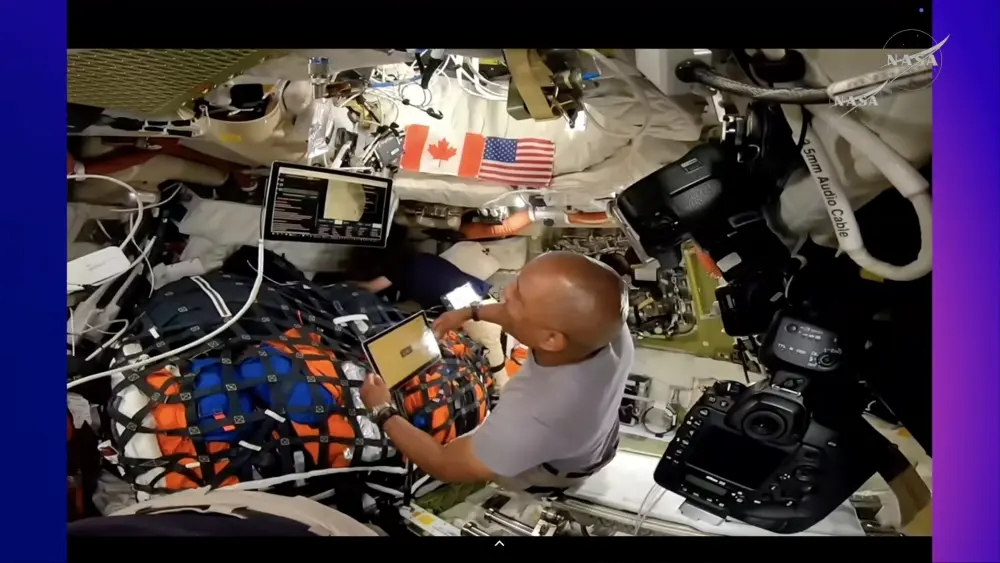
Victor practising with the Lunar Targeting Plan – as referenced by Kelsey Young above.
Mention was also made of the preparation and training done back on earth. One of the exercises was to use a mock up Orion window and the crew then looked through that and took photographs of a huge inflatable moon model! Training was also given in using the Nikon D5s.
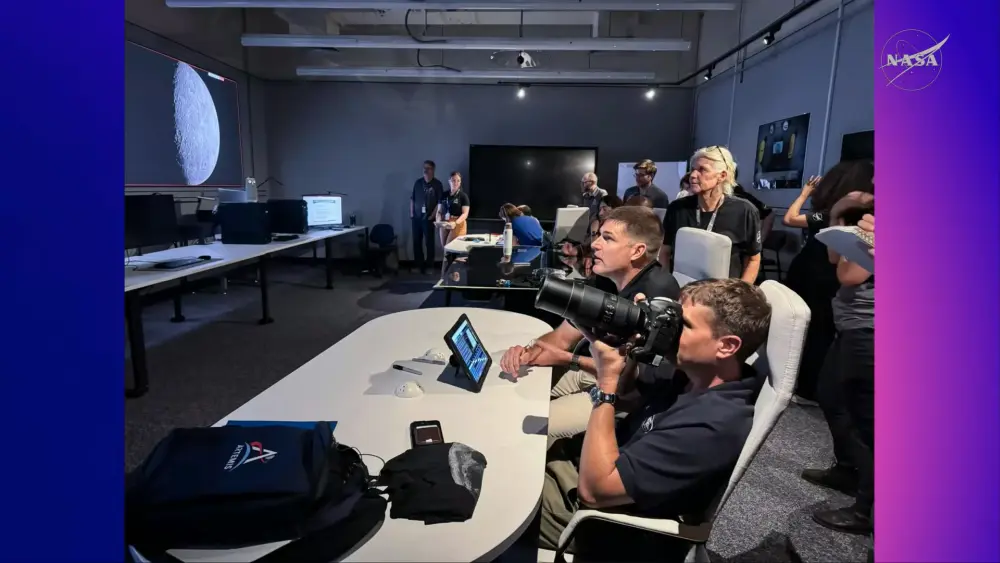
Jeremy and Reid practicing with the Nikon D5 DSLRs and the 80 to 400mm Nikon lens for the Lunar Targeting Plan.
Kelsey Young wound up her talk with a mention that the crew would also be observing the Apollo 12 and 14 landing sites. This would be before the forty minute or so blackout when Orion goes behind the moon. Soon after that there would be an opportunity to observe the moon eclipsing the sun, giving an opportunity to observe the solar corona. But also in due course, around sunrise and sunset, they crew will also be able to take pictures of several planets that will be visible – including Mercury, Venus, Mars and Saturn. They will also be looking for possible earthshine effects too.
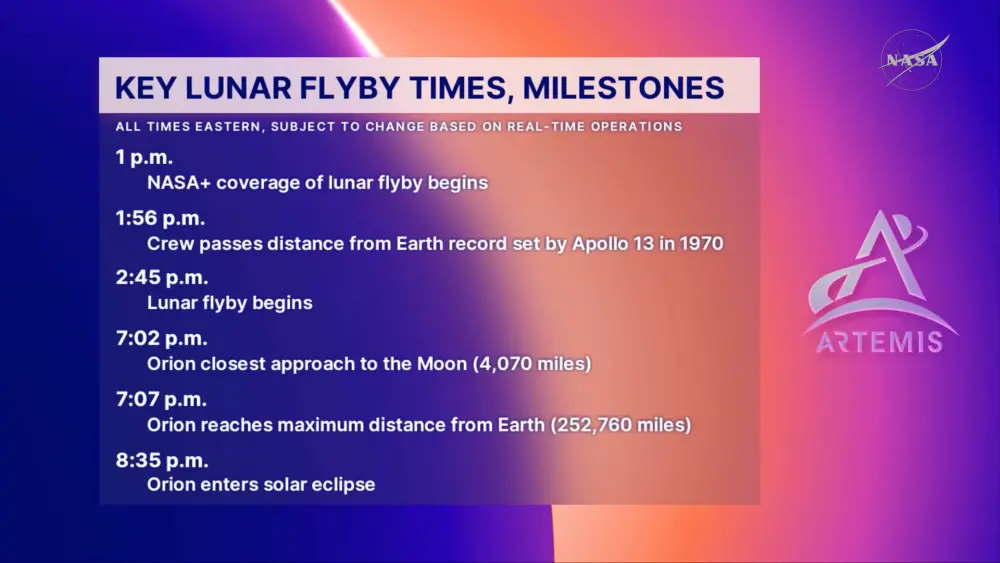
The NASA conference released this summary of tomorrow’s events (TODAY’S events in terms of the UK!) There’s more detail shown further back on this page.
Leave a Reply