Switzerland’s first ever cable car was once to be found near Grindelwald. Sometimes it is extolled as the first in the world – which it certainly is when it is described in the technical sense it was – as lift or aufzug (German for elevator). The Wetterhorn Aufzug was a short lived operation nevertheless in the course of history its contribution to aerial cable transport has been recognised. What was had essentially been an intermediate station on the way to the Wetterhorn summit was built and it is the only remaining structure of this early cable car system. The remote Enge bergstation has been recognised for having enormous historical value in terms of the development of the cablecar / funivia / seilbahn / téléphérique even though the terminal has lain unused for more than a hundred and ten years.
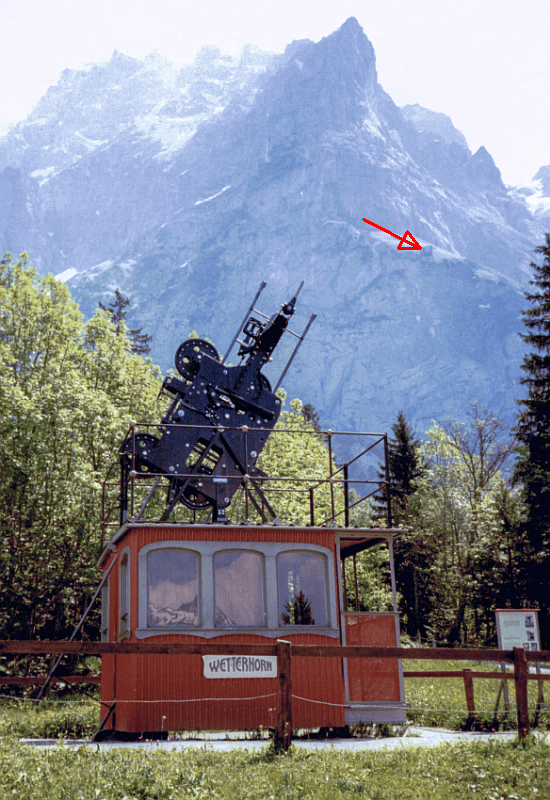
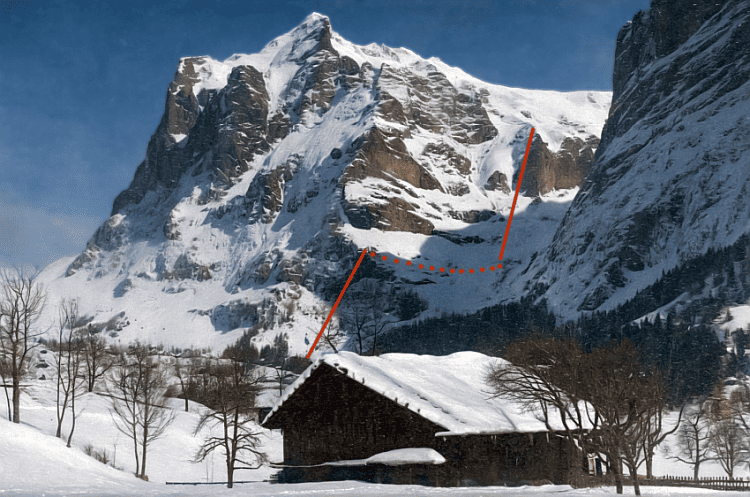
The replica Wetterhorn Aufzug car in Grindelwald at its original position with the Enge station (marked) just visible on the mountain. Author’s photo from 1990.
A view of the exhibit can be seen at Google Streets. This shows the car in a different location which is now established. The 1990 view was in the field opposite. The original lower terminus of the line was here on Google Streets. Its interesting to note the site has been cleared somewhat and there is an information hut! There wasn’t any such on my 1990 visit and lack of clearance meant the cable car talstation’s remains were difficult to see.
The Wetterhorn cable car or aufzug was also known as the electric aerial monorail (eg Scientific American May 1909) and that is because its designer was the one who had been in change of the construction of what were no doubt a specialist type of railway. Thus we know Wilhelm Feldmann had been responsible for the construction of both the Wuppertal and the Dresden Schwebebahn systems. He had worked under the direction of Eugen Langen, the Schwebebahn’s creator. Feldmann was from Elberfeld, the main town the Schwebebahn passed through.
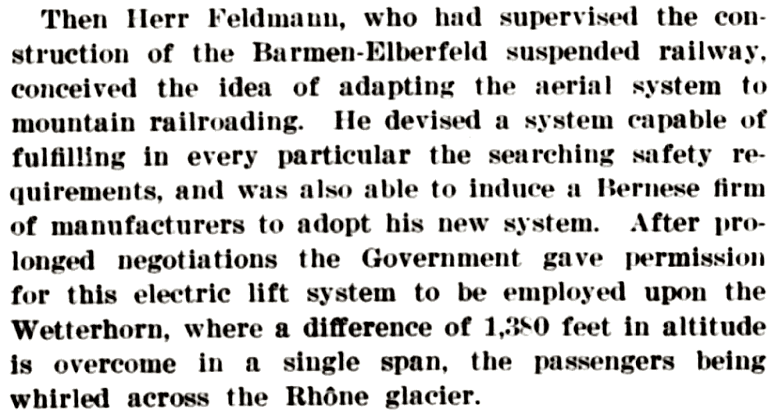
From: Scientific American Supplement 1913-03-15.
Feldman went on to other transport projects after Wuppertal including the Wetterhorn Aufzug. The fact the latter was described as a lift more than anything was the line’s steepness which amazed many at the time. The paperwork for the Wetterhorn concession describes Feldmann as an engineer who had ‘designed and supervised the construction of groundbreaking technical projects, such as the Elberfeld Suspension Railway and the mountain suspension railway in Loschwitz near Dresden.’
A result of this word association was several cable car systems in Austria, Switzerland and France were originally termed ‘Schwebebahn’ (hanging railway) and in a number of cases a more definitive but clearly defunct description was used – this was Seilschwebebahn (essentially a hanging cable railway). At least one cable car operator to this day still uses the term as part of its business name and that’s the Säntis-Schwebebahn AG.

The remains of of the Wetterhorn lift talstation at Oberer Gletscher. Flickr.
In 1904 Feldmann set up a company based in Bern, called the Bergaufzug Patent Feldmann Aktiengesellschaft (the Feldmann Patent Mountain Lift Corporation). It seems from the following documentation that the first project Feldmann had intended was one for the Eiger. There is evidence the Jungfrau Railway were completely against the idea as an aufzug would no doubt take patronage away from the railway. Feldman however did not live to see his company build any aufzugs for he died soon after and that during a visit to undertake surveys for the Wetterhorn Aufzug.
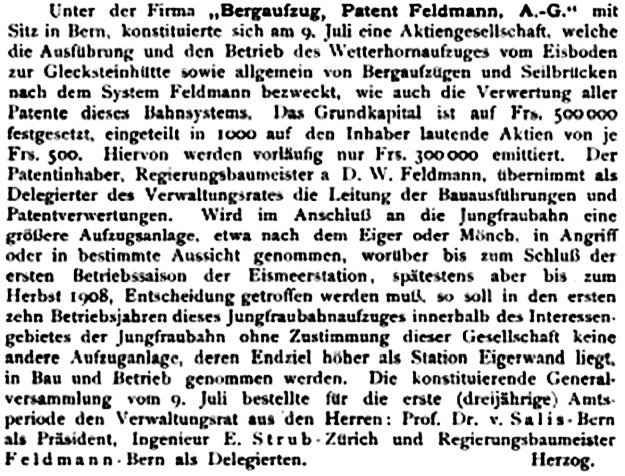
Feldmann’s Bern based company, 1904. From Elektrische Bahnen (Internet Archive).
The Wetterhorn aufzug system opened on 27th July 1908 and operated for a mere six years before closing on 10th September 1914. The cableway left from a terminus near where the present Hotel Wetterhorn is. From here the cableway rose sharply to the upper terminus (or bergstation) at Enge – sited on a ledge bordering the western flank of the Wetterhorn. Extensions to the system were planned but never built and in due course the sheer remoteness of its upper terminal left something to be desired, thus patronage was low and all future plans for extensions were dropped. The next stage of the line would have involved a covered way along a specially created route from the Enge terminal in order to reach the second stage of the aufzug.
The proposed walkway from Oberer Gletscher via Enge to the Glecksteinhütte where another aufzug would lift visitors even higher. This was an early plan and appears there had been no thought upon any attempt to reach the mountain’s summit. Colourised version of an image originally shown in The Sphere 18th November 1905.
This other line which would have commenced 750 metres further on, was to be reached by means of a covered way open to one side. This second stage would lead to a point on a ridge some 500 metres from the Glecksteinhütte and it would be much steeper than the original. Its lower terminal would be at Station Unterre Clubhütte and the upper at Station Obere. Plans of this second stage were submitted. These two additional stations would be in a similar style to that at Enge. The original plan for the lower section of line came to be the only part of Feldman’s plans which were fully realised.
Sometime later plans for a four stage system from Grindelwald to the summit of the Wetterhorn at around 12,100 feet were deposited. It was said the surveys had ‘proved that the project offers no insuperable difficulties’. (Scientific American May 1909). The same modus would be employed as that earlier – a series of aufzugs plus a interlinking set of access paths which would be covered ways where applicable. Whether this was a completely new system or additional to the original is uncertain. However one thing is certain – the first stage from Grindelwald to Enge (by the Rehrwoengen Rock) was the definitive first stage for whichever route was ultimately built. The name Enge actually refers to the goat path that existed on this part of the mountain – and in both planned examples there was an attempt to ensure the first section of line reached this goat path. The elevations for the system that gained the full height of the Wetterhorn are as follows.
1325m at Grindelwald (Oberer Gletscher) to 1845 at Enge.
1920m at Byhorn to a station near Chrinnenhorn at 2433m.
From 2500m to the ridge above the Gutzgletscher at 3100m(?).
A fourth ascent from 3300m(?) to the summit at 3703 metres.
(The modern height for the Wetterhorn is given as 3690 metres).
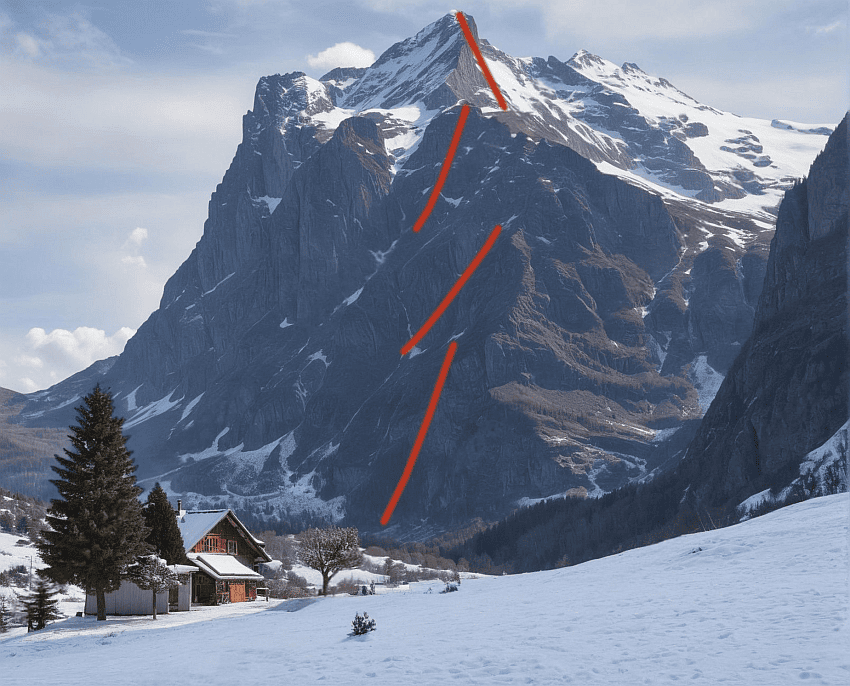
Image showing the approximate locations of the planned four stage aufzug from Grindelwald to the Wetterhorn’s summit. That to Enge was changed in order to provide further onward travel via these newer and different alignments – which were linked by walkways sometimes consisting of galleries cut into the mountainside. Detail of the Feldmann/Von Roll system was found at the Swiss Federal Archives in Bern. The image was specially created by the author in lieu of a copyright on the original.
Some later plans (including one depicted in Deutsche Bauzeitung November 1910) do show a different system planned. The lower two lines have a common interchange at Enge whilst the upper two lines are further apart with a even greater amount of walking necessary between these. It seems one of Feldmann’s associates at Bergaufzug Patent Feldmann Aktiengesellschaft had attempted to keep the Wetterhorn schemes alive.
In addition to that new line, a further system was also applied for – this being one to the Eigerspite. This would be facilitated by way of a constructed path from Eisemeer (on the Jungrafu railway) to a lower station at an elevation of 3270 metres. The aufzug would rise to a terminus at 3900 metres and a further path would take visitors to the summit of the Eiger at 3974 metres. (Modern day measurements indicate the Eiger is 3,967-metres or 13,015 ft).
Larger mountains were also under scrutiny with Mont Blanc and Matterhorn mooted. A six stage lift system to the latter’s summit would employ the same modus as those for the Eiger and Wetterhorn with stations linked by well built footways. As for Mont Blanc, a cable car from Chamonix to the Glacier des Bossons (Aigle du Midi) was planned and thence an aufzug onward to the summit.
There’s no doubt an inordinate amount of construction would be needed in the most inhospitable locations. These would have been an engineering nightmare. Clearly those at the Bergaufzug Patent Feldmann Aktiengesellschaft associates kept matters active by way of promoting more daring schemes.
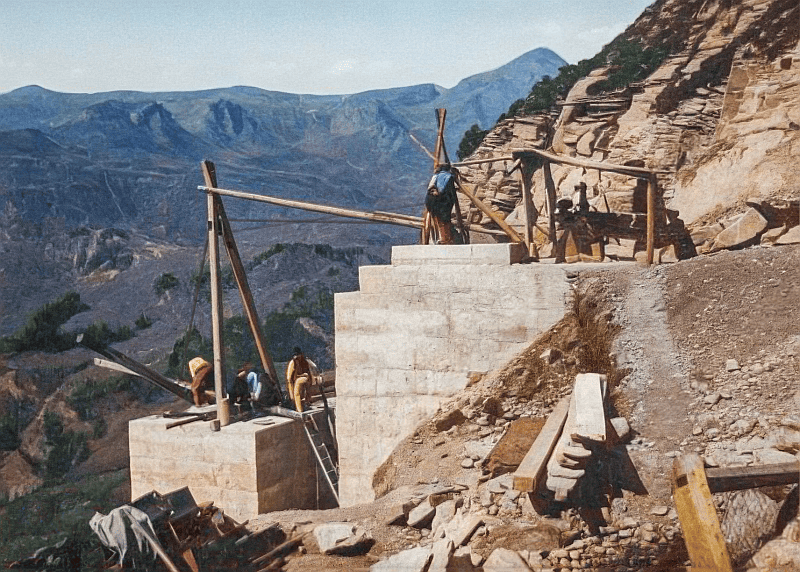
The Enge bergstation under construction. Image colourised by the author from one featured in The Sphere 18th November 1905.
In hindsight its perhaps wise no further stages were built simply because of the sheer difficulty of construction. Whether it was a route to the Glecksteinhütte or to the summit of the Wetterhorn, there would no doubt be very considerable engineering required to achieve the different sections of line, and not just that, to also create the pathways that would link up the different termini. These ‘lifts’ certainly would have formed spectacular ascents of the mountain, but would they be a white elephant?
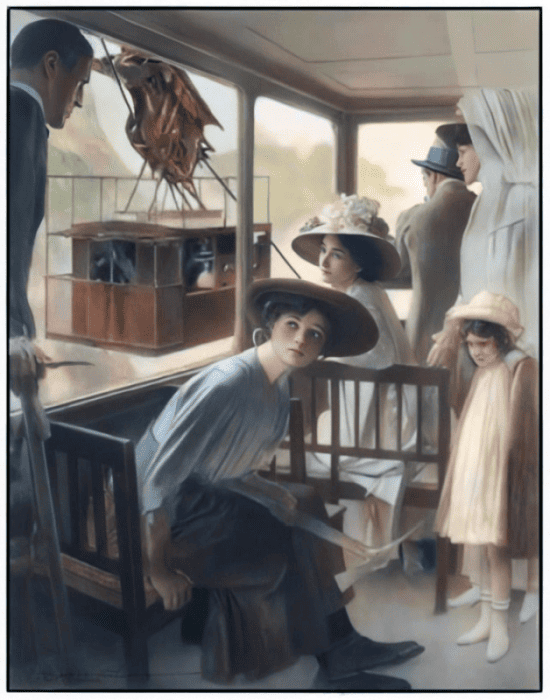
Interior of the aufzug with some rather concerned looking tourists as the guy apparently tries to convey reassurance there is nothing to worry about! The capacity of these cars was a mere ten passengers. Image upscaled, enhanced and colourised by the author from a small low res black and white example found on Ebay.

The upper (Enge) station in 1912. Wikipedia.
The fact considerable walking would be needed between each section of the route was deemed a problem in terms of attracting patronage. Its why the one aufzug in operation from 1908-1914 did not warrant a second stage being built. The small size of the cabins (sixteen passengers) throttled any potential for far greater revenue and a reason the aufzug did not reopen in 1918. The concession was to expire in 1927 and in view of the aufzug’s limited potential the concession was left alone and the line was abandoned instead. According to the Swiss Transport Museum an avalanche caused considerable damage to the aufzug thus it was dismantled in 1934.

The now restored Enge bergstation on the flanks of the Wetterhorn. Hikr.
The upper Enge station has remained intact and is now a listed building. A seasoned mountain climber can tackle the hardcore climb up the Wetterhorn and view the bergstation in its isolated splendour. As for others unable to climb the mountain, the bergstation can easily be viewed from many parts of Grindelwald. It is quite clearly visible from many other mountain prominences including First, Männlichen and even Grindelwald’s one and only southern eastern side ascent to Pfingstegg. Down at ground level the partial remains of the lower station can be seen, and on a grassed area of land opposite the Hotel Wetterhorn (see Google Streets) stands one of the pair of auzug cable cars. The other, the original, is in the Swiss Transport Museum at Lucerne.